Enhanced with market attractiveness analysis, total addressable market evaluation, company benchmarking matrices, interactive Excel dashboards, expanded supply chain intelligence, emerging startup coverage, and detailed product insights, The Business Research Company’s 2026 market reports deliver more actionable and strategically valuable research.
Self-Organizing Network Artificial Intelligence (AI) Market Size, Value And Growth Trends Through 2030
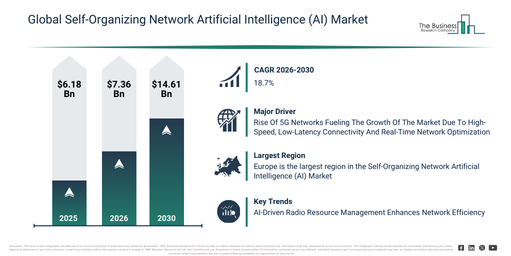
The self-organizing network artificial intelligence (AI) market has seen substantial growth recently. This market is projected to expand from $6.18 billion in 2025 to reach $7.36 billion by 2026, achieving a compound annual growth rate (CAGR) of 19.0%. Historically, this expansion has been propelled by factors such as the rapid increase in mobile network traffic, the complexity associated with multi-vendor RAN deployments, the ongoing need to reduce network operational expenses (OPEX), the growth of 4G and initial 5G rollouts, and the availability of network performance datasets.
The market for self-organizing network artificial intelligence (AI) is projected to experience substantial expansion over the coming years. This market is anticipated to reach a valuation of $14.61 billion by 2030, demonstrating a compound annual growth rate (CAGR) of 18.7%. Factors driving this growth during the forecast period include the implementation of autonomous networks supporting advanced 5G capabilities, the integration of AIOps for comprehensive automation, optimized edge computing for extremely reliable and low-latency performance, increased uptake by businesses for private network deployments, and the development of security-conscious self-healing mechanisms and anomaly detection systems. Key trends expected during the same timeframe encompass AI-driven network self-configuration for both 4G and 5G, closed-loop optimization strategies for radio access networks, automated predictive fault detection and self-healing, algorithms designed for energy-efficient network optimization, and the adoption of cloud-native SON deployments by telecommunication operators.
Download A Free Sample Report For Comprehensive Market Insights:
Self-Organizing Network Artificial Intelligence (AI) Market Industry Drivers: What Is Driving Revenue Growth?
The increasing integration of 5G networks is anticipated to stimulate the expansion of the self-organizing network artificial intelligence (AI) market in the future. As the latest generation of mobile connectivity, 5G networks provide high-speed data, ultra-low latency, and greater capacity, facilitating advanced technologies such as immersive gaming and the internet of things. This growing embrace of 5G networks stems from the escalating need for high-speed, low-latency connections to power real-time digital applications. 5G networks augment self-organizing network artificial intelligence (AI) by supplying high-speed, low-latency connectivity, which facilitates real-time data processing and prompt decision-making. Furthermore, they boost network efficiency through their support for AI-driven automation, optimization, and predictive maintenance, thereby elevating overall service quality and user experience. For example, data from December 2023, released by the Office of Communications (Ofcom), a UK-based regulator and competition authority, indicated that outdoor 5G coverage from at least one mobile network operator reached 85-93% in 2023, a significant increase from 67-78% in 2022. Consequently, the expanding adoption of 5G networks is fueling the expansion of the self-organizing network artificial intelligence (AI) market.
Self-Organizing Network Artificial Intelligence (AI) Market Segment Breakdown: Which Categories Generate The Most Revenue?
The self-organizing network artificial intelligence (AI) market covered in this report is segmented –
1) By Component: Software, Hardware, Services
2) By Network Type: 2G Or 3G, 4G Or LTE, 5G, Other Network Types
3) By Deployment Mode: On-Premises, Cloud
4) By Application: Network Optimization, Network Configuration Management, Network Healing, Network Planning and Design, Other Applications
5) By End-User: Telecom Operators, Enterprises, Managed Service Providers, Other End Users
Subsegments:
1) By Software: Network Planning Optimization, Configuration Management, Fault Management, Performance Management, Security Management
2) By Hardware: Servers, Antennas, Base Stations, Routers, Switches, Sensors
3) By Services: Consulting Services, Integration Services, Managed Services, Support Maintenance Services, Training Services
Self-Organizing Network Artificial Intelligence (AI) Market Transformation Trends: Which Innovations Are Driving Change?
Prominent companies operating in the self-organizing network artificial intelligence (AI) market are concentrating on developing advanced solutions, such as AI-driven radio resource management, to improve network performance, enhance user experience, and reduce operational costs. AI-driven radio resource management (RRM) refers to the application of artificial intelligence and machine learning algorithms for dynamically allocating, optimizing, and managing radio spectrum and network resources within a telecommunications network. For instance, in March 2025, Huawei Technologies Co. Ltd., a China-based technology company, introduced the AI Core Network at the Mobile World Congress (MWC), marking a significant advancement in the evolution of intelligent telecommunications. This innovative network architecture integrates artificial intelligence into the core of telecom systems, facilitating seamless connectivity and collaboration among AI agents. It is designed to deliver intelligent automation, real-time decision-making, AI-driven radio resource management, and optimized network performance across diverse service scenarios, thereby paving the way for next-generation smart networks.
Self-Organizing Network Artificial Intelligence (AI) Market Key Players And Strategic Industry Positioning
Major companies operating in the self-organizing network artificial intelligence (AI) market are Huawei Investment & Holding Co. Ltd., Cisco Systems Inc., Qualcomm Incorporated, Telefonaktiebolaget LM Ericsson, NEC Corporation, Nokia Oyj, ZTE Corporation, Juniper Networks Inc., Amdocs Limited, Ciena Corporation, Mavenir plc, Viavi Solutions Inc., RadiSys Corporation, Comarch SA, Parallel Wireless Inc., Rohde & Schwarz India Private Limited., Airspan Networks (India) Private Limited, Infovista SAS, P.I. Works Inc., Samsung Electronics Co. Ltd., Innovile, AirHop Communications Inc.
Access The Complete Self-Organizing Network Artificial Intelligence (AI) Market Report:
Self-Organizing Network Artificial Intelligence (AI) Market Regional Distribution: Which Areas Drive Market Expansion?
Europe was the largest region in the self-organizing network artificial intelligence (AI) market in 2025. Asia-Pacific is expected to be the fastest-growing region in the forecast period. The regions covered in the self-organizing network artificial intelligence (AI) market report are Asia-Pacific, South East Asia, Western Europe, Eastern Europe, North America, South America, Middle East, Africa.
Get in touch with us:
The Business Research Company: https://www.thebusinessresearchcompany.com/
Americas: +1 310-496-7795
Asia: +44 7882 955267 & +91 8897263534
Europe: +44 7882 955267
Email us at: marketing@tbrc.info
Follow us on:
LinkedIn: https://in.linkedin.com/company/the-business-research-company
YouTube: https://www.youtube.com/channel/UC24_fI0rV8cR5DxlCpgmyFQ
Global Market Model: https://www.thebusinessresearchcompany.com/global-market-model

Wasay has over a decade of experience in market research, data modelling, and analytics, with prior experience at GlobalData and Decision Tree Consulting Services. At The Business Research Company , he leads research operations across syndicated studies, customized consulting engagements, and the Global Market Model platform. His professional experience includes supporting organizations such as Boston Consulting Group, KPMG, and Ernst & Young. Wasay holds a degree in Electronics and Communications Engineering, postgraduate management qualifications from International Management Institute Belgium and Indian School of Business and Entrepreneurship, and completed the Integrated Program in Business Analytics from Indian Institute of Management Indore.