
Delivering more actionable and strategically valuable research, The Business Research Company’s 2026 market reports feature market attractiveness analysis, total addressable market evaluation, company benchmarking matrices, interactive Excel dashboards, expanded supply chain intelligence, emerging startup coverage, and detailed product insights.
Optical Communication And Networking Equipment Market Value Analysis: What Growth Is Expected Over The Forecast Period?
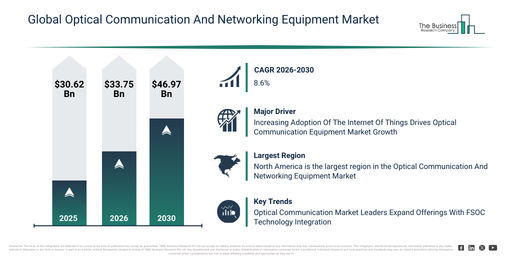
The optical communication and networking equipment market has experienced significant expansion recently. It is projected to increase from $30.62 billion in 2025 to $33.75 billion in 2026, advancing at a compound annual growth rate (CAGR) of 10.2%. Historically, this market’s growth has been driven by factors such as the proliferation of global internet traffic, heightened investments in telecom infrastructure, the escalating adoption of fiber-based broadband, the increasing need for high-speed data transmission, and the early establishment of optical backbone networks.
The optical communication and networking equipment market is anticipated to experience substantial growth over the next few years, with its size projected to reach $46.97 billion by 2030, exhibiting a compound annual growth rate (CAGR) of 8.6%. This expansion during the forecast period is primarily fueled by the increasing establishment of cloud data centers, the growing uptake of 5G and next-generation networks, rising capital outlays in hyperscale connectivity, the escalating demand for applications requiring ultra-high bandwidth, and continuous innovations in optical component technologies. Significant developments expected in this period encompass the wider deployment of high-capacity optical fiber networks, a greater adoption of advanced optical transceivers, enhanced integration of WDM technologies, the extension of long-haul and metro optical networks, and a heightened emphasis on low-latency data transmission.
Download A Free Sample Report For Comprehensive Market Insights:
Optical Communication And Networking Equipment Market Development Factors: Which Trends Are Supporting Demand?
The expanded integration of the Internet of Things is anticipated to drive expansion within the optical communication and networking equipment market. The Internet of Things refers to a connected infrastructure comprising computing devices, mechanical, and electronic machinery, each with unique identifiers (UIDs), capable of data transmission autonomously, without human intervention. This growing uptake of the Internet of Things (IoT) is fueled by multiple elements that boost efficiency, convenience, and interconnectedness across diverse industries. Optical communication networks, including fiber optic cables, offer the essential bandwidth required to manage the substantial data volumes produced by IoT devices in areas like smart cities, industrial IoT (IIoT), and autonomous vehicles, thereby guaranteeing rapid and effective data transfer among devices, sensors, and data centers. As an illustration, in April 2024, a report from Ericsson, a telecommunications firm based in Sweden, indicated that worldwide IoT connections totaled 15.7 billion connections in 2023 and are projected to grow by 16%, reaching 38.8 billion connections by 2029. Consequently, the expanding deployment of the Internet of Things is poised to further stimulate the growth of the optical communication and networking equipment market.
Optical Communication And Networking Equipment Market Segment Landscape: Which Areas Lead Market Development?
The optical communication and networking equipment market covered in this report is segmented –
1) By Component: Optical Fibers, Optical Transceivers, Optical Amplifiers, Optical Switches, Optical Splitters, Optical Circulators, Other Components
2) By Technology: Wavelength Division Multiplexing (WDM), Fiber Channel, Synchronous Optical Network (SONET), Other Technologies
3) By Vertical: Banking, Financial Services And Insurance (BFSI), Government, Healthcare, Cloud, Energy And Utilities, Other Verticals
Subsegments:
1) By Optical Fibers: Single-Mode Optical Fibers, Multi-Mode Optical Fibers, Polarization-Maintaining Optical Fibers, Specialty Optical Fibers
2) By Optical Transceivers: Small Form-Factor Pluggable (SFP) Optical Transceivers, SFP Plus (SFP+) Optical Transceivers, Quad Small Form-Factor Pluggable (QSFP) Optical Transceivers, Coarse Wavelength Division Multiplexing (CWDM) Optical Transceivers
3) By Optical Amplifiers: Erbium-Doped Fiber Amplifiers (EDFA), Raman Optical Amplifiers, Semiconductor Optical Amplifiers (SOA), Fiber Raman Amplifiers
4) By Optical Switches: Mechanical Optical Switches, Micro-Electro-Mechanical Systems (MEMS) Optical Switches, Liquid Crystal Optical Switches, Thermo-Optic Optical Switches
5) By Optical Splitters: Planar Lightwave Circuit (PLC) Splitters, Fused Biconical Taper (FBT) Splitters, Asymmetric Optical Splitters, Symmetric Optical Splitters
6) By Optical Circulators: Three-Port Optical Circulators, Four-Port Optical Circulators, Polarization-Independent Optical Circulators, High-Isolation Optical Circulators
7) By Other Components: Optical Attenuators, Optical Connectors, Optical Couplers, Dispersion Compensation Modules
Optical Communication And Networking Equipment Market Trends Reshaping Industry Growth
Leading companies in the optical communication and networking equipment market are concentrating on enhancing their product portfolios by integrating technologies like tactical free-space optical communications (FSOC) systems, thereby improving product offerings and expanding communication and networking options. A tactical free-space optical communications (FSOC) system is a method of communication that transmits data between two points using light traveling through the atmosphere, eliminating the need for physical cables or wires. As an example, Raytheon Technologies Corporation, a US-based firm, introduced NexGen Optix in May 2023. This tactical free-space optical communications system facilitates quick and secure data transfer, even under difficult circumstances. Compared to conventional optical systems, it provides increased bandwidth in a more compact, lighter, energy-efficient, and economical design. Consequently, it represents an optimal solution for entities operating in peer and near-peer operational settings. The system underwent testing and approval during U.S. government exercises, highlighting its reliability and effectiveness in challenging environments where traditional communication systems.
Optical Communication And Networking Equipment Market Industry Leaders And Market Competition
Major companies operating in the optical communication and networking equipment market are Huawei Technologies Co. Ltd., Cisco System Inc., Broadcom Corporation, Mitsubishi Electric Corporation, Nokia Corporation, Telefonaktiebolaget LM Ericsson, Fujitsu Optical Components Limited, NEC Corporation, ZTE Corporation, Corning Incorporated, Commscope Holding Company Inc., Juniper Networks Inc., FiberHome Technologies Group, Arista Networks Inc., Ciena Corporation, II-VI Incorporated (Coherent Corp.), Lumentum Holdings Inc., Infinera Corporation, Finisar Corporation, Viavi Solutions Inc., ADTRAN Inc., Ribbon Communications Inc., ADVA Optical Networking SE, Acacia Communications Inc., PacketLight Networks Ltd.
Access The Complete Optical Communication And Networking Equipment Market Report:
Optical Communication And Networking Equipment Market Leading Geography: Which Region Generates The Most Revenue?
North America was the largest region in the optical communication and networking equipment market in 2025. Asia-Pacific is expected to be the fastest-growing region in the forecast period. The regions covered in the optical communication and networking equipment market report are Asia-Pacific, South East Asia, Western Europe, Eastern Europe, North America, South America, Middle East, Africa.
Get in touch with us:
The Business Research Company: https://www.thebusinessresearchcompany.com/
Americas: +1 310-496-7795
Asia: +44 7882 955267 & +91 8897263534
Europe: +44 7882 955267
Email us at: marketing@tbrc.info
Follow us on:
LinkedIn: https://in.linkedin.com/company/the-business-research-company
YouTube: https://www.youtube.com/channel/UC24_fI0rV8cR5DxlCpgmyFQ
Global Market Model: https://www.thebusinessresearchcompany.com/global-market-model

Wasay has over a decade of experience in market research, data modelling, and analytics, with prior experience at GlobalData and Decision Tree Consulting Services. At The Business Research Company , he leads research operations across syndicated studies, customized consulting engagements, and the Global Market Model platform. His professional experience includes supporting organizations such as Boston Consulting Group, KPMG, and Ernst & Young. Wasay holds a degree in Electronics and Communications Engineering, postgraduate management qualifications from International Management Institute Belgium and Indian School of Business and Entrepreneurship, and completed the Integrated Program in Business Analytics from Indian Institute of Management Indore.