Delivering more actionable and strategically valuable research, The Business Research Company’s 2026 market reports feature market attractiveness analysis, total addressable market evaluation, company benchmarking matrices, interactive Excel dashboards, expanded supply chain intelligence, emerging startup coverage, and detailed product insights.
Personal Luxury Goods Market Forecast: What Market Value Is Expected By 2030?
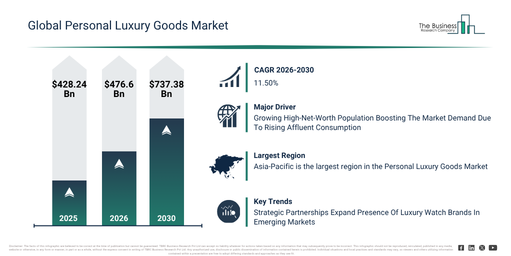
The personal luxury goods market has experienced swift expansion in recent years, with its valuation projected to increase from $428.24 billion in 2025 to $476.6 billion in 2026, reflecting a compound annual growth rate (CAGR) of 11.3%. This upward trajectory during the historical period can be linked to factors such as the commanding presence of heritage brands, product differentiation driven by craftsmanship, limited global retail reach, conventional luxury shopping conducted in physical stores, and steadfast brand allegiance among wealthy clientele.
The personal luxury goods market is set for significant expansion in the coming years, with projections indicating it will reach $737.38 billion by 2030, driven by an 11.5% compound annual growth rate. This anticipated growth in the forecast period can be attributed to several key factors, including the implementation of artificial intelligence to create personalized shopping experiences in the luxury sector, the widening reach of digital marketplaces dedicated to high-end goods, a growing consumer preference for materials sourced through sustainable practices, the emergence of immersive luxury offerings within the metaverse, and a noticeable uptick in luxury product consumption across developing economies. Looking ahead, major trends shaping this landscape include the rise of experiential retail formats that prioritize customer engagement, a heightened demand for both personalized and limited-edition luxury items, the ongoing development of the resale and circular economy models within the luxury industry, the amplified role of celebrity and influencer partnerships in driving brand desirability, and the continued advancement of digital-first platforms that serve as primary channels for luxury commerce.
Download A Free Sample Report For Comprehensive Market Insights:
Personal Luxury Goods Market Demand Drivers: What Is Fueling Industry Growth?
The anticipated expansion of the personal luxury goods market is being fueled by a growing population of high-net-worth individuals. This demographic consists of people with significant investable assets, generally exceeding USD 1 million, and considerable discretionary spending capacity. The increase in this group is largely attributed to wealth creation in developed nations, supported by strong financial markets and sustained economic growth. As the number of high-net-worth individuals rises, demand for personal luxury goods intensifies, driven by greater purchasing power for premium items, reinforced brand exclusivity, and ongoing market expansion through elevated discretionary spending and aspirational buying habits. For example, data from World Population Review, a US-based platform offering comprehensive global statistics, shows that the number of millionaires stood at 21.95 million in 2023 and is expected to climb to around 25.33 million by 2028. Consequently, the rising high-net-worth population is propelling growth in the personal luxury goods market.
Personal Luxury Goods Market Segment Performance And Strategic Opportunities
The personal luxury goods market covered in this report is segmented –
1) By Product Type: Apparel, Footwear, Bags, Jewelry, Watches, Accessories
2) By Distribution Channel: Online Retail, Department Stores, Exclusive Brand Stores, Luxury Boutiques
3) By Application: Affluent Consumers, High-Net-Worth Individuals
4) By End User: Women, Unisex, Men
Subsegments:
1) By Apparel: Luxury Dresses, Luxury Jackets And Coats, Luxury Shirts And Tops, Luxury Trousers And Pants, Luxury Knitwear And Sweaters
2) By Footwear: Luxury Sneakers, Luxury Formal Shoes, Luxury Boots, Luxury Sandals, Luxury Loafers
3) By Bags: Luxury Handbags, Luxury Tote Bags, Luxury Shoulder Bags, Luxury Crossbody Bags, Luxury Clutch Bags
4) By Jewelry: Luxury Diamond Jewelry, Luxury Gold Jewelry, Luxury Platinum Jewelry, Luxury Gemstone Jewelry, Luxury Pearl Jewelry
5) By Watches: Luxury Mechanical Watches, Luxury Automatic Watches, Luxury Quartz Watches, Luxury Chronograph Watches, Luxury Smart Watches
6) By Accessories: Luxury Sunglasses, Luxury Belts, Luxury Scarves And Shawls, Luxury Wallets And Card Holders, Luxury Hats And Caps
Personal Luxury Goods Market Innovation Trends: Which Developments Are Transforming The Industry?
Leading players within the personal luxury goods sector are increasingly prioritizing strategic alliances as a means to elevate brand image, broaden their premium product ranges, and capture the interest of high-net-worth consumers. Such strategic collaborations involve organizations merging their respective strengths and resources to pursue mutual objectives, stimulate creativity, and boost operational effectiveness. A relevant example occurred in March 2026, when Titan’s Helios Luxe, an Indian watch company, formed a partnership with Alexander Shorokhoff, a luxury watchmaker from Germany, to launch its unique, handcrafted timepieces in India. The goal of this partnership is to fulfill the rising demand for exclusive, limited-series watches among wealthy clientele, thereby increasing product variety and strengthening the brand’s stature within the luxury watch market.
Personal Luxury Goods Market Key Players: Which Companies Shape Industry Competition?
Major companies operating in the personal luxury goods market are LVMH Moët Hennessy Louis Vuitton SE, Compagnie Financière Richemont SA, Kering SA, Rolex SA, The Estée Lauder Companies Inc., Hermès International SCA, The Swatch Group Ltd, Prada S. p. A., Burberry Group plc, Moncler S. p. A., Giorgio Armani S. p. A., Ermenegildo Zegna N. V., Chopard International SA, Tod’s S. p. A., Dolce & Gabbana S. r. l., Longchamp SAS, Breitling SA, Graff Diamonds International Ltd, Mulberry Group plc, Audemars Piguet Holding SA
Access The Complete Personal Luxury Goods Market Report:
https://www.thebusinessresearchcompany.com/report/personal-luxury-goods-market-report
Personal Luxury Goods Market Geographic Analysis: Where Is Demand Growing The Fastest?
Asia-Pacific was the largest region in the personal luxury goods market in 2025. Asia-Pacific is expected to be the fastest-growing region in the forecast period. The regions covered in the personal luxury goods market report are Asia-Pacific, South East Asia, Western Europe, Eastern Europe, North America, South America, Middle East and Africa.
Access a Customized Personal Luxury Goods Market Report for Deeper Competitive Insights
Get in touch with us:
The Business Research Company: https://www.thebusinessresearchcompany.com/
Americas: +1 310-496-7795
Asia: +44 7882 955267 & +91 8897263534
Europe: +44 7882 955267
Email us at: marketing@tbrc.info
Follow us on:
LinkedIn: https://in.linkedin.com/company/the-business-research-company
YouTube: https://www.youtube.com/channel/UC24_fI0rV8cR5DxlCpgmyFQ
Global Market Model: https://www.thebusinessresearchcompany.com/global-market-model

Wasay has over a decade of experience in market research, data modelling, and analytics, with prior experience at GlobalData and Decision Tree Consulting Services. At The Business Research Company , he leads research operations across syndicated studies, customized consulting engagements, and the Global Market Model platform. His professional experience includes supporting organizations such as Boston Consulting Group, KPMG, and Ernst & Young. Wasay holds a degree in Electronics and Communications Engineering, postgraduate management qualifications from International Management Institute Belgium and Indian School of Business and Entrepreneurship, and completed the Integrated Program in Business Analytics from Indian Institute of Management Indore.