Delivering more actionable and strategically valuable research, The Business Research Company’s 2026 market reports feature market attractiveness analysis, total addressable market evaluation, company benchmarking matrices, interactive Excel dashboards, expanded supply chain intelligence, emerging startup coverage, and detailed product insights.
Wireless Infrastructure Market Value Analysis: What Growth Is Expected Over The Forecast Period?
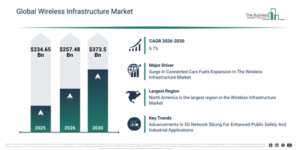
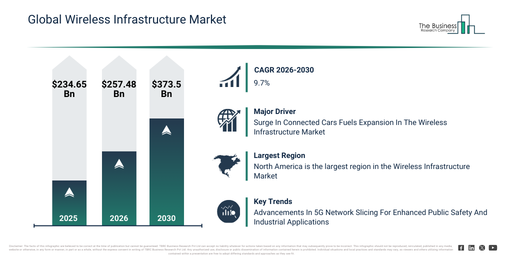
The wireless infrastructure market has experienced robust expansion in recent years. It is anticipated to grow from $234.65 billion in 2025 to $257.48 billion in 2026, achieving a compound annual growth rate (CAGR) of 9.7%. This historical growth can be attributed to the rising adoption of mobile broadband, increased smartphone penetration, escalating data traffic volumes, the deployment of 4G and early 5G networks, and significant investments in telecom infrastructure.
The wireless infrastructure market is projected to experience substantial expansion over the coming years. By 2030, this market is anticipated to reach $373.5 billion, demonstrating a compound annual growth rate (CAGR) of 9.7%. This projected growth is driven by several factors, including the increasing implementation of private 5G networks, a surging need for ultra-low latency connections, the broadening scope of IoT connectivity demands, intensified investments in expanding rural network coverage, and the greater incorporation of satellite communication technologies. Key trends anticipated during this period encompass the wider rollout of 5G network deployments, a greater uptake of small cell infrastructure, the increasing integration of software-defined networking, an escalating requirement for high-capacity data transmission, and a heightened emphasis on network reliability and coverage.
Download A Free Sample Report For Comprehensive Market Insights:
Wireless Infrastructure Market Demand Drivers: What Is Fueling Industry Growth?
The escalating demand for connected automobiles is projected to drive the expansion of the wireless infrastructure market moving forward. A connected car refers to a vehicle outfitted with internet connectivity, enabling bidirectional communication with external systems. The surge in connected car demand is attributed to innovations in enhanced safety features, increased consumer interest, perceived value, and environmental concerns. Wireless infrastructure plays a crucial role in connected cars by facilitating communication between vehicles and various networks, such as the internet, road infrastructure, and other vehicles or pedestrians. For instance, in October 2023, according to Entrapeer, a US-based AI-powered innovation platform, forecasts suggest that the count of connected vehicles on roads will exceed 400 million by 2025, and by 2030, specialists estimate that nearly 96% of all vehicles will include connected capabilities. Therefore, the growing need for connected cars is a primary catalyst for the growth of the wireless infrastructure market.
Wireless Infrastructure Market Segmentation Trends And Revenue Drivers
The wireless infrastructure market covered in this report is segmented –
1) By Type: Satellite, Second Generation (2G) And Third Generation (3G), Fourth Generation (4G), Fifth Generation (5G)
2) By Infrastructure: Small And Macro Cells, Radio Access Networks, Mobile Core, Distributed Area Network
3) By Platform: Government, Defense, Commercial
Subsegments:
1) By Satellite: Low Earth Orbit (LEO) Satellites, Medium Earth Orbit (MEO) Satellites, Geostationary Orbit (GEO) Satellites
2) By Second Generation (2G) And Third Generation (3G): 2G (GSM, CDMA), 3G (UMTS, CDMA2000, HSPA)
3) By Fourth Generation (4G): Long-Term Evolution (LTE), LTE-Advanced (LTE-A), WiMAX (Worldwide Interoperability For Microwave Access)
4) By Fifth Generation (5G): Sub-6 GHz (5G NR), Millimeter Wave (5G NR mmWave), Private 5G Networks
Wireless Infrastructure Market Trends: What Is Shaping Future Industry Growth?
Leading companies in the Wireless Infrastructure market are concentrating on developing advanced solutions, such as network slices. These innovations aim to boost network efficiency, enhance service reliability, support diverse applications like public safety and industrial automation, and provide tailored connectivity for businesses and consumers. A Network Slice is essentially a virtual, independent, and complete network segment operating within a physical network, typically found in 5G or advanced mobile network environments. In April 2025, Verizon Communications Inc., a US-based telecommunications company, unveiled its 5G Frontline network slice, a new technology crafted to improve public safety communications. This offering grants first responders access to a dedicated section of Verizon’s 5G network, guaranteeing uninterrupted connectivity during emergencies, optimized device management, real-time data exchange, and secure communication channels. By delivering these functionalities, 5G Frontline enhances operational efficiency, reduces response times, and supports sophisticated applications such as live video streaming and IoT-enabled sensors in critical situations.
#Wireless Infrastructure Market Industry Leaders: Which Organizations Are Driving Competition?
Major companies operating in the wireless infrastructure market are Samsung Electronics Co. Ltd., Huawei Technologies Co. Ltd., Intel Corporation, Cisco Systems Inc., Qualcomm Technologies Inc., Fujitsu Limited, Hewlett Packard Enterprise, Telefonaktiebolaget LM Ericsson, Nokia Corporation, NEC Corporation, Capgemini Engineering, ZTE Corporation, Corning Incorporated, NXP Semiconductors, Motorola Solutions Inc., CommScope Holding Company Inc., Juniper Networks Inc., Arista Networks Inc., Ciena Corporation, Extreme Networks Inc., ADTRAN Inc., Mavenir Systems Inc., D-Link Corporation, RAD Data Communications Ltd., ARRIS International plc
Access The Complete Wireless Infrastructure Market Report:
Wireless Infrastructure Market Regional Outlook: Where Are The Largest Opportunities Located?
North America was the largest region in the wireless infrastructure market in 2025. The regions covered in the wireless infrastructure market report are Asia-Pacific, South East Asia, Western Europe, Eastern Europe, North America, South America, Middle East, Africa.
Get in touch with us:
The Business Research Company: https://www.thebusinessresearchcompany.com/
Americas: +1 310-496-7795
Asia: +44 7882 955267 & +91 8897263534
Europe: +44 7882 955267
Email us at: marketing@tbrc.info
Follow us on:
LinkedIn: https://in.linkedin.com/company/the-business-research-company
YouTube: https://www.youtube.com/channel/UC24_fI0rV8cR5DxlCpgmyFQ
Global Market Model: https://www.thebusinessresearchcompany.com/global-market-model

Wasay has over a decade of experience in market research, data modelling, and analytics, with prior experience at GlobalData and Decision Tree Consulting Services. At The Business Research Company , he leads research operations across syndicated studies, customized consulting engagements, and the Global Market Model platform. His professional experience includes supporting organizations such as Boston Consulting Group, KPMG, and Ernst & Young. Wasay holds a degree in Electronics and Communications Engineering, postgraduate management qualifications from International Management Institute Belgium and Indian School of Business and Entrepreneurship, and completed the Integrated Program in Business Analytics from Indian Institute of Management Indore.