Enhanced with market attractiveness analysis, total addressable market evaluation, company benchmarking matrices, interactive Excel dashboards, expanded supply chain intelligence, emerging startup coverage, and detailed product insights, The Business Research Company’s 2026 market reports deliver more actionable and strategically valuable research.
Wireless Local Area Network (LAN) Controller Market Value Analysis: What Growth Is Expected Over The Forecast Period?
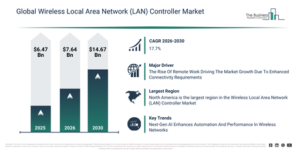
The wireless local area network (lan) controller market size has experienced rapid growth recently. It is set to expand from $6.47 billion in 2025 to $7.64 billion in 2026, demonstrating a compound annual growth rate (CAGR) of 18.0%. This historical market expansion can be attributed to the increase in enterprise wifi networks, the adoption of wireless lan controllers, a rising demand for network visibility, the growing need for secure wireless infrastructure, and the enlargement of educational and healthcare networks.
The market size for wireless local area network (LAN) controllers is projected to experience rapid expansion in the upcoming years. It is anticipated to grow to $14.67 billion by 2030, exhibiting a compound annual growth rate (CAGR) of 17.7%. This growth over the forecast period can be primarily ascribed to the adoption of Wi-Fi 6 and Wi-Fi 6E technologies, the increasing deployment of cloud-based LAN management solutions, a rising demand for AI-enabled performance optimization, an increase in hybrid network deployments, and the expansion of managed services tailored for wireless LAN controllers. Significant trends identified for this period include centralized network management, AI-driven performance optimization, automated configuration and provisioning, robust security and compliance monitoring, and innovative hybrid cloud deployment solutions.
Download A Free Sample Report For Comprehensive Market Insights:
Wireless Local Area Network (LAN) Controller Market Industry Drivers: What Is Driving Revenue Growth?
The increasing prevalence of remote work is anticipated to fuel the expansion of the wireless local area network (LAN) controller market in the future. Remote work refers to a setup where individuals execute their professional responsibilities from non-traditional office environments, typically their residences. The embrace of remote work is on the rise, driven by organizations’ emphasis on flexible employment options to enhance staff contentment and lower operating expenses. This surge in remote work underscores the demand for wireless LAN controllers, given that companies need robust and effective network administration to link dispersed personnel and ensure uninterrupted data accessibility. For example, data from March 2025 by the U.S. Bureau of Labor Statistics, a federal government agency in the US, indicated that in the first quarter of 2024, 35.5 million individuals were working from home or teleworking for remuneration, marking an increase of 5.1 million over the prior year. These employees constituted 22.9% of the total employed population during that timeframe, a rise from 19.6% in the corresponding quarter of the previous year. Consequently, the growing trend of remote work is propelling the expansion of the wireless local area network (LAN) controller market.
Wireless Local Area Network (LAN) Controller Market Segment Breakdown: Which Categories Generate The Most Revenue?
The wireless local area network (lan) controller market covered in this report is segmented –
1) By Component: Hardware, Software, Services
2) By Technology: Wireless Fidelity (Wi-Fi) 5 (802.11ac), Wireless Fidelity (Wi-Fi) 6 (802.11ax), Wireless Fidelity (Wi-Fi) 6e, Wireless Fidelity (Wi-Fi) 7 (802.11be)
3) By Deployment Mode: On-Premises, Cloud-Based, Hybrid
4) By Management Features: Network Visibility, Security And Compliance, Application Performance And Optimization
5) By End-User Verticals: Healthcare, Education, Retail, Hospitality, Manufacturing, Transportation And Logistics, Government
Subsegments:
1) By Hardware: Wireless Local Area Network (LAN) Controllers, Access Point Controllers, Management Appliances, Networking Interface Modules
2) By Software: Wireless Local Area Network (LAN) Management Software, Traffic Monitoring Software, Security And Authentication Software, Configuration And Provisioning Software
3) By Services: Installation And Deployment Services, Maintenance And Support Services, Consulting And Optimization Services, Training And Technical Assistance Services
Wireless Local Area Network (LAN) Controller Market Innovation Trends: Which Developments Are Transforming The Industry?
Major companies in the wireless local area network (LAN) controller market are focusing on developing innovative solutions, such as artificial intelligence (AI)-powered cloud-based network management platforms. These platforms aim to enhance network automation, optimize performance, and simplify management across complex enterprise environments. Artificial intelligence (AI)-powered cloud-based network management platforms employ advanced algorithms and machine learning to automatically analyze, optimize, and manage network operations in real time. This assists organizations in improving performance, reducing downtime, strengthening security, and minimizing manual intervention across distributed wireless LAN environments. For instance, in September 2024, Hewlett Packard Enterprise (HPE), a US-based technology company, introduced new AI-powered automation and expanded monitoring capabilities for third-party devices and end-user experiences within its HPE Aruba Networking Central platform. These enhancements encompass the integration of OpsRamp for monitoring network devices from other vendors like Cisco, Juniper Networks, and Palo Alto Networks, alongside improved network configuration tools, expanded observability, and AI-generated optimizations. Such advancements are designed to offer greater visibility, security, and performance across heterogeneous network environments, helping organizations streamline network management and accelerate deployment through sophisticated AI insights.
Wireless Local Area Network (LAN) Controller Market Key Players And Strategic Industry Positioning
Major companies operating in the wireless local area network (lan) controller market are Samsung Electronics Co. Ltd., Huawei Technologies Co. Ltd., Dell Technologies Inc., Cisco Systems Inc., NEC Corporation, ZTE Corporation, Fortinet Inc., Zebra Technologies Corporation, TP-Link Technologies Co. Ltd., Ubiquiti Inc., Extreme Networks Inc., Edgecore Networks Corporation, Anritsu Corporation, Allied Telesis Inc., Zyxel Communications Corporation, Cambium Networks Corporation, FS.com Inc., D-Link Corporation, NETGEAR Inc., UTStarcom Holdings Corp., EnGenius Technologies Inc.
Access The Complete Wireless Local Area Network (LAN) Controller Market Report:
Wireless Local Area Network (LAN) Controller Market Regional Distribution: Which Areas Drive Market Expansion?
North America was the largest region in the wireless local area network (LAN) controller market in 2025. Asia-Pacific is expected to be the fastest-growing region in the forecast period. The regions covered in the wireless local area network (lan) controller market report are Asia-Pacific, South East Asia, Western Europe, Eastern Europe, North America, South America, Middle East, Africa.
Get in touch with us:
The Business Research Company: https://www.thebusinessresearchcompany.com/
Americas: +1 310-496-7795
Asia: +44 7882 955267 & +91 8897263534
Europe: +44 7882 955267
Email us at: marketing@tbrc.info
Follow us on:
LinkedIn: https://in.linkedin.com/company/the-business-research-company
YouTube: https://www.youtube.com/channel/UC24_fI0rV8cR5DxlCpgmyFQ
Global Market Model: https://www.thebusinessresearchcompany.com/global-market-model

Wasay has over a decade of experience in market research, data modelling, and analytics, with prior experience at GlobalData and Decision Tree Consulting Services. At The Business Research Company , he leads research operations across syndicated studies, customized consulting engagements, and the Global Market Model platform. His professional experience includes supporting organizations such as Boston Consulting Group, KPMG, and Ernst & Young. Wasay holds a degree in Electronics and Communications Engineering, postgraduate management qualifications from International Management Institute Belgium and Indian School of Business and Entrepreneurship, and completed the Integrated Program in Business Analytics from Indian Institute of Management Indore.