Built to provide research that’s more actionable and strategically valuable, The Business Research Company’s 2026 market reports include market attractiveness analysis, total addressable market sizing, company benchmarking matrices, interactive Excel dashboards, broader supply chain intelligence, emerging startup tracking, and in-depth product insights.
Avionics Market Size And Revenue Outlook Through 2030
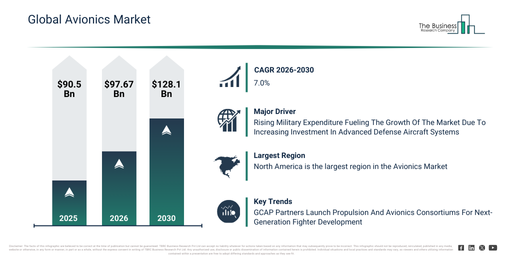
The avionics market has experienced significant growth in recent years. Its valuation is set to rise from $90.5 billion in 2025 to $97.67 billion in 2026, reflecting a compound annual growth rate (CAGR) of 7.9%. This past growth can be attributed to the increasing adoption of digital flight management and control systems within commercial aircraft, the greater deployment of advanced navigation and surveillance avionics to meet regulatory requirements, the modernization of aging aircraft fleets stimulating replacement demand for cockpit display and weather control systems, the rising production of spacecraft and satellites which require specialized avionics subsystems, and the expansion of global air travel boosting installations of communication and health-monitoring avionics.
The avionics market is projected to experience substantial expansion over the upcoming years, reaching a size of $128.1 billion by 2030, driven by a compound annual growth rate (CAGR) of 7.0%. This anticipated growth during the forecast period is fueled by several factors, including the increasing integration of next-generation display control systems offering improved situational awareness, a rising demand for sophisticated weather sensing and predictive avionics aimed at enhancing flight safety, the expanding adoption of integrated avionics suites in modern commercial and military aircraft, greater investments in satellite and spacecraft initiatives that necessitate advanced avionics architectures, and the accelerating progress in autonomous and semi-autonomous flight technologies, which in turn demand more advanced avionics. Key trends anticipated in this period encompass the growing integration of multi-function cockpit displays, the increasing use of advanced flight-management and health-monitoring systems, a notable shift towards modular and upgradable avionics architectures, an escalating need for improved communication and surveillance functionalities, and the expansion of services related to avionics retrofitting and aftermarket support.
Get A Free Sample Report With In-Depth Market Insights:
Avionics Market Demand Drivers: What’s Powering Industry Growth?
The increasing military expenditure is projected to advance the growth of the avionics market. Military expenditure refers to the financial resources a country or government dedicates to its military forces and related operations. This spending is on the rise due to intensifying geopolitical tensions and the imperative for major global powers to modernize their defense capabilities. Military expenditure aids avionics by financing the development, acquisition, and implementation of sophisticated navigation, communication, and flight control systems for defense aircraft, thereby boosting operational efficiency and mission readiness. For instance, in April 2024, according to the Stockholm International Peace Research Institute, a Sweden-based research organization, global military spending totaled approximately $2.29 trillion in 2022. This amount subsequently increased to $2.44 trillion in 2023, reflecting a 6.8% year-over-year growth. Therefore, the growing military expenditure is fueling the expansion of the avionics market.
Avionics Market Segment Trends And Revenue Contributors
The avionics market covered in this report is segmented –
1) By Platform: Commercial Aviation, Military Aviation, Business Jets, General Aviation, Helicopters
2) By Sub System: Flight Management and Control, Health Monitoring, Electrical and Emergency, Communication Navigation and Surveillance
3) By End User: Original Equipment Manufacturer (OEM), Aftermarket
Subsegments:
1) By Commercial Aviation: Air Transport Aircraft, Regional Aircraft
2) By Military Aviation: Fighter Aircraft, Transport Aircraft, Unmanned Aerial Vehicles (UAVs)
3) By Business Jets: Light Jets, Mid-Size Jets, Large Jets
4) By General Aviation: Single-Engine Aircraft, Multi-Engine Aircraft, Turboprop Aircraft
5) By Helicopters: Civil Helicopters, Military Helicopters, Commercial Helicopters
Avionics Market Innovation Trends: What Developments Are Reshaping The Industry?
Major companies within the fighter aircraft systems market are strategically engaging in collaborative consortiums for the development of propulsion and avionics. This approach aims to enhance performance, reduce development timelines, and accelerate the capabilities of next-generation fighters. These propulsion and avionics consortiums integrate diverse expertise from multiple aerospace and defense companies, which helps optimize engine performance, improve flight control systems, and boost electronic warfare capabilities, ultimately leading to more advanced, reliable, and efficient fighter aircraft. For instance, in September 2025, partners in the Global Combat Air Programme (GCAP) launched dedicated propulsion and avionics consortiums focused on advancing technologies for future fighter jets. Developed to address the growing demand for cutting-edge fighter aircraft with superior speed, maneuverability, and mission effectiveness, these consortiums are designed to foster joint innovation, facilitate the sharing of technological expertise, and streamline system integration. This initiative capitalizes on the combined experience and capabilities of the partner companies, enabling the creation of fighter aircraft that are more powerful, technologically sophisticated, and operationally superior than existing platforms.
Avionics Market Competitive Landscape: Which Companies Lead The Industry?
Major companies operating in the avionics market are Safran SA, Honeywell International Inc., Thales Group, L-3 Avionics Systems, Raytheon Technologies Ltd., GE Aviation Inc., BAE Systems plc, Meggitt plc, Rockwell Collins Inc., Panasonic Avionics Corporation, Garmin Ltd., Universal Avionics System Corporation, Airbus SE, The Boeing Company, Cobham Limited, Curtiss-Wright Corporation, Teledyne Technologies Inc., Raytheon Technologies Corp., L3Harris Technologies Inc., Leonardo S.p.A., Moog Inc., Esterline Technologies Corporation, Astronics Corporation, Elbit Systems Ltd., FLIR Systems Inc., Avidyne Corporation, Aspen Avionics Inc., FreeFlight Systems, Mid-Continent Instruments and Avionics, Bendix Aviation Corporation
View The Full Avionics Market Report:
Avionics Market Top Region: Where Does Most Revenue Come From?
North America was the largest region in the avionics market in 2025. Asia-Pacific is expected to be the fastest-growing region in the forecast period. The regions covered in the avionics market report are Asia-Pacific, South East Asia, Western Europe, Eastern Europe, North America, South America, Middle East, Africa.
Reach Out To Our Team:
The Business Research Company: https://www.thebusinessresearchcompany.com/
Americas: +1 310-496-7795
Asia: +44 7882 955267 & +91 8897263534
Europe: +44 7882 955267
Email us at: marketing@tbrc.info
Follow us on:
LinkedIn: https://in.linkedin.com/company/the-business-research-company
YouTube: https://www.youtube.com/channel/UC24_fI0rV8cR5DxlCpgmyFQ
Global Market Model: https://www.thebusinessresearchcompany.com/global-market-model

Wasay has over a decade of experience in market research, data modelling, and analytics, with prior experience at GlobalData and Decision Tree Consulting Services. At The Business Research Company , he leads research operations across syndicated studies, customized consulting engagements, and the Global Market Model platform. His professional experience includes supporting organizations such as Boston Consulting Group, KPMG, and Ernst & Young. Wasay holds a degree in Electronics and Communications Engineering, postgraduate management qualifications from International Management Institute Belgium and Indian School of Business and Entrepreneurship, and completed the Integrated Program in Business Analytics from Indian Institute of Management Indore.