Backed by market attractiveness analysis, total addressable market sizing, company benchmarking matrices, interactive Excel dashboards, wider supply chain intelligence, emerging startup coverage, and detailed product-level insights, The Business Research Company’s 2026 market reports are designed to offer research that is more actionable and strategically valuable than ever.
Belt Loader Market Size Outlook: How Quickly Will Revenue Expand Through 2030?
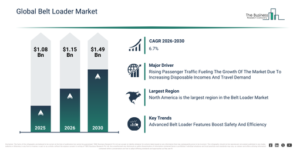
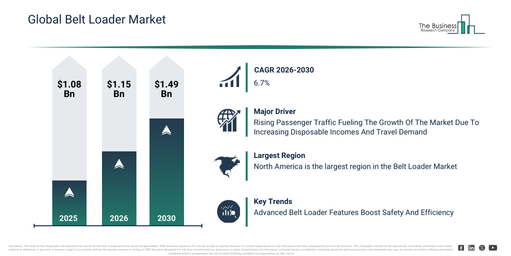
The market size for belt loaders has demonstrated strong growth in recent years. It is projected to expand from $1.08 billion in 2025 to $1.15 billion in 2026, progressing at a compound annual growth rate (CAGR) of 6.5%. This historical rise can be attributed to several factors: the widespread adoption of manual and low-profile belt loaders for airport ground handling, the development of telescopic belt loaders to reach various aircraft cargo heights, the increasing utilization of hybrid belt loaders for improved fuel efficiency, the implementation of solar-powered belt loaders for environmentally conscious operations, and the deployment of standard belt loaders to streamline baggage and cargo transfer.
The belt loader market is projected to experience substantial expansion over the upcoming years, reaching a size of $1.49 billion by 2030, with a compound annual growth rate (CAGR) of 6.7%. This anticipated growth during the forecast period is driven by several factors, including the increasing need for autonomous belt loaders to support automated ground operations, the spread of zero-emission and electric belt loader options, an emphasis on enhanced ergonomic and safety features for ground personnel, the growing implementation of hybrid and energy-efficient loaders to cut operational expenses, and greater purchasing for airport modernization and extensive cargo handling activities. Key developments observed during this period involve the increasing integration of hybrid and solar-powered belt loaders, a rising inclination towards autonomous and self-propelled loaders, wider deployment of loader designs that improve ergonomics and safety, the enlargement of loader fleets due to airport capacity improvements, and a move towards low-profile and telescopic belt loaders for compatibility with a wider range of aircraft.
Get A Free Sample Report With In-Depth Market Insights:
Belt Loader Market Growth Backed By Core Demand Fundamentals
The belt loader market is projected to expand with an increase in passenger traffic. Passenger traffic defines the aggregate count of individuals moving through airports or airlines, either arriving, departing, or in transit, within a given duration. A primary cause for the growing passenger count is an increase in disposable incomes, as improved earnings permit more individuals to engage in leisure and business trips, thereby fueling demand across various transportation segments. Elevated passenger movement positively impacts belt loader operations by generating a greater need for streamlined baggage processing, particularly during peak travel windows. Such demand prompts the uptake of modern belt loaders that facilitate smoother loading and unloading, decrease operational turnaround times, and elevate ground handling effectiveness at heavily used airports. For example, data from November 2024 by Eurostat, a government agency based in Luxembourg, indicated that air passenger numbers in the EU reached 973 million in 2023, representing a 19.3% increase from 2022. Hence, increasing passenger volumes are stimulating the belt loader market’s expansion.
Belt Loader Market Segment Analysis And Revenue Potential
The belt loader market covered in this report is segmented –
1) By Product Type: Self-Propelled, Electric, Diesel, Towable, Gas
2) By Ownership: New Delivery, Resale, Lease Or Rent
3) By Weight: 0-1000 Kilogram (KG), 1000 – 5000 Kilogram (KG), <5000 Kilogram (KG)
4) By Application: Commercial Airports, Military Airports
Subsegments:
1) By Self-Propelled: Hydraulic Drive, Electric Drive, All-Wheel Drive
2) By Electric: Battery-Powered, Plug-In Electric, Solar-Assisted
3) By Diesel: Low Emission Diesel, High-Capacity Diesel, Turbo Diesel
4) By Towable: Manual Tow, Motorized Tow, Adjustable Height
5) By Gas: Compressed Natural Gas (CNG), Liquefied Petroleum Gas (LPG), Dual-Fuel Gas Systems
Belt Loader Market Growth Trends Reshaping The Competitive Landscape
Key companies operating within the belt loader market are concentrating on developing advanced offerings, such as automatic height adjustment systems, with the goal of boosting operational efficiency, enhancing overall safety, and lessening both manual exertion and potential harm to aircraft. Automatic height adjustment systems describe sophisticated mechanisms integrated into belt loaders that autonomously raise or lower the conveyor belt to achieve precise alignment with the specific height of an aircraft’s cargo hold. As an example, in April 2024, Mallaghan Engineering Ltd., a manufacturing firm specializing in lifting and handling equipment based in the UK, unveiled the SkyBelt belt loader. The SkyBelt is a completely electric, self-propelled belt loader featuring a patented vertical-lift boom that actively prevents lateral movement, thereby significantly reducing the likelihood of fuselage damage. This system includes automatic height adjustment and auto-raise capabilities, facilitating smooth synchronization with varying aircraft bin floor heights without requiring any intervention from an operator.
Belt Loader Market Key Players Shaping Industry Direction
Major companies operating in the belt loader market are Textron Inc., Weihai Guangtai Airport Equipment Co. Ltd., Mallaghan Engineering Limited, TLD Group Inc., Fast Global Solutions Inc., Trepel Airport Equipment GmbH, Power Stow A/S, Aero Specialties Inc., Aviogei Airport Equipment S.r.l., LAS-1 Company Ltd., Sammitr Motors Manufacturing Public Company Limited, MULAG Fahrzeugwerk GmbH, Hangfu Airdrome Equipment Co. Ltd., Jetall GPU Ground Support Equipment Co. Ltd., Shanghai Waycan Industrial Co. Ltd., Darmec Technologies S.r.l., Ersel Technology S.r.l., Harlan Global Manufacturing LLC, Jiangsu Tianyi Aviation Industry Co. Ltd., Shanghai Cartoo Machinery Co., Ltd.
View The Full Belt Loader Market Report:
Belt Loader Market Largest Region: Which Geography Holds The Biggest Share?
North America was the largest region in the belt loader market in 2025. Asia-Pacific is expected to be the fastest-growing region in the forecast period. The regions covered in the belt loader market report are Asia-Pacific, South East Asia, Western Europe, Eastern Europe, North America, South America, Middle East, Africa.
Reach Out To Our Team:
The Business Research Company: https://www.thebusinessresearchcompany.com/
Americas: +1 310-496-7795
Asia: +44 7882 955267 & +91 8897263534
Europe: +44 7882 955267
Email us at: marketing@tbrc.info
Follow us on:
LinkedIn: https://in.linkedin.com/company/the-business-research-company
YouTube: https://www.youtube.com/channel/UC24_fI0rV8cR5DxlCpgmyFQ
Global Market Model: https://www.thebusinessresearchcompany.com/global-market-model

Wasay has over a decade of experience in market research, data modelling, and analytics, with prior experience at GlobalData and Decision Tree Consulting Services. At The Business Research Company , he leads research operations across syndicated studies, customized consulting engagements, and the Global Market Model platform. His professional experience includes supporting organizations such as Boston Consulting Group, KPMG, and Ernst & Young. Wasay holds a degree in Electronics and Communications Engineering, postgraduate management qualifications from International Management Institute Belgium and Indian School of Business and Entrepreneurship, and completed the Integrated Program in Business Analytics from Indian Institute of Management Indore.