Built to provide research that’s more actionable and strategically valuable, The Business Research Company’s 2026 market reports include market attractiveness analysis, total addressable market sizing, company benchmarking matrices, interactive Excel dashboards, broader supply chain intelligence, emerging startup tracking, and in-depth product insights.
Civil Defense Unmanned Aerial Vehicles Market Set To Climb From $2.77 Billion In 2026 To $4.45 Billion By 2030
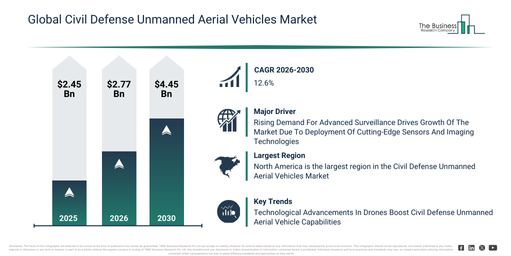
The civil defense unmanned aerial vehicles market has witnessed substantial growth in recent years. It is projected to expand from $2.45 billion in 2025 to $2.77 billion in 2026, achieving a compound annual growth rate (CAGR) of 13.1%. The expansion observed in the past can be ascribed to the increasing use of surveillance and reconnaissance drones for civil monitoring and public safety, the deployment of firefighting UAVs for quick fire detection and response, the growing utilization of communication relay UAVs to bolster emergency operations, the incorporation of UAVs in search and rescue missions, and the implementation of UAV-based environmental monitoring for preparing for disasters.
The civil defense unmanned aerial vehicles market size is anticipated to expand rapidly in the coming years, projected to reach $4.45 billion by 2030, at a compound annual growth rate (CAGR) of 12.6%. This growth during the forecast period is fueled by an increasing demand for autonomous civil defense UAVs equipped with advanced AI, the broadening application of multi-purpose UAV platforms for disaster response and public safety, a greater uptake of UAVs featuring sophisticated sensors and real-time data analytics, an emphasis on long-endurance and high-payload UAVs for extended operations, and higher procurement rates for municipal, state, and federal emergency management programs. Key trends identified for this period include the rising utilization of UAVs for prompt disaster assessment, their expanded deployment in urban search and rescue missions, the increasing adoption of specialized firefighting drones, the development of civil defense UAV training and skill enhancement programs, and a growing preference for long-endurance UAV platforms in emergency operations.
Get A Free Sample Report With In-Depth Market Insights:
Civil Defense Unmanned Aerial Vehicles Market Development Factors: What’s Supporting Demand?
The escalating requirement for sophisticated surveillance and reconnaissance functionalities is projected to drive the expansion of the civil defense unmanned aerial vehicles market moving forward. These advanced surveillance and reconnaissance capabilities encompass the deployment of cutting-edge technologies and sensors to collect real-time, high-precision intelligence, leading to improved situational awareness and decision-making. The increasing call for these advanced surveillance and reconnaissance capabilities is fueled by the growing need for immediate situational awareness to effectively identify and address evolving security and emergency threats. Civil defense unmanned aerial vehicles boost advanced surveillance and reconnaissance capabilities by delivering real-time aerial monitoring, high-resolution imaging, and data acquisition across extensive or challenging-to-access areas, all without jeopardizing human lives. For instance, in September 2024, data from the Congressional Research Service, a US government agency, indicated that National Intelligence Program (NIP) and Military Intelligence Program (MIP) allocations increased from $99.6 billion in Fiscal Year 2023 to $106.3 billion in FY 2024, and then to $101.6 billion in FY 2025. Consequently, the rising demand for advanced surveillance and reconnaissance capabilities is propelling the growth of the civil defense unmanned aerial vehicles market.
Civil Defense Unmanned Aerial Vehicles Market Segment Trends And Revenue Contributors
The civil defense unmanned aerial vehicles market covered in this report is segmented –
1) By Type: Fixed-Wing Unmanned Aerial Vehicles, Rotary-Wing Unmanned Aerial Vehicles, Hybrid Unmanned Aerial Vehicles
2) By Application: Surveillance, Search And Rescue, Disaster Management, Firefighting, Border Security
3) By End-User: Government, Military, Civil Defense Organizations, Public Safety Agencies, Emergency Services
Subsegments:
1) By Fixed-Wing Unmanned Aerial Vehicles: Conventional Fixed-Wing Unmanned Aerial Vehicles, High-Altitude Long-Endurance (HALE) Unmanned Aerial Vehicles, Medium-Altitude Long-Endurance (MALE) Unmanned Aerial Vehicles
2) By Rotary-Wing Unmanned Aerial Vehicles: Single-Rotor Unmanned Aerial Vehicles, Multi-Rotor Unmanned Aerial Vehicles, Coaxial Rotor Unmanned Aerial Vehicles
3) By Hybrid Unmanned Aerial Vehicles: Tilt-Wing Hybrid Unmanned Aerial Vehicles, Tilt-Rotor Hybrid Unmanned Aerial Vehicles, Tail-Sitter Unmanned Aerial Vehicles
Civil Defense Unmanned Aerial Vehicles Market Transformation Trends: What Innovations Are Driving Change?
Leading companies in the civil defense unmanned aerial vehicles market are concentrating on developing advanced capabilities like fixed-wing vertical takeoff and landing (VTOL) drones. This effort aims to improve operational flexibility, endurance, and rapid deployment in emergency response scenarios. A fixed-wing vertical takeoff and landing (VTOL) drone is an uncrewed aircraft that combines the runway-independent launch and recovery common to rotorcraft with the extended range and high-speed flight characteristic of fixed-wing designs. For instance, in June 2025, Delair, a France-based manufacturing company, unveiled the DT61. This drone features advanced VTOL capabilities, a prolonged endurance of over seven hours, and modular payload integration for versatile, multi-mission surveillance and inspection across extensive land and maritime areas in both civilian and military sectors. Its compact, swiftly deployable design supports the simultaneous operation of high-performance sensors, making it an ideal choice for rapid response, intelligence gathering, and civil defense operations.
Civil Defense Unmanned Aerial Vehicles Market Competitive Landscape: Which Companies Lead The Industry?
Major companies operating in the civil defense unmanned aerial vehicles market are Lockheed Martin Corporation, Thales S.A., Leonardo S.p.A., Textron Inc., Elbit Systems Ltd., General Atomics Aeronautical Systems Inc., TEKEVER Autonomous Systems, Parrot Drones SAS, Schiebel Group, Garuda Aerospace Pvt. Ltd., Drone Volt SA, Delair SAS, Paras Defence and Space Technologies Ltd., BlueBird Aero Systems Ltd., ideaForge Technology Ltd., Threod Systems, UAVOS Inc., AceCore Technologies, C-Astral Aerospace, Dragonfly Pictures, FLIR Systems, AeroExpo, GRIFF Aviation AS, OM UAV Systems.
View The Full Civil Defense Unmanned Aerial Vehicles Market Report:
Civil Defense Unmanned Aerial Vehicles Market Geographic Distribution And Regional Opportunities
North America was the largest region in the civil defense unmanned aerial vehicles market in 2025. Asia-Pacific is expected to be the fastest-growing region in the forecast period. The regions covered in the civil defense unmanned aerial vehicles market report are Asia-Pacific, South East Asia, Western Europe, Eastern Europe, North America, South America, Middle East, Africa.
Reach Out To Our Team:
The Business Research Company: https://www.thebusinessresearchcompany.com/
Americas: +1 310-496-7795
Asia: +44 7882 955267 & +91 8897263534
Europe: +44 7882 955267
Email us at: marketing@tbrc.info
Follow us on:
LinkedIn: https://in.linkedin.com/company/the-business-research-company
YouTube: https://www.youtube.com/channel/UC24_fI0rV8cR5DxlCpgmyFQ
Global Market Model: https://www.thebusinessresearchcompany.com/global-market-model

Wasay has over a decade of experience in market research, data modelling, and analytics, with prior experience at GlobalData and Decision Tree Consulting Services. At The Business Research Company , he leads research operations across syndicated studies, customized consulting engagements, and the Global Market Model platform. His professional experience includes supporting organizations such as Boston Consulting Group, KPMG, and Ernst & Young. Wasay holds a degree in Electronics and Communications Engineering, postgraduate management qualifications from International Management Institute Belgium and Indian School of Business and Entrepreneurship, and completed the Integrated Program in Business Analytics from Indian Institute of Management Indore.