Backed by market attractiveness analysis, total addressable market sizing, company benchmarking matrices, interactive Excel dashboards, wider supply chain intelligence, emerging startup coverage, and detailed product-level insights, The Business Research Company’s 2026 market reports are designed to offer research that is more actionable and strategically valuable than ever.
Civil Unmanned Aircraft Systems (UAS) Market Size, Value And Growth Trajectory Through 2030
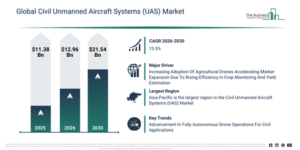
The civil unmanned aircraft systems (uas) market size has seen significant growth in recent years. It is anticipated to expand from $11.38 billion in 2025 to $12.96 billion in 2026, achieving a compound annual growth rate (CAGR) of 13.9%. This historical expansion can be attributed to factors such as the broader application of commercial drones in agriculture and surveying, increased deployment of UAS for infrastructure inspection and maintenance, initial regulatory permissions allowing controlled civilian drone usage, enhancements in battery efficiency and flight control systems, and a growing requirement for economical aerial data gathering by civilian industries.
The market for civil unmanned aircraft systems (UAS) is projected to experience swift expansion over the coming years. This market is set to reach $21.54 billion by 2030, demonstrating a compound annual growth rate (CAGR) of 13.5%. Factors contributing to this anticipated growth include improvements in autonomous navigation and beyond-visual-line-of-sight (BVLOS) capabilities, the increasing incorporation of UAS into logistics and last-mile delivery, stronger regulatory structures facilitating secure large-scale UAS deployment, the expanding use of AI-powered analytics for immediate aerial data processing, and rising investments in drone applications for environmental monitoring and smart cities. Key trends during this projection period involve a surging demand for BVLOS (beyond visual line of sight) operations, the proliferation of drone-as-a-service business models, increased use of lightweight composite materials, greater integration of UAS in emergency response scenarios, and an uptick in regulatory clearances for commercial activities.
Get A Free Sample Report With In-Depth Market Insights:
Civil Unmanned Aircraft Systems (UAS) Market Growth Momentum: What Factors Are Shaping Demand?
The increasing demand within the agriculture sector is poised to drive the expansion of the civil unmanned aircraft systems (UAS) market. Unmanned aerial systems in farming are drone-based tools utilized for crop surveillance, field condition assessment, and improving farm output through data collected from the air. The escalating need for UAS in agriculture is attributed to the requirement for precision farming techniques that enhance crop observation, yield prediction, and resource optimization, as drones equipped with multispectral sensors and artificial intelligence help farmers make informed decisions and efficiently boost productivity across extensive areas. Civil UAS are valuable in the agriculture sector, as more farmers adopt drone technology to refine crop monitoring, optimize resource utilization, and elevate overall farm productivity through precision farming solutions. For instance, in February 2024, Airservices Australia, an Australia-based air navigation service provider, indicated that by 2043, Australian farmers will undertake 500,000 drone flights for crop monitoring, while drones will complete 1.5 million food deliveries to households, which is three times as many flights for food as for farming. Hence, the growing demand from the agriculture sector is fueling the growth of the civil unmanned aircraft systems (UAS) market.
Civil Unmanned Aircraft Systems (UAS) Market Segment Breakdown: Which Categories Lead On Revenue?
The civil unmanned aircraft systems (uas) market covered in this report is segmented –
1) By Product Type: Rotary Blade Drone, Fixed Wing Drone, Hybrid Drone
2) By Usage: Commercial Drones, Civil Government Drones, Consumer Drones
3) By Application Type: Filming And Photography, Inspection And Maintenance, Mapping And Surveying, Precision Agriculture, Surveillance And Monitoring, Other Applications
4) By End User: Agriculture, Delivery And Logistics, Media And Entertainment, Building And Construction, General Photography Or Real State, Energy, Insurance, Security And Law Enforcement, Consumer, Other End-Users
Subsegments:
1) By Rotary Blade Drone: Single-Rotor Drone, Multi-Rotor Drone, Quadcopter, Hexacopter, Octocopter
2) By Fixed Wing Drone: Conventional Fixed Wing, Vertical Take-Off and Landing (VTOL) Fixed Wing, Solar-Powered Fixed Wing, Glider-Type Fixed Wing
3) By Hybrid Drone: Tilt-Rotor Hybrid, Tilt-Wing Hybrid, Lift + Cruise Hybrid, Coaxial Propulsion Hybrid
Civil Unmanned Aircraft Systems (UAS) Market Trends Redefining Industry Growth
Major companies operating in the civil unmanned aircraft systems (UAS) market are focusing on innovative solutions, such as fully autonomous beyond-visual-line-of-sight (BVLOS) flights, to extend operational range, reduce dependence on ground-based pilots, and enable efficient long-distance missions across critical sectors such as infrastructure inspection, agriculture, and logistics. These fully autonomous beyond-visual-line-of-sight flights are drone operations that occur without human control and beyond the pilot’s visual range, using onboard systems to navigate and complete missions independently. For instance, in November 2024, Carbonix, an Australia-based company that manufactures long-range fixed-wing vertical take-off and landing (VTOL) drones, received a nationwide waiver from United States aviation authorities that allows the Volanti drone to perform fully autonomous beyond-visual-line-of-sight operations in uncontrolled airspace. This represents a critical step toward integrating long-range drones into commercial airspace, removing traditional visual oversight requirements and enabling scalable, efficient missions across key civil sectors.
Civil Unmanned Aircraft Systems (UAS) Market Leading Players And Competitive Positioning
Major companies operating in the civil unmanned aircraft systems (uas) market are The Boeing Company, SZ DJI Technology Co. Ltd., Quantum-Systems GmbH, Parrot Drones SAS, ALTI Unmanned Aircraft Systems, Schiebel Elektronische Geraete GmbH, Edge Autonomy Ltd., Drone Volt SA, Delair SAS, AgEagle Aerial Systems Inc., Chengdu JOUAV Automation Tech Co. Ltd., IdeaForge Technology Limited, Rocketmine, EHang Holdings Limited, Applied Aeronautics LLC, Avy B.V., Carbonix Pty Ltd, ModalAI Inc., Primoco UAV SE, Sky-Watch A/S.
View The Full Civil Unmanned Aircraft Systems (UAS) Market Report:
Civil Unmanned Aircraft Systems (UAS) Market Largest Region: Which Geography Holds The Highest Market Share?
Asia-Pacific was the largest region in the civil unmanned aircraft systems (UAS) market in 2025. The regions covered in the civil unmanned aircraft systems (uas) market report are Asia-Pacific, South East Asia, Western Europe, Eastern Europe, North America, South America, Middle East, Africa.
Reach Out To Our Team:
The Business Research Company: https://www.thebusinessresearchcompany.com/
Americas: +1 310-496-7795
Asia: +44 7882 955267 & +91 8897263534
Europe: +44 7882 955267
Email us at: marketing@tbrc.info
Follow us on:
LinkedIn: https://in.linkedin.com/company/the-business-research-company
YouTube: https://www.youtube.com/channel/UC24_fI0rV8cR5DxlCpgmyFQ
Global Market Model: https://www.thebusinessresearchcompany.com/global-market-model

Wasay has over a decade of experience in market research, data modelling, and analytics, with prior experience at GlobalData and Decision Tree Consulting Services. At The Business Research Company , he leads research operations across syndicated studies, customized consulting engagements, and the Global Market Model platform. His professional experience includes supporting organizations such as Boston Consulting Group, KPMG, and Ernst & Young. Wasay holds a degree in Electronics and Communications Engineering, postgraduate management qualifications from International Management Institute Belgium and Indian School of Business and Entrepreneurship, and completed the Integrated Program in Business Analytics from Indian Institute of Management Indore.