Backed by market attractiveness analysis, total addressable market sizing, company benchmarking matrices, interactive Excel dashboards, wider supply chain intelligence, emerging startup coverage, and detailed product-level insights, The Business Research Company’s 2026 market reports are designed to offer research that is more actionable and strategically valuable than ever.
#Aerospace Support and Auxiliary Equipment Market Expansion Outlook: What Revenue Opportunities Are Ahead?#_x000D_
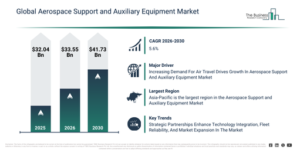
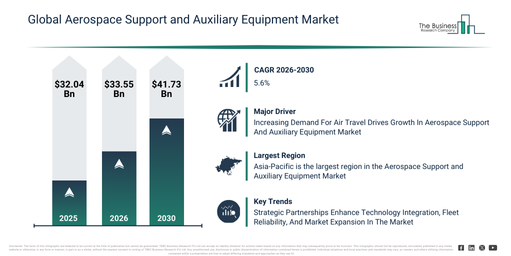
The aerospace support and auxiliary equipment market size has experienced consistent growth in recent years. It is anticipated to expand from $32.04 billion in 2025 to $33.55 billion in 2026, achieving a compound annual growth rate (CAGR) of 4.7%. This historical growth can be attributed to the broadening of commercial and military aviation infrastructure, advancements in radar and air traffic control systems, an elevated demand for airport modernization and safety enhancements, an increase in aerospace maintenance and warranty services, and government regulations prompting the modernization of air navigation systems._x000D_
_x000D_
The aerospace support and auxiliary equipment market is projected to experience substantial expansion over the coming years. By 2030, this market is anticipated to reach a valuation of $41.73 billion, demonstrating a compound annual growth rate (CAGR) of 5.6%. This projected growth is driven by several factors, including the increasing integration of next-generation air traffic management technologies, heightened investments in airport development and intelligent infrastructure, a surge in the need for sophisticated radar and surveillance systems, the worldwide expansion of aerospace maintenance and support offerings, and the incorporation of AI and IoT within aerospace support and auxiliary equipment. Key trends expected during this period involve the wider implementation of advanced air traffic management solutions, a growing call for radar system upgrades, the enlargement of space-based surveillance capabilities, increased funding for defense aerospace support mechanisms, and an emphasis on improving maintenance and warranty provisions._x000D_
_x000D_
#Get A Free Sample Report With In-Depth Market Insights:#_x000D_
_x000D_
#Aerospace Support and Auxiliary Equipment Market Growth Backed By Core Demand Fundamentals#_x000D_
The aerospace support and auxiliary equipment market is anticipated to expand due to the rising demand for air travel. Air travel refers to movement facilitated by flight-capable vehicles like airplanes, jet aircraft, or helicopters, involving boarding and disembarking from an aircraft for a journey. This increase in air travel spurs greater aircraft production and maintenance, encompassing areas such as air traffic control, manufacturing tools, safety gear, and associated offerings. As an illustration, Eurostat, the Luxembourg-based statistical office of the European Union (EU), reported in November 2024 that in 2023, air travel within the EU saw a substantial increase, reaching 973 million passengers, which signifies a 19.3% rise over 2022. Consequently, the escalating need for air travel is fueling the expansion of the aerospace support and auxiliary equipment market._x000D_
_x000D_
#Aerospace Support and Auxiliary Equipment Market Segment Landscape And Growth Outlook#_x000D_
The aerospace support and auxiliary equipment market covered in this report is segmented – _x000D_
_x000D_
1) By Type: Commercial Radars, Satellites_x000D_
2) By Ownership: Public, Private_x000D_
3) By Platform: Airborne, Land, Naval, Space_x000D_
_x000D_
Subsegments:_x000D_
1) By Commercial Radars: Ground-Based Radars, Airborne Radars, Space-Based Radars _x000D_
2) By Satellites: Communication Satellites, Earth Observation Satellites, Navigation Satellites, Remote Sensing Satellites_x000D_
_x000D_
#Aerospace Support and Auxiliary Equipment Market Growth Trends Reshaping The Competitive Landscape#_x000D_
Leading enterprises within the aerospace support and auxiliary equipment market are prioritizing the establishment of strategic collaborations. This focus aims to bolster the incorporation of technology, broaden service offerings, and improve the operational dependability for those who operate aircraft. These alliances are defined as cooperative arrangements where entities merge their technical know-how, assets, and enduring service pledges. The objective is to fulfill common aspirations, including heightened maintenance effectiveness, lowered total ownership costs, and superior fleet functionality. Illustratively, during October 2025, Honeywell, an American technology and manufacturing firm, forged a prolonged pact with Air India, an airline under the Tata Group. The purpose of this agreement is to deliver extensive post-sales assistance for auxiliary power units (APUs) throughout their existing and upcoming aircraft fleets. Such a collaboration enhances the consistency of aircraft dispatch, boosts the overall availability of the fleet, and diminishes expenditures associated with unscheduled maintenance. Auxiliary Power Units (APUs), which are essential for providing power and climate control to aircraft on the tarmac, constitute a vital element within Honeywell’s aerospace technology offerings. Furthermore, they resonate with the corporation’s strategic emphasis on aviation, automation, and the shift towards sustainable energy._x000D_
_x000D_
#Aerospace Support and Auxiliary Equipment Market Competitive Landscape: Who Leads The Industry?#_x000D_
Major companies operating in the aerospace support and auxiliary equipment market are Lockheed Martin Corporation, Northrop Grumman Corporation, Raytheon Inc., Reutech Radar Systems Pty Ltd., Rockwell Collins Inc., Boeing Airplane & Transport Corporation, Airbus Group Inc., Safran Aerosystems, General Electric Aircraft Engines, Rolls-Royce Motors Holdings Ltd., Leonardo UK Ltd., Honeywell International Inc., BAE Systems Inc., L3 Technologies Inc., Bombardier Inc., Spirit AeroSystems Inc., Public Joint-Stock Company United Aircraft Corporation, MTU Aero Engines AG, Empresa Brasileira De Aeronáutica, GKN Aerospace Services Ltd., Israel Aerospace Industries Ltd., Triumph Group Inc., Torry Harris Integration Solutions, Collins Aerospace Systems, Thales SA, General Electric Company Ltd., United Technologies Corporation India Pvt Ltd., Textron Inc., Eaton Corporation PLC, Moog Inc., Woodward Inc. _x000D_
_x000D_
#View The Full Aerospace Support and Auxiliary Equipment Market Report:#_x000D_
_x000D_
#Aerospace Support and Auxiliary Equipment Market Regional Analysis And Top Geography#_x000D_
Asia-Pacific was the largest region in the aerospace support and auxiliary equipment market in 2025. Asia-Pacific is expected to be the fastest growing region in the forecast period. The regions covered in the aerospace support and auxiliary equipment market report are Asia-Pacific, South East Asia, Western Europe, Eastern Europe, North America, South America, Middle East, Africa._x000D_
_x000D_
#Reach Out To Our Team:#_x000D_
_x000D_
The Business Research Company: https://www.thebusinessresearchcompany.com/_x000D_
Americas: +1 310-496-7795_x000D_
Asia: +44 7882 955267 & +91 8897263534_x000D_
Europe: +44 7882 955267_x000D_
Email us at: marketing@tbrc.info_x000D_
_x000D_
#Follow us on:#_x000D_
_x000D_
LinkedIn: https://in.linkedin.com/company/the-business-research-company_x000D_
YouTube: https://www.youtube.com/channel/UC24_fI0rV8cR5DxlCpgmyFQ_x000D_
Global Market Model: https://www.thebusinessresearchcompany.com/global-market-model

Wasay has over a decade of experience in market research, data modelling, and analytics, with prior experience at GlobalData and Decision Tree Consulting Services. At The Business Research Company , he leads research operations across syndicated studies, customized consulting engagements, and the Global Market Model platform. His professional experience includes supporting organizations such as Boston Consulting Group, KPMG, and Ernst & Young. Wasay holds a degree in Electronics and Communications Engineering, postgraduate management qualifications from International Management Institute Belgium and Indian School of Business and Entrepreneurship, and completed the Integrated Program in Business Analytics from Indian Institute of Management Indore.