Backed by market attractiveness analysis, total addressable market sizing, company benchmarking matrices, interactive Excel dashboards, wider supply chain intelligence, emerging startup coverage, and detailed product-level insights, The Business Research Company’s 2026 market reports are designed to offer research that is more actionable and strategically valuable than ever.
Rocket Combustion Stability Market Revenue Outlook: What CAGR Lies Ahead Through 2030?
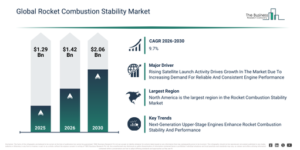
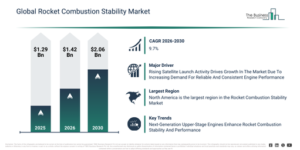
The rocket combustion stability market has experienced significant expansion recently. This market is projected to expand from $1.29 billion in 2025 to $1.42 billion in 2026, exhibiting a compound annual growth rate (CAGR) of 10.1%. Historical growth in this sector can be ascribed to several factors, including the increasing implementation of acoustic damping devices designed to lessen combustion-induced pressure oscillations in rocket engines. Other contributing factors are the rising deployment of engine control units aimed at stabilizing propellant flow and combustion behavior, the greater utilization of thermal protection liners to avert heat-driven instability and structural damage, the initial establishment of combustion stability testing protocols to enhance engine performance, and the widening scope of propulsion system research and development, which fuels the need for solutions in instability diagnostics and mitigation.
The rocket combustion stability market size is anticipated to demonstrate robust expansion over the coming years. It is projected to reach $2.06 billion by 2030, driven by a compound annual growth rate (CAGR) of 9.7%. This growth throughout the forecast period can be attributed to several factors, including the increasing requirement for advanced combustion stability solutions to support high-performance and reusable rocket engines, the rising adoption of real-time sensor and data analytics systems for predicting instability and active control, the ongoing development of next-generation thermal liners that offer improved resistance to extreme combustion environments, the expansion of commercial launch providers who are investing in stability-optimized engine architectures, and technological advancements enabling integrated acoustic, thermal, and control-system solutions for enhanced combustion reliability. Key trends during this period will involve a greater use of active combustion damping and real-time control systems, a growing embrace of high-fidelity combustion modeling and simulation, a rising demand for robust sensors for monitoring pressure, temperature, and vibration, the integration of additive-manufactured injector and chamber designs to improve stability, and an expansion of test-facility instrumentation coupled with automated hot-fire testing.
Get A Free Sample Report With In-Depth Market Insights:
Rocket Combustion Stability Market Growth Momentum: What Factors Are Shaping Demand?
The increasing need for satellite launches is expected to boost the expansion of the rocket combustion stability market in the foreseeable future. These launches entail sending artificial satellites into space via rockets, positioning them in specific orbits for purposes such as communication, navigation, and observing Earth. The number of satellite launches is rising, driven by a greater need for worldwide connectivity, particularly from internet services provided by satellites that target isolated and neglected areas. Stable rocket combustion guarantees consistent and uninterrupted thrust, which is essential for precise satellite deployment and successful orbit insertion. For example, reports from June 2024 by the Satellite Industry Association, a US-based organization, indicated that the commercial satellite sector experienced unprecedented growth in 2023, deploying 2,781 satellites, marking a 20% increase compared to 2022. Additionally, the space industry reached a new landmark with 190 total launches, representing the highest count ever documented. By year-end, the count of operational satellites stood at 9,691, showing a 361% surge over the last five years. Consequently, the escalating demand for satellite launches is propelling the growth of the rocket combustion stability market.
Rocket Combustion Stability Market Segmentation: How Does The Market Break Down By Category?
The rocket combustion stability market covered in this report is segmented –
1) By Component: Combustion Chambers, Injectors, Nozzles, Sensors, Other Component
2) By Propellant Type: Liquid Propellants, Solid Propellants, Hybrid Propellants
3) By Application: Aerospace, Defense, Space Exploration, Other Applications
4) By End-User: Government Agencies, Private Space Companies, Research Institutions, Other End-Users
Subsegments:
1) By Combustion Chambers: Regeneratively Cooled Chambers, Vortex Combustion Chambers, Ablatively Cooled Chambers
2) By Injectors: Pintle Injectors, Impinging Jet Injectors, Coaxial Injectors
3) By Nozzles: Bell-shaped Nozzles, Expansion-Deflection Nozzles, Aerospike Nozzles
4) By Sensors: Pressure Sensors, Vibration Sensors, Temperature Sensors
5) By Other Component: Turbopumps, Propellant Feed Lines, Ignition Systems
Rocket Combustion Stability Market Trends Redefining Industry Growth
Major companies operating in the rocket combustion stability market are concentrating on developing innovative solutions, such as vortex-cooled, staged-combustion upper-stage engines, to address the increasing demand for higher performance, reusability, and mission flexibility within national security and commercial space sectors. These vortex-cooled staged-combustion engines employ centrifugal vortex flows to simultaneously maintain high-pressure combustion and cool chamber walls, thereby offering improved thermal efficiency over traditional gas-generator cycle engines. For instance, in February 2025, Sierra Space, a US-based commercial space company, successfully completed its fully integrated VR35K A upper-stage engine under contract with the US Air Force Research Laboratory. The VR35K-A engine incorporates a fuel-rich staged combustion cycle with LOX or LH2 propellants and a patented VORTEX combustion chamber. Tests conducted in 2024 showcased stable thrust, precise mixture control, active cooling, and efficient single-shaft turbopump operation. Additive manufacturing further enables faster production, while its 35,000 lbf thrust boosts payload capacity by up to 30%.
Rocket Combustion Stability Market Competitive Overview And Top Companies
Major companies operating in the rocket combustion stability market are China Aerospace Science and Technology Corporation, Northrop Grumman Innovation Systems, Mitsubishi Heavy Industries Ltd., L3Harris Technologies Inc., IHI Corporation, Blue Origin LLC, ArianeGroup SAS, Ansys Inc., United Launch Alliance, Sierra Space Corporation, Relativity Space Inc., Firefly Aerospace Inc., Gilmour Space Technologies Pty Ltd, Ursa Major Technologies Inc., HyImpulse Technologies GmbH, Chemical Automatics Design Bureau, Indian Space Research Organisation, Nammo AS, China Academy of Launch Vehicle Technology, NPO Energomash
View The Full Rocket Combustion Stability Market Report:
Rocket Combustion Stability Market Regional Analysis And Leading Geography
North America was the largest region in the rocket combustion stability market in 2025. The regions covered in the rocket combustion stability market report are Asia-Pacific, South East Asia, Western Europe, Eastern Europe, North America, South America, Middle East, Africa.
Reach Out To Our Team:
The Business Research Company: https://www.thebusinessresearchcompany.com/
Americas: +1 310-496-7795
Asia: +44 7882 955267 & +91 8897263534
Europe: +44 7882 955267
Email us at: marketing@tbrc.info
Follow us on:
LinkedIn: https://in.linkedin.com/company/the-business-research-company
YouTube: https://www.youtube.com/channel/UC24_fI0rV8cR5DxlCpgmyFQ
Global Market Model: https://www.thebusinessresearchcompany.com/global-market-model

Wasay has over a decade of experience in market research, data modelling, and analytics, with prior experience at GlobalData and Decision Tree Consulting Services. At The Business Research Company , he leads research operations across syndicated studies, customized consulting engagements, and the Global Market Model platform. His professional experience includes supporting organizations such as Boston Consulting Group, KPMG, and Ernst & Young. Wasay holds a degree in Electronics and Communications Engineering, postgraduate management qualifications from International Management Institute Belgium and Indian School of Business and Entrepreneurship, and completed the Integrated Program in Business Analytics from Indian Institute of Management Indore.