Backed by market attractiveness analysis, total addressable market sizing, company benchmarking matrices, interactive Excel dashboards, wider supply chain intelligence, emerging startup coverage, and detailed product-level insights, The Business Research Company’s 2026 market reports are designed to offer research that is more actionable and strategically valuable than ever.
Rocket Engine Turbo Pump Market Revenue Growth On Track For A 7% CAGR Through 2030
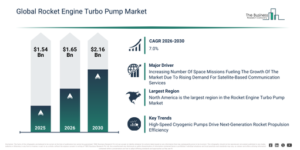
The rocket engine turbo pump market size has demonstrated robust expansion in recent years. This market is projected to expand from $1.54 billion in 2025 to $1.65 billion by 2026, growing at a compound annual growth rate (CAGR) of 7.1%. The historical increase can be attributed to several factors, including the rising adoption of high-thrust liquid propulsion systems, which drives the need for advanced turbo pumps; the creation of staged combustion and gas-generator cycle turbo pumps designed to improve engine performance; the initial integration of cryogenic turbo pumps essential for liquid oxygen and liquid hydrogen missions; technological enhancements in turbine efficiency enabling greater flow and pressure capabilities; and government-funded space programs stimulating the manufacturing of precision-engineered turbo pump assemblies.
The rocket engine turbo pump market size is expected to show significant growth in the upcoming years. It is projected to expand to $2.16 billion by 2030, achieving a compound annual growth rate (CAGR) of 7.0%. This expansion over the forecast period is attributed to the proliferation of reusable launch vehicles demanding more durable and maintainable turbo pumps, advancements in electric turbo pump designs that enable simplified engine architectures, and a growing commercial launch cadence driving the need for scalable turbo pump manufacturing. Furthermore, innovations in dual-mode and expander cycle systems enhance mission flexibility, and rising investment in high-performance propulsion for deep-space missions boosts the demand for next-generation turbo pumps. Key trends anticipated in this period include sophisticated high-speed turbine designs, the integration of electric turbo pump architectures, improved cryogenic propellant handling systems, technologies for extending the life of reusable engine turbo pumps, and high-precision manufacturing necessary for extreme rotational speeds.
Get A Free Sample Report With In-Depth Market Insights:
Rocket Engine Turbo Pump Market Industry Drivers: What’s Behind The Revenue Growth?
The rising frequency of space missions is anticipated to drive the expansion of the rocket engine turbo pump market in the future. These missions involve predetermined activities outside Earth’s atmospheric boundary, utilizing spacecraft or satellites for objectives such as exploration, scientific investigation, communication, surveillance, or defense. An escalation in space mission occurrences stems from the expanding requirement for communication services delivered via satellites, given the ongoing surge in worldwide demand for rapid internet access, connectivity in remote areas, and efficient data transfer. Rocket engine turbopumps improve space missions by providing a high-pressure flow of propellant, thereby facilitating powerful and efficient engine operation. These turbopumps also decrease the overall system’s weight and complexity through the incorporation of compact, high-speed pumps, which in turn enhances mission reliability and the efficiency of propulsion. For example, as reported by the US-based Satellite Industry Association in June 2024, the commercial satellite sector experienced unprecedented growth in 2023, with 2,781 satellites launched, representing a 20% increase from 2022. Furthermore, the space industry reached a new benchmark with a record-setting 190 total launches. By year-end, the count of operational satellites reached 9,691, showing a 361% increase over the preceding five years. Consequently, the expanding volume of space missions is propelling the expansion of the rocket engine turbo pump market.
Rocket Engine Turbo Pump Market Segment Landscape And Growth Outlook
The rocket engine turbo pump market covered in this report is segmented –
1) By Type: Liquid Rocket Engine Turbo Pump, Solid Rocket Engine Turbo Pump
2) By Application: Space Launch Vehicles, Missiles, Satellites, Other Applications
3) By End-User: Commercial, Military, Government, Other End Users
Subsegments:
1) By Liquid Rocket Engine Turbo Pump: Cryogenic Turbo Pump, Storable Propellant Turbo Pump
2) By Solid Rocket Engine Turbo Pump: Single-Stage Turbo Pump, Multi-Stage Turbo Pump
#Rocket Engine Turbo Pump Market Growth Trends: What’s Shaping The Future Outlook?
Major companies operating in the rocket engine turbo pump market are concentrating on implementing technological advancements, such as cryogenic feed systems, to improve fuel efficiency, elevate engine performance, and support high-thrust cryogenic propulsion applications. A cryogenic feed system is defined as a mechanism crafted to store, manage, and deliver extremely cold propellants like liquid hydrogen or liquid oxygen to a rocket engine under precise pressure and temperature conditions. For example, in September 2025, Astrophel Aerospace, an India-based technology company, is building an indigenous cryogenic pump for its Astra C1 rocket, which is designed to carry small satellites into space. It provides efficient, high-pressure fuel delivery, which is crucial for rocket engine propulsion. Its compact and cost-effective design supports affordable small satellite launches, thereby strengthening India’s private space sector and lessening reliance on foreign technology. By transitioning to a turbopump, Astrophel aims to enhance engine power and sustainability, thereby advancing India’s space capabilities and contributing to the burgeoning $44 billion space economy.
Rocket Engine Turbo Pump Market Competitive Landscape: Who Leads The Industry?
Major companies operating in the rocket engine turbo pump market are Mitsubishi Heavy Industries Ltd., L3Harris Technologies Inc., IHI Corporation, Reaction Engines Limited, Ebara Corporation, Space Exploration Technologies Corp., Blue Origin LLC, GKN Aerospace Services Limited, German Aerospace Center (DLR), Pfeiffer Vacuum Technology AG, Safran S.A., Avio S.p.A., Sierra Space Corporation, Rocket Lab USA Inc., Firefly Aerospace Inc., Ursa Major Technologies Inc., Barber-Nichols Inc., Astra Space Inc., P3 Technologies GmbH, Taylor Hobson Ltd., Space Engine Systems Inc., WEPA-Technologies GmbH.
View The Full Rocket Engine Turbo Pump Market Report:
Rocket Engine Turbo Pump Market Global Footprint: Which Region Leads The Market?
North America was the largest region in the rocket engine turbo pump market in 2025. The regions covered in the rocket engine turbo pump market report are Asia-Pacific, South East Asia, Western Europe, Eastern Europe, North America, South America, Middle East, Africa.
Reach Out To Our Team:
The Business Research Company: https://www.thebusinessresearchcompany.com/
Americas: +1 310-496-7795
Asia: +44 7882 955267 & +91 8897263534
Europe: +44 7882 955267
Email us at: marketing@tbrc.info
Follow us on:
LinkedIn: https://in.linkedin.com/company/the-business-research-company
YouTube: https://www.youtube.com/channel/UC24_fI0rV8cR5DxlCpgmyFQ
Global Market Model: https://www.thebusinessresearchcompany.com/global-market-model

Wasay has over a decade of experience in market research, data modelling, and analytics, with prior experience at GlobalData and Decision Tree Consulting Services. At The Business Research Company , he leads research operations across syndicated studies, customized consulting engagements, and the Global Market Model platform. His professional experience includes supporting organizations such as Boston Consulting Group, KPMG, and Ernst & Young. Wasay holds a degree in Electronics and Communications Engineering, postgraduate management qualifications from International Management Institute Belgium and Indian School of Business and Entrepreneurship, and completed the Integrated Program in Business Analytics from Indian Institute of Management Indore.