Backed by market attractiveness analysis, total addressable market sizing, company benchmarking matrices, interactive Excel dashboards, wider supply chain intelligence, emerging startup coverage, and detailed product-level insights, The Business Research Company’s 2026 market reports are designed to offer research that is more actionable and strategically valuable than ever.
Rocket Ground Support Systems Market Size Forecast: How Big Could The Market Get By 2030?
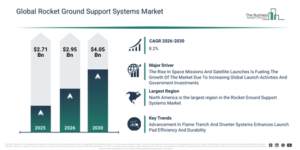
The rocket ground support systems market size has experienced strong growth in recent years. It is projected to expand from $2.71 billion in 2025 to $2.95 billion in 2026, achieving a compound annual growth rate (CAGR) of 8.9%. The market’s historical development is attributable to factors such as the rise in government space programs, which increased demand for ground infrastructure and support equipment; the creation of cryogenic handling systems supporting liquid propellant launches; the increasing utilization of thermal control systems to maintain vehicle and payload stability prior to liftoff; improvements in instrumentation systems allowing more accurate pre-launch diagnostics; and the broadening of environmental control systems to manage humidity, temperature, and air purity in launch preparation areas.
The market for rocket ground support systems is projected to experience robust expansion over the coming years. This market is anticipated to reach a valuation of $4.05 billion by 2030, exhibiting a compound annual growth rate (CAGR) of 8.2%. Several factors are expected to fuel this growth during the forecast period. These include the expansion of commercial launch activities demanding adaptable and automated ground support equipment, improvements in power supply systems that facilitate more effective and dependable launch site operations, the growing trend of reusable rockets which boosts the need for quick vehicle turnaround support, breakthroughs in digital monitoring and control platforms that improve the efficiency of ground operations, and increased investments in global spaceports which require modern and standardized ground support infrastructure. Key trends anticipated over the forecast period encompass the wider deployment of advanced cryogenic ground systems, the incorporation of modular launch platform designs, a greater utilization of high-precision environmental control systems, an increase in automated propellant loading and pressurization technologies, and the creation of improved ground safety and monitoring frameworks.
Get A Free Sample Report With In-Depth Market Insights:
Rocket Ground Support Systems Market Growth Drivers: What’s Behind The Acceleration?
The expansion of space missions and satellite deployments is projected to boost the rocket ground support systems market going forward. These operations involve sending spacecraft and satellites into orbit for diverse objectives including communication, defense, research, and commercial endeavors. A primary force behind the increase in space missions and satellite launches is the growing government investment in space programs, aiming to bolster national security and technological capabilities. Rocket ground support systems are vital for these missions and launches, offering crucial infrastructure for fueling, testing, monitoring, and environmental regulation. They ensure that rockets and payloads are prepared for launch, thereby minimizing risks and maximizing mission reliability. For instance, the Space Foundation, a US-based nonprofit organization, reported in January 2024 that global launch activity reached record levels for the third consecutive year, with 223 attempts and 212 successful launches, signaling substantial growth. Commercial launches surged by 50% compared to 2022, while the United States saw a 33% increase in launch attempts. Consequently, the heightened activity in space missions and satellite launches is driving the growth of the rocket ground support systems market.
Rocket Ground Support Systems Market Segment Outlook: Which Categories Are Growing Fastest?
The rocket ground support systems market covered in this report is segmented –
1) By Type: Mechanical Systems, Electrical Systems, Fluid Systems, Other Types
2) By Component: Launch Platforms, Ground Handling Equipment, Control Systems, Other Components
3) By Application: Commercial Space, Military, Government, Other Applications
Subsegments:
1) By Mechanical Systems: Launch Mounts And Hold-Down Mechanisms, Flame Deflectors And Trenches, Transporter-Erector Systems, Mobile Service Towers, Access Platforms And Ladders
2) By Electrical Systems: Power Distribution Units, Ground Power Units (GPUs), Control Panels And Relay Systems, Monitoring And Safety Systems, Grounding and Lightning Protection Systems
3) By Fluid Systems: Propellant Loading Systems, Pressurization And Venting Systems, Water Deluge And Cooling Systems, Pneumatic Supply Systems, Leak Detection And Containment Units
4) By Other Types: Communication And Telemetry Systems, Environmental Control Systems (ECS), Fire Detection And Suppression Systems, Navigation And Alignment Systems, Instrumentation And Data Acquisition Systems
Rocket Ground Support Systems Market Trends: What’s Defining The Industry’s Next Phase?
Leading entities within the rocket ground support systems market are prioritizing the creation of advanced solutions like automated flame trench and diverter systems to bolster launch infrastructure durability and facilitate quick launch turnarounds. An automated flame trench and diverter system represents a launch pad component specifically designed to redirect and cool rocket exhaust, utilizing water-cooled steel structures to ensure more secure and effective liftoffs. For example, in May 2025, SpaceX, a US-based commercial space firm, unveiled the Orbital Launch Mount (OLM) for Pad B at its Starbase facility. This particular system includes an enhanced flame trench featuring diverter buckets, integrated water cooling, and a reinforced mount structure. These innovations are intended to optimize heat management, safeguard ground assets, and enable faster reusability for frequent launch operations. The launch mount is engineered to support the Starship-Super Heavy system, aiming to boost pad longevity and assist rapid launch turnaround, thus marking a considerable improvement for Starbase’s second orbital launch pad.
Rocket Ground Support Systems Market Leading Companies And Competitive Benchmarking
Major companies operating in the rocket ground support systems market are Raytheon Technologies Corporation, The Boeing Company, Lockheed Martin Corporation, Airbus, General Dynamics, Northrop Grumman Corporation, Mitsubishi Heavy Industries Ltd., Thales Group, Moog Inc., ArianeGroup, United Launch Alliance (ULA), OHB SE, Kratos Defense & Security Solutions Inc., Firefly Aerospace, Redwire Corporation, Swedish Space Corporation, Unimech Aerospace Pvt. Ltd., Dedienne Aerospace SAS, ColumbusJACK/Regent, RST Rostock System-Technik GmbH
View The Full Rocket Ground Support Systems Market Report:
Rocket Ground Support Systems Market Leading Geography: Which Region Contributes The Most Revenue?
North America was the largest region in the rocket ground support systems market in 2025. Asia-Pacific is expected to be the fastest-growing region in the forecast period. The regions covered in the rocket ground support systems market report are Asia-Pacific, South East Asia, Western Europe, Eastern Europe, North America, South America, Middle East, Africa.
Reach Out To Our Team:
The Business Research Company: https://www.thebusinessresearchcompany.com/
Americas: +1 310-496-7795
Asia: +44 7882 955267 & +91 8897263534
Europe: +44 7882 955267
Email us at: marketing@tbrc.info
Follow us on:
LinkedIn: https://in.linkedin.com/company/the-business-research-company
YouTube: https://www.youtube.com/channel/UC24_fI0rV8cR5DxlCpgmyFQ
Global Market Model: https://www.thebusinessresearchcompany.com/global-market-model

Wasay has over a decade of experience in market research, data modelling, and analytics, with prior experience at GlobalData and Decision Tree Consulting Services. At The Business Research Company , he leads research operations across syndicated studies, customized consulting engagements, and the Global Market Model platform. His professional experience includes supporting organizations such as Boston Consulting Group, KPMG, and Ernst & Young. Wasay holds a degree in Electronics and Communications Engineering, postgraduate management qualifications from International Management Institute Belgium and Indian School of Business and Entrepreneurship, and completed the Integrated Program in Business Analytics from Indian Institute of Management Indore.