Backed by market attractiveness analysis, total addressable market sizing, company benchmarking matrices, interactive Excel dashboards, wider supply chain intelligence, emerging startup coverage, and detailed product-level insights, The Business Research Company’s 2026 market reports are designed to offer research that is more actionable and strategically valuable than ever.
Rocket Inertial Measurement Units Market Expansion Outlook: What Revenue Opportunities Are Ahead?
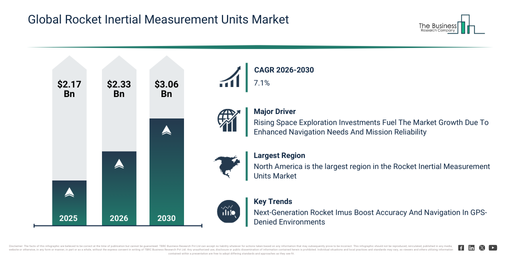
The market size for rocket inertial measurement units has shown significant expansion in recent years. It is forecast to increase from $2.17 billion in 2025 to $2.33 billion in 2026, achieving a compound annual growth rate (CAGR) of 7.4%. This historical growth can be ascribed to the rising complexity of launch trajectories, which generated early demand for high-precision IMU technologies; the advancement of ring laser gyroscope IMUs, enabling improved navigation accuracy; the incorporation of fiber optic gyroscope systems for enhanced reliability in severe environments; developments in MEMS IMU miniaturization, supporting their integration into smaller launch vehicles; and the broadening of government and defense launch programs that require independent navigation capabilities.
The market for rocket inertial measurement units is anticipated to experience substantial expansion in the coming years. This market is projected to reach a size of $3.06 billion by 2030, demonstrating a compound annual growth rate (CAGR) of 7.1%. Several factors will drive this growth during the forecast period, including the expansion of commercial launch providers, which fuels demand for IMU solutions that are both cost-efficient and scalable. Additionally, innovations in IMU fault-tolerance and redundancy are enhancing mission safety. The increasing use of reusable rockets necessitates IMU architectures that are durable and easy to recalibrate. Further contributions come from advancements in sensor fusion algorithms, which improve real-time guidance accuracy, and the proliferation of deep-space and autonomous mission profiles, which demand high-accuracy, next-generation inertial measurement systems. Key trends expected during this period involve the greater integration of radiation-hardened IMUs, the creation of ultra-high-accuracy gyroscope systems, the miniaturization of IMUs for use in small launch vehicles, refinements in thermal stabilization and drift reduction methods, and the broadening of redundant IMU architectures to ensure mission reliability.
Get A Free Sample Report With In-Depth Market Insights:
Rocket Inertial Measurement Units Market Industry Drivers: What’s Behind The Revenue Growth?
The rocket inertial measurement units market is projected for future growth, primarily driven by increasing investments in space exploration. Such investments represent funding from both public and private sources, directed towards developing technologies, infrastructure, and missions focused on exploring and utilizing outer space. The surge in space exploration investments is a result of the expanding commercial potential within space-based industries, encompassing satellite services, space tourism, and resource mining. These investments further boost the growth of rocket inertial measurement units (IMUs) by escalating the demand for precise navigation and guidance systems in advanced launch vehicles. For example, in April 2024, the World Economic Forum, a Switzerland-based non-profit organization, reported a projection for the space economy to grow from $630 billion in 2023 to $1.8 trillion by 2035, signifying an average annual growth rate of 9%. Therefore, the rising investments in space exploration are a key driver for the rocket inertial measurement units market.
Rocket Inertial Measurement Units Market Breakdown By Product Type And Application
The rocket inertial measurement units market covered in this report is segmented –
1) By Component: Accelerometers, Gyroscopes, Magnetometers, Other Components
2) By Platform: Spacecraft, Missiles, Launch Vehicles, Other Platforms
3) By Application: Navigation, Control, Stabilization
4) By End-User: Defense, Space, Commercial
Subsegments:
1) By Accelerometers: Fiber Optic Accelerometers, Piezoelectric Accelerometers
2) By Gyroscopes: Ring Laser Gyroscopes (RLG), Mems Gyroscopes, Fiber Optic Gyroscopes (FOG)
3) By Magnetometers: Fluxgate Magnetometers, Magneto-Resistive Magnetometers, Magneto-Inductive Magnetometers
4) By Other Components: Digital Signal Processors, Power Supply Modules, Data Acquisition Systems
#Rocket Inertial Measurement Units Market Growth Trends: What’s Shaping The Future Outlook?
Leading companies within the rocket inertial measurement units market are dedicating efforts to developing innovative solutions, such as navigation and guidance systems, to improve flight accuracy, enhance missile targeting, and support precision for long-range missions. Navigation and guidance systems encompass integrated technologies that ascertain a rocket’s position and trajectory, then guide it precisely toward its target or destination. For example, in April 2025, Thales Group, an aerospace company located in France, revealed a next-generation Inertial Measurement Unit (IMU) engineered to deliver resilient navigation in situations where GPS signals could be disrupted by jamming or spoofing. This advanced design incorporates Thales’s cutting-edge sensors, including a three-axis Ring Laser Gyroscope (RLG) and three digital MEMS accelerometers, into a compact, lightweight unit. The application of MEMS technology allows for scalable serial production, facilitating quick increases in manufacturing capacity.
Rocket Inertial Measurement Units Market Company Landscape And Competitive Strategy
Major companies operating in the rocket inertial measurement units market are Airbus SE, Northrop Grumman Corporation, Honeywell International Inc., GE Aerospace, Rockwell Collins, Safran S.A., Thales Group, L3Harris Technologies Inc., Analog Devices, Israel Aerospace Industries Ltd, Moog Inc., Kearfott Corporation, KVH Industries Inc., EMCORE Corporation, Advanced Navigation, SBG systems, IMAR Navigation GmbH, VectorNav Technologies, Gladiator Technologies, Japan Aviation Electronics Industries, Inertial Labs Inc.
View The Full Rocket Inertial Measurement Units Market Report:
Rocket Inertial Measurement Units Market Geographic Analysis: Where Is Demand Accelerating Fastest?
North America was the largest region in the rocket inertial measurement units market in 2025. The regions covered in the rocket inertial measurement units market report are Asia-Pacific, South East Asia, Western Europe, Eastern Europe, North America, South America, Middle East, Africa.
Reach Out To Our Team:
The Business Research Company: https://www.thebusinessresearchcompany.com/
Americas: +1 310-496-7795
Asia: +44 7882 955267 & +91 8897263534
Europe: +44 7882 955267
Email us at: marketing@tbrc.info
Follow us on:
LinkedIn: https://in.linkedin.com/company/the-business-research-company
YouTube: https://www.youtube.com/channel/UC24_fI0rV8cR5DxlCpgmyFQ
Global Market Model: https://www.thebusinessresearchcompany.com/global-market-model

Wasay has over a decade of experience in market research, data modelling, and analytics, with prior experience at GlobalData and Decision Tree Consulting Services. At The Business Research Company , he leads research operations across syndicated studies, customized consulting engagements, and the Global Market Model platform. His professional experience includes supporting organizations such as Boston Consulting Group, KPMG, and Ernst & Young. Wasay holds a degree in Electronics and Communications Engineering, postgraduate management qualifications from International Management Institute Belgium and Indian School of Business and Entrepreneurship, and completed the Integrated Program in Business Analytics from Indian Institute of Management Indore.