Featuring market attractiveness scoring, total addressable market sizing, company benchmarking matrices, interactive Excel dashboards, deeper supply chain intelligence, emerging startup tracking, and granular product-level insights, The Business Research Company’s 2026 market reports are built to deliver research that is both more actionable and more strategically valuable.
Rocket Launch Failure Analysis Market Revenue Growth On Track For A 9.9% CAGR Through 2030
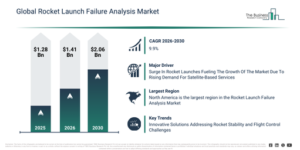
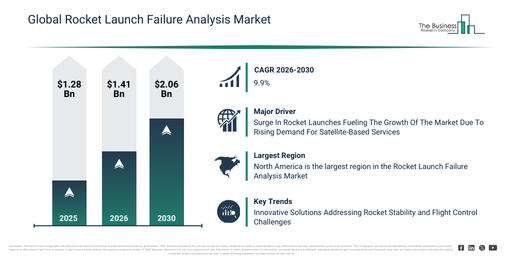
The rocket launch failure analysis market has witnessed substantial growth over recent years. This market is projected to expand from $1.28 billion in 2025 to $1.41 billion in 2026, exhibiting a compound annual growth rate (CAGR) of 10.2%. The expansion observed historically can be attributed to several factors, including the rising intricacy of launch vehicles, which spurred initial demand for organized failure analysis support. Also contributing were the creation of telemetry data analyzers, enabling thorough post-launch diagnoses. Furthermore, the implementation of fault tree analysis and FMEA methodologies helped in systematically pinpointing failure locations. Technological leaps in high-speed imaging systems also enhanced real-time detection of anomalies. Finally, the broadening scope of both governmental and commercial launch initiatives necessitated stringent root cause examinations.
The rocket launch failure analysis market size is anticipated to demonstrate robust expansion over the forthcoming years. This market is projected to attain a valuation of $2.06 billion by 2030, growing at a compound annual growth rate (CAGR) of 9.9%. This expansion during the forecast period can be attributed to several factors: the escalating launch cadence, which increases the demand for quick and automated failure analysis solutions; advancements in AI-driven simulation platforms, enhancing predictive diagnostics capabilities; the growing adoption of structural health monitoring tools, improving the accuracy of anomaly detection; the expansion of reusable rockets, necessitating continuous evaluation of component fatigue and failure modes; and heightened regulatory scrutiny, driving the need for comprehensive and standardized failure analysis services. Prominent trends expected during this period include a greater utilization of advanced telemetry data processing frameworks, the growth of high-fidelity failure modeling and simulation capabilities, an increasing uptake of multidisciplinary root cause investigation methodologies, the expansion of dedicated infrastructure for launch failure diagnostics, and the enhanced integration of structural health monitoring into launch operations.
Get A Free Sample Report With In-Depth Market Insights:
Rocket Launch Failure Analysis Market Growth Catalysts And Demand Drivers
The increasing frequency of rocket launches is projected to stimulate expansion in the rocket launch failure analysis market in the coming period. Rocket launches involve the intentional propulsion of rockets into space, primarily for purposes such as satellite deployment, scientific exploration, or aiding defense initiatives. This increase in launches is largely due to the growing worldwide need for internet delivered via satellite, which leads to the deployment of extensive satellite constellations by both governmental and commercial entities. Analyzing rocket launch failures improves the dependability of subsequent launches by identifying the fundamental reasons behind prior mishaps. This process allows engineers to resolve technical problems and avert identical mistakes, thereby mitigating the chance of future mission complications. For example, in January 2024, as reported by The Space Foundation, a U.S.-based organization, worldwide rocket launch activity hit record levels for the third consecutive year, recording 223 launch attempts and 212 successful launches in 2023. Furthermore, commercial launch operations increased by 50% from 2022, and over 2,800 satellites were placed into orbit, marking a 23% rise when contrasted with 2022. Consequently, the escalating volume of rocket launches is fueling the expansion of the rocket launch failure analysis market.
Rocket Launch Failure Analysis Market Segmentation: How Does The Market Break Down By Category?
The rocket launch failure analysis market covered in this report is segmented –
1) By Component: Software, Hardware, Services
2) By Failure Type: Structural Failures, Propulsion Failures, Guidance System Failures, Other Failure Types
3) By End-User: Government, Commercial, Defense, Research Organizations
Subsegments:
1) By Software: Simulation Software, Diagnostic Software, Data Analytics Tools, Predictive Maintenance Software, Telemetry Analysis Software
2) By Hardware: Sensors, Control Systems, Telemetry Units, Flight Data Recorders, Ground Monitoring Equipment
3) By Services: Failure Investigation Services, Maintenance And Support Services, Launch Monitoring Services, Consulting And Training Services, Post-Launch Analysis Services
Rocket Launch Failure Analysis Market Trends Shaping Long-Term Demand
Leading companies in the Rocket Launch Failure Analysis market are concentrating on creating innovative solutions, such as those related to attitude control failure, to boost rocket stability, refine flight trajectory accuracy, and avert crucial mission losses. Attitude control failure describes the loss or faulty operation of a rocket’s capacity to uphold its intended orientation or direction during flight, resulting in instability or a departure from its planned trajectory. For instance, in October 2023, Galactic Energy, a private rocket enterprise based in China, finalized its internal inquiry into a recent launch mishap. The investigation determined that the failure resulted from unusual ablation in the first-stage rocket nozzle, attributed to improper manufacturing defects within the carbon fiber layer, which subsequently led to a loss of attitude control. This represented the company’s inaugural failure after nine successful orbital attempts, and corrective actions have since been implemented to resolve the issue and bolster reliability.
Rocket Launch Failure Analysis Market Competitive Overview And Top Companies
Major companies operating in the rocket launch failure analysis market are Lockheed Martin Corporation, Airbus, Northrop Grumman Corporation, The National Aeronautics and Space Administration, SpaceX, KBR Inc., Blue Origin LLC, United Launch Alliance (ULA), Sierra Space, Rocket Lab, Firefly Aerospace, Swedish Space Corporation, Roscosmos, Isar Aerospace, Seradata, Ulyssix Technologies, Teal Group Corporation, Qualtech Systems Inc., Collier Aerospace, European Space Agency
View The Full Rocket Launch Failure Analysis Market Report:
Rocket Launch Failure Analysis Market Largest Region: Which Geography Holds The Highest Market Share?
North America was the largest region in the rocket launch failure analysis market in 2025. Asia-Pacific is expected to be the fastest-growing region in the forecast period. The regions covered in the rocket launch failure analysis market report are Asia-Pacific, South East Asia, Western Europe, Eastern Europe, North America, South America, Middle East, Africa.
Reach Out To Our Team:
The Business Research Company: https://www.thebusinessresearchcompany.com/
Americas: +1 310-496-7795
Asia: +44 7882 955267 & +91 8897263534
Europe: +44 7882 955267
Email us at: marketing@tbrc.info
Follow us on:
LinkedIn: https://in.linkedin.com/company/the-business-research-company
YouTube: https://www.youtube.com/channel/UC24_fI0rV8cR5DxlCpgmyFQ
Global Market Model: https://www.thebusinessresearchcompany.com/global-market-model

Wasay has over a decade of experience in market research, data modelling, and analytics, with prior experience at GlobalData and Decision Tree Consulting Services. At The Business Research Company , he leads research operations across syndicated studies, customized consulting engagements, and the Global Market Model platform. His professional experience includes supporting organizations such as Boston Consulting Group, KPMG, and Ernst & Young. Wasay holds a degree in Electronics and Communications Engineering, postgraduate management qualifications from International Management Institute Belgium and Indian School of Business and Entrepreneurship, and completed the Integrated Program in Business Analytics from Indian Institute of Management Indore.