Featuring market attractiveness scoring, total addressable market sizing, company benchmarking matrices, interactive Excel dashboards, deeper supply chain intelligence, emerging startup tracking, and granular product-level insights, The Business Research Company’s 2026 market reports are built to deliver research that is both more actionable and more strategically valuable.
Satellite Services Market Growth Potential: How Will Market Size Shift Through 2030?
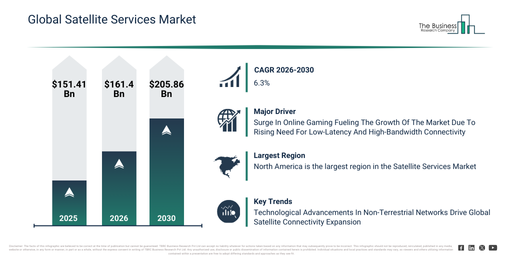
The satellite services market has demonstrated significant expansion in recent years. Its value is expected to rise from $151.41 billion in 2025 to $161.4 billion in 2026, reflecting a compound annual growth rate (CAGR) of 6.6%. This historical growth can be attributed to a number of factors, including the increasing reliance on satellite broadcasting and communication for global media distribution, the growth of the maritime and aviation sectors driving demand for satellite-based connectivity, advancements in satellite imaging capabilities for sophisticated mapping and weather analysis, the rising adoption of satellite navigation systems to support transportation and logistics, and the expanded deployment of geostationary satellites to provide wide-area communication coverage.
The satellite services market is anticipated to experience substantial growth over the coming years. It is projected to achieve a size of $205.86 billion by 2030, growing at a compound annual growth rate (CAGR) of 6.3%. The expansion during this forecast period is attributable to several factors: the swift development of high-throughput satellites enhancing capacity for communication and data services; the proliferation of LEO constellations improving latency and accessibility for global internet services; an escalating demand for real-time earth observation data across defense, agriculture, and environmental sectors; the integration of satellite services with 5G networks, enabling hybrid connectivity solutions; and an increasing requirement for resilient communication infrastructure, driving the adoption of satellite services for disaster response and continuity operations. Prominent trends expected in this timeframe include the expansion of satellite-based mobility services, the rising embrace of cloud-enabled satellite operations, a heightened demand for high-resolution satellite imaging, the extension of satellite broadband into remote regions, and the growing integration of satellite services in aviation and maritime communication.
Get A Free Sample Report With In-Depth Market Insights:
Satellite Services Market Expansion Drivers: What’s Shaping Future Growth?
The escalating need for high-speed internet and global connectivity is projected to fuel the expansion of the satellite services market. This refers to swift and widespread access to digital networks, enabling seamless communication, data transfer, and online services globally. The increasing requirement for high-speed internet and global connectivity arises from a growing dependence on digital platforms for work, education, and communication. This shift has made uninterrupted and fast internet access indispensable for daily activities and economic productivity. Satellite services deliver high-speed internet and global connectivity by utilizing orbiting satellites to wirelessly transmit data between ground stations and user terminals, effectively bypassing terrestrial infrastructure. For instance, in November 2024, Telefonaktiebolaget LM Ericsson, a Sweden-based telecommunications company, reported that by 2030, global 5G subscriptions are expected to reach approximately 6.3 billion, constituting 67% of all mobile subscriptions worldwide. Therefore, the rising demand for high-speed internet and global connectivity is a primary impetus for the growth of the satellite services market.
Satellite Services Market Segmentation And Category Overview
The satellite services market covered in this report is segmented –
1) By Type: Consumer Services, Fixed Satellite Services, Mobile Satellite Services, Earth Observation Services
2) By Deployment Type: Public Cloud, Private Cloud, Hybrid Cloud
3) By End-User: Media And Entertainment, Government, Aviation, Defense, Aerospace, Retail And Enterprise, Other End-Users
Subsegments:
1) By Consumer Services: Satellite Television, Satellite Radio, Direct-To-Home Services, Broadband Internet Services, Voice Communication Services
2) By Fixed Satellite Services: Telephony, Television Broadcasting, Data Communication, Internet Backbone Connectivity, Backhaul Services
3) By Mobile Satellite Services: Voice Services, Messaging Services, Mobile Data Services, Emergency Communication, GPS Navigation Support
4) By Earth Observation Services: Weather Monitoring, Environmental Monitoring, Agricultural Data Services, Disaster Management, Land And Resource Mapping
Satellite Services Market Strategic Trends: What Defines The Next Growth Phase?
Major companies operating in the satellite services market are concentrating on developing technological advancements, notably non-terrestrial networks, to enhance global connectivity, enable seamless integration with terrestrial 5G networks, and expand communication coverage in remote or underserved regions. A non-terrestrial network (NTN) is defined as a communication network that employs space-based or aerial platforms such as satellites, high-altitude platforms, or unmanned aerial vehicles to provide wireless connectivity extending beyond the reach of traditional terrestrial networks. For instance, in November 2023, Viasat, a US-based communication company, partnered with Skylo Technologies, a US-based satellite company, to launch the world’s first global direct-to-device (D2D) network, enabling seamless satellite connectivity for standard mobile devices worldwide. This offers significant advantages, including universal connectivity, especially in remote areas, and supports critical sectors such as logistics, agriculture, and defense. It also enhances emergency response capabilities by providing reliable satellite communication during disasters when terrestrial networks are down. Overall, its purpose is to bridge connectivity gaps worldwide, enabling seamless data exchange between satellites and devices, regardless of location.
Satellite Services Market Competitive Analysis Of Leading Industry Participants
Major companies operating in the satellite services market are The Boeing Company, General Dynamics Mission Systems Inc., EchoStar Corporation, ViaSat Inc., Tata Communications, SES S.A., Eutelsat Communications S.A., Airbus Defence and Space, Iridium Communications Inc., Comtech PST Corp., China Satellite Communications Co. Ltd., Gilat Satellite Networks Ltd., Asia Satellite Telecommunications Company Limited, APT Satellite Holdings Limited (Apstar), Campbell Scientific Inc., Fleet Space Technologies Pty Ltd, Digisat International Inc., Antrix Corporation Limited, Blue Sky Network LLC, SKY Perfect JSAT Holdings Inc.
View The Full Satellite Services Market Report:
Satellite Services Market Geographic Landscape: Which Region Dominates Industry Growth?
North America was the largest region in the satellite services market in 2025. Asia-Pacific is expected to be the fastest-growing region in the forecast period. The regions covered in the satellite services market report are Asia-Pacific, South East Asia, Western Europe, Eastern Europe, North America, South America, Middle East, Africa.
Reach Out To Our Team:
The Business Research Company: https://www.thebusinessresearchcompany.com/
Americas: +1 310-496-7795
Asia: +44 7882 955267 & +91 8897263534
Europe: +44 7882 955267
Email us at: marketing@tbrc.info
Follow us on:
LinkedIn: https://in.linkedin.com/company/the-business-research-company
YouTube: https://www.youtube.com/channel/UC24_fI0rV8cR5DxlCpgmyFQ
Global Market Model: https://www.thebusinessresearchcompany.com/global-market-model

Wasay has over a decade of experience in market research, data modelling, and analytics, with prior experience at GlobalData and Decision Tree Consulting Services. At The Business Research Company , he leads research operations across syndicated studies, customized consulting engagements, and the Global Market Model platform. His professional experience includes supporting organizations such as Boston Consulting Group, KPMG, and Ernst & Young. Wasay holds a degree in Electronics and Communications Engineering, postgraduate management qualifications from International Management Institute Belgium and Indian School of Business and Entrepreneurship, and completed the Integrated Program in Business Analytics from Indian Institute of Management Indore.