Backed by market attractiveness analysis, total addressable market sizing, company benchmarking matrices, interactive Excel dashboards, wider supply chain intelligence, emerging startup coverage, and detailed product-level insights, The Business Research Company’s 2026 market reports are designed to offer research that is more actionable and strategically valuable than ever.
Ship Bridge Simulators Market Growth From $2.39 Billion In 2026 To $2.92 Billion By 2030 At A CAGR Of 5.1%
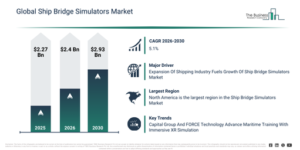
The ship bridge simulators market has shown robust growth recently. This sector is projected to expand from $2.27 billion in 2025 to $2.4 billion in 2026, achieving a compound annual growth rate (CAGR) of 5.5%. Historically, this growth has been fueled by the early adoption of simulation-based maritime training, advancements in radar and navigation display technologies, the expansion of global shipping and naval operations, regulatory demands for certified maritime training, and the integration of integrated control panels within training systems.
The ship bridge simulators market is anticipated to experience substantial expansion over the next few years. Its valuation is projected to climb to $2.93 billion by 2030, demonstrating a compound annual growth rate (CAGR) of 5.1%. This growth during the forecast period is attributed to the increasing demand for virtual and immersive simulation technologies, the adoption of AI-driven scenario generation and predictive training, the expansion of remote and cloud-based simulator access, a rising focus on safety and operational efficiency in maritime operations, and the development of next-generation multi-sensor and full-bridge simulator systems. Prominent trends expected in this period include the increasing adoption of full mission and part task simulators for maritime training, a growing demand for VR-based and dynamic positioning simulators, the integration of advanced radar and navigation displays within simulators, the expansion of simulation-based professional and constructive training programs, and the rising use of simulators by maritime academies and large-scale shipping organizations.
Get A Free Sample Report With In-Depth Market Insights:
Ship Bridge Simulators Market Growth Drivers: What’s Behind The Acceleration?
The forward growth of the ship bridge simulators market is anticipated to be driven by the expanding shipping industry. Maritime transport, also known as the shipping industry, functions as a worldwide system for conveying goods and raw materials via sea. This industry’s growth stems from its role in enabling global trade and commerce through the efficient and economical movement of substantial volumes of products and raw materials across marine routes. Ship bridge simulators improve safety, operational efficiency, and skill enhancement within the shipping industry by offering lifelike training settings where navigation, emergency protocols, and standard procedures can be practiced without the inherent dangers of actual situations. As an illustration, the U.S Naval Institute, a US-based non-profit organization, reported in March 2025 that the worldwide shipbuilding sector secured contracts totaling approximately $188 billion during the first 11 months of 2024. This represents a substantial increase when contrasted with the average value of $90 billion from a decade prior. Furthermore, a record 530 new container ships commenced operations in 2024, which is a considerable jump from 350 new ships in 2023, indicating heightened investment in expanding fleets, even amidst operational challenges. Consequently, the burgeoning shipping industry is acting as a catalyst for the expansion of the ship bridge simulator market.
Ship Bridge Simulators Market Segment Trends And Revenue Contributors
The ship bridge simulators market covered in this report is segmented –
1) By Type: Interactive Ship Bridge Simulators, Non-Interactive Ship Bridge Simulators
2) By Solution Type: Live Training, Professional Training, Constructive Training, Virtual Training, System Training, Game Simulation Training
3) By Organization Size: Large Scale Organizations, Medium Scale Organizations, Small Scale Organizations
4) By End-Use: Marine, Educational
Subsegments:
1) By Interactive Ship Bridge Simulators: Full Mission Simulators (FMS), Part Task Simulators (PTS), Virtual Reality-based Simulators, Dynamic Positioning Simulators
2) By Non-Interactive Ship Bridge Simulators: Fixed Ship Bridge Simulators, Non-Dynamic Simulators, Basic Training Simulators
Ship Bridge Simulators Market Trends: What’s Defining The Industry’s Next Phase?
Leading companies within the ship bridge simulator market are concentrating on creating immersive technologies, specifically extended reality (XR) full mission bridge simulation, to improve maritime training, bolster navigation safety, and encourage sustainable practices. This XR full mission bridge simulation merges virtual, augmented, and mixed reality environments with authentic vessel equipment, offering seafarers realistic, interactive, and high-fidelity training experiences. For example, in January 2025, Capital Group, a US-based management services company, joined forces with FORCE Technology, a Denmark-based simulation technology company, to unveil Europe’s initial extended reality (XR) full mission bridge simulator, signifying a substantial progression in maritime training technology. This system enhances safety, operational decision-making, and teamwork, while also facilitating remote multi-user collaboration, reducing costs, and decreasing the carbon footprint. Developed for seafarer training in Greece, it transforms maritime education through its focus on realism, efficiency, and sustainability.
Ship Bridge Simulators Market Competitive Landscape: Which Companies Lead The Industry?
Major companies operating in the ship bridge simulators market are General Dynamics Information Technology Inc., Rheinmetall Defence Electronics GmbH, Wärtsilä Corporation, Kongsberg Gruppen, FORCE Technology, Synergy Marine Group, ARI Simulation, Adacel Technologies Limited, Aboa Mare AB, ST Engineering Antycip, ARI (Applied Research International), Virtual Marine Inc., SeaSkills Maritime Academy, PC Maritime Ltd, VSTEP BV, Image Soft Inc., Cal-Tek Srl, Japan Marine Science Inc., SSPA Sweden AB, Pivot Maritime International, Simwave B.V., AMC Search Ltd., Coral Nautical Ventures LLP, NAUDEQ, Presagis Canada Inc, SIPORT XXI SL
View The Full Ship Bridge Simulators Market Report:
Ship Bridge Simulators Market Geographic Distribution And Regional Opportunities
North America was the largest region in the ship bridge simulators market in 2025. The regions covered in the ship bridge simulators market report are Asia-Pacific, South East Asia, Western Europe, Eastern Europe, North America, South America, Middle East, Africa.
Reach Out To Our Team:
The Business Research Company: https://www.thebusinessresearchcompany.com/
Americas: +1 310-496-7795
Asia: +44 7882 955267 & +91 8897263534
Europe: +44 7882 955267
Email us at: marketing@tbrc.info
Follow us on:
LinkedIn: https://in.linkedin.com/company/the-business-research-company
YouTube: https://www.youtube.com/channel/UC24_fI0rV8cR5DxlCpgmyFQ
Global Market Model: https://www.thebusinessresearchcompany.com/global-market-model

Wasay has over a decade of experience in market research, data modelling, and analytics, with prior experience at GlobalData and Decision Tree Consulting Services. At The Business Research Company , he leads research operations across syndicated studies, customized consulting engagements, and the Global Market Model platform. His professional experience includes supporting organizations such as Boston Consulting Group, KPMG, and Ernst & Young. Wasay holds a degree in Electronics and Communications Engineering, postgraduate management qualifications from International Management Institute Belgium and Indian School of Business and Entrepreneurship, and completed the Integrated Program in Business Analytics from Indian Institute of Management Indore.