Built to provide research that’s more actionable and strategically valuable, The Business Research Company’s 2026 market reports include market attractiveness analysis, total addressable market sizing, company benchmarking matrices, interactive Excel dashboards, broader supply chain intelligence, emerging startup tracking, and in-depth product insights.
Military Cybersecurity Market Set To Climb From $16.27 Billion In 2026 To $22.3 Billion By 2030
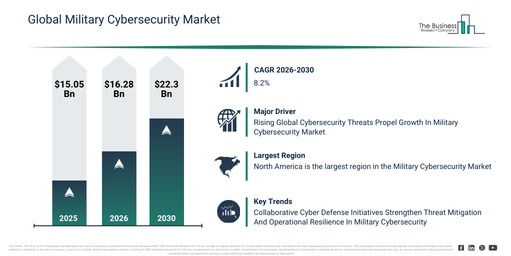
The military cybersecurity market size has experienced strong growth in recent years. It is anticipated to increase from $15.05 billion in 2025 to $16.28 billion in 2026, exhibiting a compound annual growth rate (CAGR) of 8.2%. The expansion observed in the past can be attributed to a higher incidence of cyberattacks targeting military networks and command-and-control systems, the proliferation of net-centric warfare increasing reliance on safeguarded digital infrastructure, the adoption of antivirus software and backup solutions to secure mission-critical data, the integration of multi-factor authentication across defense systems to minimize unauthorized access, and the increased deployment of secure storage devices and DSP modules to strengthen military platforms.
The military cybersecurity market is projected to experience substantial expansion in the coming years. This market is forecast to reach $22.3 billion by 2030, demonstrating a compound annual growth rate (CAGR) of 8.2%. This anticipated growth is driven by several factors, including greater investment in sophisticated threat detection and response platforms tailored for military networks, the increasing integration of AI- and ML-powered cyber defense systems to combat advanced attacks, the broadening of secure communication technologies for unmanned aerial vehicles and autonomous defense assets, the establishment of zero-trust architectures throughout military information systems, and expanding defense budgets that support the modernization of comprehensive military cybersecurity capabilities. Key trends anticipated during this period encompass the wider deployment of military-grade multifactor authentication, a surge in the utilization of secure storage and data protection devices, an increase in uav-based cyber surveillance capabilities, the enlargement of military network intrusion detection systems, and a greater embrace of digital signal processor modules for enhanced cyber defense.
Get A Free Sample Report With In-Depth Market Insights:
Military Cybersecurity Market Demand Drivers Opening New Revenue Streams
The expansion of the military cybersecurity market is projected to be fueled by a rising frequency of cyberattacks. A cyberattack constitutes an unlawful endeavor to gain entry to a computer system or network with the intent to inflict harm. Such attacks are capable of data theft, intentional machine incapacitation, or leveraging a compromised computer for subsequent offensive actions. It is imperative for the military to possess robust information security to preserve the operational integrity. Military cybersecurity is vital for thwarting assaults on social networks and securing data, networks, net-centric functionalities, and other specified systems. For example, in April 2024, findings from the U.S.-based investigation by the Federal Bureau of Investigation’s Internet Crime Complaint Center (IC3) indicated that the 2024 Internet Crime Report amalgamated data from 859,532 complaints of suspected Internet crime, revealing reported losses surpassing $16 billion, marking a 33% surge in losses compared to 2023. Among all states, Texas was ranked 2 in terms of the volume of public complaints received. Residents in Texas declared losses amounting to $1.35 billion, an increase of $328 million from the previous year. Consequently, the escalating number of cyberattacks is a primary catalyst for the growth observed in the military cybersecurity market.
Military Cybersecurity Market Segmentation And Category Overview
The military cybersecurity market covered in this report is segmented –
1) By Type: Defensive Cybersecurity, Offensive Cybersecurity
2) By Platform: Hardware, Service, Software
3) By Security Type: Network Security, Cyber Threat Intelligence, IT Infrastructure, Logistics And Operation Security, Training Services
Subsegments:
1) By Defensive Cybersecurity: Network Security Solutions, Endpoint Security, Data Protection and Encryption, Intrusion Detection and Prevention Systems (IDPS), Security Information and Event Management (SIEM)
2) By Offensive Cybersecurity: Penetration Testing, Red Teaming, Cyber Warfare Tools, Threat Intelligence and Analysis, Vulnerability Assessment and Exploitation Tools
Military Cybersecurity Market Trends Powering Strategic Industry Growth
Leading companies active in the military cybersecurity market, along with defense alliances and security organizations, are prioritizing the development of advanced initiatives, such as integrated cyber defense centers, to improve information sharing, enhance cyber readiness, and safeguard critical networks. Integrated cyber defense centers are defined as collaborative cybersecurity hubs that consolidate threat intelligence, capability development, incident response, and defense planning across participating military entities to strengthen protection against evolving cyberattacks. For example, in July 2024, NATO, a military alliance consisting of 30 countries across Europe and North America, announced its preparedness to launch a novel integrated cyber defense center at the coalition’s military headquarters in Mons, Belgium. This initiative, intended to facilitate cooperative information exchange, capability building, and synchronized cyber defense strategies, aims to bolster collective resilience and protect allied military infrastructure from sophisticated cyber threats.
Military Cybersecurity Market Competitive Analysis Of Leading Industry Participants
Major companies operating in the military cybersecurity market are Airbus SE, Raytheon Technologies Company, Lockheed Martin Corporation, International Business Machines Corporation, Cisco Systems Inc., Northrop Grumman Corporation, BAE Systems plc, Thales Group, Leidos Holdings, Inc., General Dynamics Mission Systems Inc., Booz Allen Hamilton Inc., Science Applications International Corporation, ST Engineering Ltd., Israel Aerospace Industries Ltd., Perspecta Inc., ManTech International Corporation, CACI International Inc., Check Point Software Technologies Ltd., Palantir Technologies Inc., QinetiQ Group plc, FireEye Inc., Salient CRGT
View The Full Military Cybersecurity Market Report:
Military Cybersecurity Market Regional Analysis And Leading Geography
North America was the largest region in the military cybersecurity market in 2025. It is expected to be the fastest-growing region in the global military cybersecurity market size forecast period. The regions covered in the military cybersecurity market report are Asia-Pacific, South East Asia, Western Europe, Eastern Europe, North America, South America, Middle East, Africa.
Reach Out To Our Team:
The Business Research Company: https://www.thebusinessresearchcompany.com/
Americas: +1 310-496-7795
Asia: +44 7882 955267 & +91 8897263534
Europe: +44 7882 955267
Email us at: marketing@tbrc.info
Follow us on:
LinkedIn: https://in.linkedin.com/company/the-business-research-company
YouTube: https://www.youtube.com/channel/UC24_fI0rV8cR5DxlCpgmyFQ
Global Market Model: https://www.thebusinessresearchcompany.com/global-market-model

Wasay has over a decade of experience in market research, data modelling, and analytics, with prior experience at GlobalData and Decision Tree Consulting Services. At The Business Research Company , he leads research operations across syndicated studies, customized consulting engagements, and the Global Market Model platform. His professional experience includes supporting organizations such as Boston Consulting Group, KPMG, and Ernst & Young. Wasay holds a degree in Electronics and Communications Engineering, postgraduate management qualifications from International Management Institute Belgium and Indian School of Business and Entrepreneurship, and completed the Integrated Program in Business Analytics from Indian Institute of Management Indore.