Featuring market attractiveness scoring, total addressable market sizing, company benchmarking matrices, interactive Excel dashboards, deeper supply chain intelligence, emerging startup tracking, and granular product-level insights, The Business Research Company’s 2026 market reports are built to deliver research that is both more actionable and more strategically valuable.
Orbital Transport Services Market Forecast: What Value Will The Market Reach By 2030?
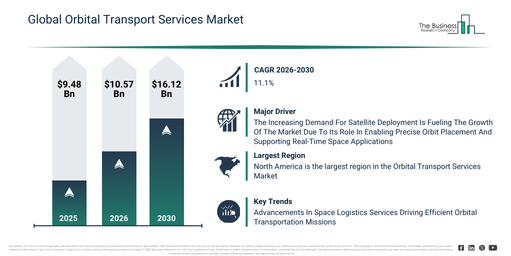
The orbital transport services market has demonstrated substantial growth in recent years. Its valuation is anticipated to climb from $9.48 billion in 2025 to $10.57 billion in 2026, achieving a compound annual growth rate (CAGR) of 11.5%. The expansion witnessed historically is attributable to an increase in government-led satellite deployment programs, a surge in demand for geostationary satellite repositioning services, the early implementation of in-orbit servicing technologies for life-extension missions, the broadened scope of crew and cargo transportation to space stations, and the growing number of commercial satellite constellations requiring orbital transfer support.
The orbital transport services market is poised for significant expansion over the coming years, projected to reach $16.12 billion by 2030, exhibiting a robust compound annual growth rate (CAGR) of 11.1%. This anticipated growth during the forecast period can be primarily attributed to several factors, including the swift increase in mega-constellation deployments necessitating frequent orbital transfers, the rising commercial application of in-orbit servicing and debris removal technologies, improvements in autonomous orbital maneuvering vehicles that enhance operational efficiency, the expansion of commercial space station initiatives leading to greater demand for cargo and crew transport, and the reduced costs of reusable orbital transport systems making the market more accessible. Key trends expected during this period involve an increasing call for in-orbit servicing and missions to extend satellite lifespans, the broadening of commercial cargo resupply operations to Low Earth Orbit (LEO) and lunar destinations, a surge in the use of rideshare launch services by small satellite operators, heightened investment in technologies for orbital debris removal, and the development of logistics and tourism support services for private space stations.
Get A Free Sample Report With In-Depth Market Insights:
Orbital Transport Services Market Growth Catalysts And Demand Drivers
The rising demand for satellite deployment is projected to fuel the expansion of the orbital transport services market moving forward. Satellite deployment entails the process of launching and positioning satellites into specific orbits for various space-based applications. This deployment is motivated by the growing requirement for real-time data, which assists governments and businesses in making faster and more accurate decisions for their communication, weather, and security needs. Orbital transport services enable satellite deployment by conveying satellites to their target orbits using either launch vehicles or orbital transfer systems. These services ensure accurate placement, minimize risks, and support efficient multi-satellite missions. For instance, in July 2023, according to Pixalytics Ltd., a UK-based earth observation company, 11,330 individual satellites were orbiting the Earth at the end of June 2023, representing a substantial 37.94% increase since January 2022. Therefore, the escalating demand for satellite deployment is driving the growth of the orbital transport services market.
Orbital Transport Services Market Breakdown By Product Type And Application
The orbital transport services market covered in this report is segmented –
1) By Service Type: Satellite Deployment, Cargo Resupply, Space Tourism, Other Service Types
2) By Vehicle Type: Reusable Launch Vehicles, Expendable Launch Vehicles
3) By End-User: Commercial, Government, Defense, Other End-Users
Subsegments:
1) By Satellite Deployment: Small Satellite Launch, Medium Satellite Launch, Heavy Satellite Launch, Rideshare Missions, Dedicated Launch Services
2) By Cargo Resupply: International Space Station (ISS) Resupply, Lunar Gateway Resupply, Deep Space Resupply Missions, Pressurized Cargo Transport, Unpressurized Cargo Transport
3) By Space Tourism: Orbital Flights, Lunar Flybys, Private Space Station Visits, Zero-Gravity Experience Packages
4) By Other Service Types: Space Debris Removal, Satellite Servicing, In-Orbit Manufacturing Support, Space Tug Services, Orbital Refueling Stations
Orbital Transport Services Market Trends Shaping Long-Term Demand
Leading companies in the orbital transport services market are prioritizing the development of advanced solutions, such as space logistics services, to efficiently and cost-effectively support extensive space infrastructure initiatives. Space logistics services encompass the transportation and coordination of cargo, equipment, and resources for diverse space missions. These services are crucial for satellite launches, in-orbit operations, and resupply activities, contributing to efficient and successful mission execution. For example, in June 2023, D-Orbit, an Italy-based enterprise specializing in space logistics and orbital transportation, announced “Above the Sky,” its 11th orbital transportation mission. This mission departed from Vandenberg Space Force Base aboard a Falcon 9 rocket and successfully deployed the ION Satellite Carrier into a 525 km Sun-synchronous orbit, marking another significant achievement in the company’s rapid expansion of reliable space logistics services.
Orbital Transport Services Market Company Landscape And Competitive Strategy
Major companies operating in the orbital transport services market are Lockheed Martin Corporation, Northrop Grumman Corporation, Space Exploration Technologies Corp, Airbus Defence and Space, Blue Origin, ArianeGroup, United Launch Alliance, Thales Alenia Space, Indian Space Research Organisation (ISRO), OHB SE, Sierra Nevada Corporation (SNC), Relativity Space Inc, Firefly Aerospace, Arianespace, PLD Space, Avio S.p.A, D-Orbit, Orbex Group, Skyrora Ltd, Absolut System, InfinAstro
View The Full Orbital Transport Services Market Report:
Orbital Transport Services Market Leading Geography: Which Region Contributes The Most Revenue?
North America was the largest region in the orbital transport services market in 2025. Asia-Pacific is expected to be the fastest-growing region in the forecast period. The regions covered in the orbital transport services market report are Asia-Pacific, South East Asia, Western Europe, Eastern Europe, North America, South America, Middle East, Africa.
Reach Out To Our Team:
The Business Research Company: https://www.thebusinessresearchcompany.com/
Americas: +1 310-496-7795
Asia: +44 7882 955267 & +91 8897263534
Europe: +44 7882 955267
Email us at: marketing@tbrc.info
Follow us on:
LinkedIn: https://in.linkedin.com/company/the-business-research-company
YouTube: https://www.youtube.com/channel/UC24_fI0rV8cR5DxlCpgmyFQ
Global Market Model: https://www.thebusinessresearchcompany.com/global-market-model

Wasay has over a decade of experience in market research, data modelling, and analytics, with prior experience at GlobalData and Decision Tree Consulting Services. At The Business Research Company , he leads research operations across syndicated studies, customized consulting engagements, and the Global Market Model platform. His professional experience includes supporting organizations such as Boston Consulting Group, KPMG, and Ernst & Young. Wasay holds a degree in Electronics and Communications Engineering, postgraduate management qualifications from International Management Institute Belgium and Indian School of Business and Entrepreneurship, and completed the Integrated Program in Business Analytics from Indian Institute of Management Indore.