Featuring market attractiveness scoring, total addressable market sizing, company benchmarking matrices, interactive Excel dashboards, deeper supply chain intelligence, emerging startup tracking, and granular product-level insights, The Business Research Company’s 2026 market reports are built to deliver research that is both more actionable and more strategically valuable.
Hybrid Electric Aircrafts Market Size Outlook: How Quickly Will Revenue Expand Through 2030?
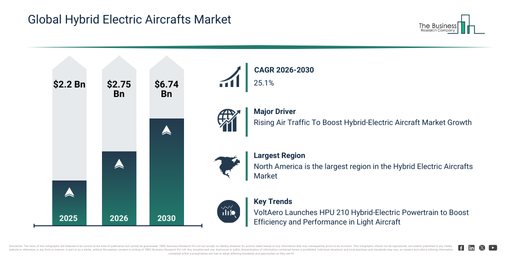
The scale of the hybrid electric aircrafts market has expanded significantly over recent years. This market is projected to expand from $2.2 billion in 2025 to $2.75 billion in 2026, demonstrating a compound annual growth rate (CAGR) of 25.1%. Factors contributing to its historical expansion include pioneering research and development efforts in hybrid-electric propulsion technologies, improvements in battery and electric motor efficiency, a strong regulatory focus on decreasing aircraft emissions, the initial integration of hybrid systems in smaller aircraft, and the rise of maintenance and retrofit services for these hybrid-electric systems.
The hybrid electric aircrafts market size is projected to experience substantial growth in the coming years. It is expected to expand to $6.74 billion in 2030, achieving a compound annual growth rate (CAGR) of 25.1%. This expansion during the forecast period is driven by factors such as a rising demand for aircraft that are fuel-efficient and produce low emissions, the advancement of next-generation electric propulsion and power management systems, the increasing availability of hybrid-electric retrofit solutions for existing fleets, the integration of sophisticated flight control systems for enhanced performance, and an increase in pilot training and certification programs for hybrid-electric aircraft operations. Significant trends anticipated during this period include the widespread adoption of hybrid propulsion systems in regional and urban air mobility, the incorporation of lightweight materials to improve energy efficiency, the expansion of retrofit and upgrade services for current aircraft, growth in training for pilots and maintenance personnel specializing in hybrid-electric systems, and the development of modular electric propulsion kits.
Get A Free Sample Report With In-Depth Market Insights:
Hybrid Electric Aircrafts Market Growth Factors: What’s Supporting Expansion?
The anticipated increase in air traffic is projected to fuel the expansion of the hybrid-electric aircraft market in the future. Economic prosperity and improved incomes contribute to greater consumer expenditure on travel, consequently elevating the demand for air transport. Furthermore, the growth in global tourism and the accessibility of reasonably priced air tickets further augment the number of passengers and overall air traffic. These hybrid-electric aircraft can aid air traffic management by lowering emissions and mitigating noise, thereby facilitating more efficient and ecologically sound operations, particularly at busy airports. As an illustration, a report released in February 2024 by the International Air Transport Association (IATA), a Canada-based trade association, indicated that global air traffic surged by 36.9% in 2023 compared to 2022. Consequently, the uptick in air traffic is set to stimulate growth within the hybrid-electric aircraft market.
Hybrid Electric Aircrafts Market Segment Analysis And Revenue Potential
The hybrid electric aircrafts market covered in this report is segmented –
1) By Aircraft Type: Regional Transport Aircraft, Business Jets And Light Aircraft, Advanced Air Mobility
2) By Component: Aerostructures, Engine, Avionics, Electric Motor, Batteries And Fuel Cells, Generator, Other Components
3) By Lift Technology: Conventional Take-Off And Landing (CTOL), Short Take-Off And Landing (STOL), Vertical Take-Off And Landing (VTOL)
4) By Mode Of Operation: Piloted, Automated
5) By Application: Commercial, Military
Subsegments:
1) By Regional Transport Aircraft: Short-Haul Regional Aircraft, Medium-Haul Regional Aircraft, Turboprop Hybrid Aircraft
2) By Business Jets And Light Aircraft: Light Business Jets, Personal Light Aircraft, Hybrid Electric Trainers
3) By Advanced Air Mobility: Urban Air Mobility Vehicles, Electric Vertical Takeoff And Landing (eVTOL) Aircraft, Cargo Delivery Drones
Hybrid Electric Aircrafts Market Industry Trends: What’s Reshaping Demand?
Major companies in the hybrid electric aircraft market are focusing on developing innovative products, such as hybrid-electric powertrains, to reduce emissions, improve fuel efficiency, and enhance aircraft performance. A hybrid-electric powertrain combines a conventional combustion engine with an electric motor, helping aircraft decrease fuel consumption, lower emissions, and provide extra power when needed for takeoff or climb. Furthermore, a hybrid-electric propulsion system refers to an aircraft power system that integrates a conventional internal combustion engine with an electric motor to enhance efficiency, performance, and reduce emissions. For instance, in June 2025, VoltAero SAS, a France-based aerospace company, launched the HPU 210, a hybrid-electric powertrain designed to bring proven hybrid propulsion technology to homebuilt, kit-built, and very light aircraft. The HPU 210 combines a high-performance Kawasaki H2SX thermal engine with a 60-kW electric motor, delivering a “push-to-perform” boost that increases power by 40%, enabling shorter takeoff distances, enhanced obstacle clearance, and higher cruise speeds. Operated via a single throttle, the system runs efficiently on aviation gasoline, biofuels, or standard automotive fuel, offering both cost savings and reduced environmental impact. VoltAero SAS plans to produce the HPU 210 at its Rochefort Airport facility in France, with deliveries expected to begin in late 2026.
Hybrid Electric Aircrafts Market Key Players Shaping Industry Direction
Major companies operating in the hybrid electric aircrafts market are Siemens AG, Raytheon Technologies Corporation, The Boeing Company, Lockheed Martin Corporation, Airbus SE, Northrop Grumman Corporation, Honeywell Aerospace, National Aeronautics and Space Administration (NASA), Safran S.A., Rolls-Royce Holdings plc, Israel Aerospace Industries Ltd., Embraer S.A., GKN Aerospace Services Limited, Daher, Aurora Flight Sciences, Heart Aerospace AB, Aura Aero S.A.S., MagniX International, Dufour Aerospace AG, Manta Aircraft Inc., Airspace Experience Technologies Inc., Zunum Aero Inc., Ampaire Inc., Elroy Air Inc., Electra Aero Inc.
View The Full Hybrid Electric Aircrafts Market Report:
Hybrid Electric Aircrafts Market Geographic Landscape: Which Region Leads Industry Growth?
North America was the largest region in the hybrid electric aircrafts market in 2025. Asia-Pacific is expected to be the fastest-growing region in the forecast period. The regions covered in the hybrid electric aircrafts market report are Asia-Pacific, South East Asia, Western Europe, Eastern Europe, North America, South America, Middle East, Africa.
Reach Out To Our Team:
The Business Research Company: https://www.thebusinessresearchcompany.com/
Americas: +1 310-496-7795
Asia: +44 7882 955267 & +91 8897263534
Europe: +44 7882 955267
Email us at: marketing@tbrc.info
Follow us on:
LinkedIn: https://in.linkedin.com/company/the-business-research-company
YouTube: https://www.youtube.com/channel/UC24_fI0rV8cR5DxlCpgmyFQ
Global Market Model: https://www.thebusinessresearchcompany.com/global-market-model

Wasay has over a decade of experience in market research, data modelling, and analytics, with prior experience at GlobalData and Decision Tree Consulting Services. At The Business Research Company , he leads research operations across syndicated studies, customized consulting engagements, and the Global Market Model platform. His professional experience includes supporting organizations such as Boston Consulting Group, KPMG, and Ernst & Young. Wasay holds a degree in Electronics and Communications Engineering, postgraduate management qualifications from International Management Institute Belgium and Indian School of Business and Entrepreneurship, and completed the Integrated Program in Business Analytics from Indian Institute of Management Indore.