Backed by market attractiveness analysis, total addressable market sizing, company benchmarking matrices, interactive Excel dashboards, wider supply chain intelligence, emerging startup coverage, and detailed product-level insights, The Business Research Company’s 2026 market reports are designed to offer research that is more actionable and strategically valuable than ever.
Microgravity Research Market Forecast: What Value Will The Market Reach By 2030?
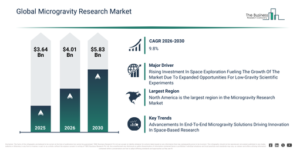
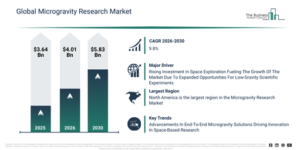
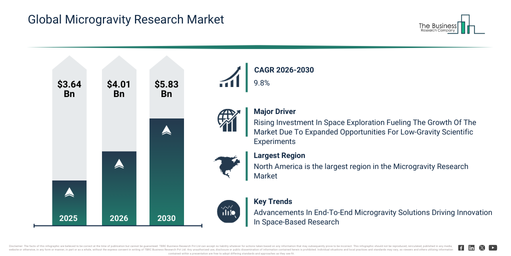
The microgravity research market size has experienced swift expansion recently. It is projected to escalate from $3.64 billion in 2025 to $4.01 billion in 2026, demonstrating a compound annual growth rate (CAGR) of 10.2%. This historical advancement can be attributed to several factors: increased government and space-agency funding dedicated to orbital microgravity experiments, augmented utilization of the International Space Station for scientific investigations, breakthroughs in payload integration technologies that enable more sophisticated experiments, a growing demand for microgravity insights within the pharmaceuticals and material sciences sectors, and the development of ground-based microgravity simulation capabilities to support pre-flight preparations.
The microgravity research market size is expected to experience substantial growth in the next few years. It is projected to increase to $5.83 billion in 2030, at a compound annual growth rate (CAGR) of 9.8%. This anticipated growth during the forecast period can be attributed to the growing commercialization of space-based research platforms, enabling broader access; a rising demand for microgravity data to support advancements in space manufacturing and biopharmaceutical innovation; the increasing availability of private spaceflight services providing opportunities for experiment deployment; the development of next-generation microgravity instrumentation with higher precision; and expanding partnerships between research institutions and space companies to scale microgravity experimentation. Major trends in the forecast period include the commercialization of microgravity research services and platforms, the expansion of private space stations and suborbital research opportunities, the standardization and modularization of microgravity payloads and interfaces, the growth of international collaborations and public–private research consortia, and the increasing use of microgravity test campaigns for pre-spaceflight technology validation.
Get A Free Sample Report With In-Depth Market Insights:
Microgravity Research Market Growth Backed By Core Demand Fundamentals
Growing financial input into space exploration is anticipated to drive the expansion of the microgravity research market in the future. Space exploration involves the scientific study and discovery of outer space, employing sophisticated technology to examine celestial bodies and cosmic events beyond our planet. Financial contributions to space exploration are increasing because of expanding commercial prospects, with private firms increasingly viewing space technologies and services as lucrative undertakings offering sustained profits. Enhanced investment in space exploration bolsters the need for microgravity research by broadening access to orbital and suborbital platforms, thereby allowing for a greater frequency and variety of scientific experiments in low-gravity settings, which in turn progresses understanding across diverse fields. As an example, in March 2025, the UK government disclosed, as per the House of Commons Library, a UK-based library and information resource of the lower house of the British Parliament, that contracts amounting to $1,135 million (£844 million) were granted to the nation from 2022 to 2024 through the European Space Agency (ESA). Consequently, the growing financial commitment to space exploration is set to stimulate the expansion of the microgravity research market.
Microgravity Research Market Segmentation And Category Overview
The microgravity research market covered in this report is segmented –
1) By Platform: International Space Station, Parabolic Flights, Drop Towers, Ground-Based Facilities, Other Platforms
2) By Application: Space Exploration, Material Science, Biotechnology, Combustion Science, Fluid Dynamics, Other Applications
3) By End-User: Government Agencies, Commercial Space Companies, Research Institutions, Other End-Users
Subsegments:
1) By International Space Station: U.S. National Laboratory Experiments, Commercial Module Services, Academic Research Programs, Pharmaceutical And Biotech Research, Government-Funded Experiments
2) By Parabolic Flights: Commercial Parabolic Flight Providers, Government And Military Research Missions, Academic Microgravity Experiments, Short-Term Biological Studies, Equipment and Payload Testing
3) By Drop Towers: Ultra-Short Duration Experiments, Material Science Research, Fluid Dynamics Studies, Educational Demonstrations, Pre-Spaceflight Experiment Validation
4) By Ground-Based Facilities: Clinostats And Random Positioning Machines, Magnetic Levitation Systems, Simulated Microgravity Bioreactors, Hypergravity And Rotating Wall Vessels, Analog Environment Research
5) By Other Platforms: Suborbital Rockets, CubeSat-Based Experiments, High-Altitude Balloons, Lunar and Martian Analog Missions, Commercial Space Stations
Microgravity Research Market Growth Trends Reshaping The Competitive Landscape
Companies operating within the microgravity research market are concentrating on developing sophisticated technological solutions, including comprehensive end-to-end commercial microgravity, to secure a competitive advantage. End-to-end commercial microgravity services are fully integrated provisions that span every stage of a microgravity research project, encompassing planning, hardware development, mission execution, and post-experiment analysis. For instance, in October 2023, the Germany-based space technology firms Rocket Factory Augsburg, Yuri, and ATMOS Space Cargo collaboratively launched Eva, an end-to-end commercial microgravity service. Eva introduces a distinctive global service aimed at generating groundbreaking insights in biotechnology and product innovation. It unites the specialized expertise of three domain specialists to deliver a completely integrated solution. This framework allows clients to focus on their primary business activities while receiving streamlined research support. The capability to cover the entire value chain within Germany demonstrates the strength and maturity of the country’s NewSpace sector.
Microgravity Research Market Competitive Analysis Of Leading Industry Participants
Major companies operating in the microgravity research market are Airbus SE, Northrop Grumman Corporation, National Aeronautics and Space Administration (NASA), Thales Group, SpaceX Corp., Blue Origin LLC, ESA, Sierra Space Corp., JAXA, Axiom Space Inc., Rocket Lab Ltd., Roscosmos, Made In Space Inc., NanoRacks LLC, Space Tango Inc., Virgin Galactic, CNSA, ISS National Lab, SpacePharma, Space Life Sciences Lab.
View The Full Microgravity Research Market Report:
Microgravity Research Market Global Footprint: Which Region Leads The Market?
North America was the largest region in the microgravity research market in 2025. The regions covered in the microgravity research market report are Asia-Pacific, South East Asia, Western Europe, Eastern Europe, North America, South America, Middle East, Africa.
Reach Out To Our Team:
The Business Research Company: https://www.thebusinessresearchcompany.com/
Americas: +1 310-496-7795
Asia: +44 7882 955267 & +91 8897263534
Europe: +44 7882 955267
Email us at: marketing@tbrc.info
Follow us on:
LinkedIn: https://in.linkedin.com/company/the-business-research-company
YouTube: https://www.youtube.com/channel/UC24_fI0rV8cR5DxlCpgmyFQ
Global Market Model: https://www.thebusinessresearchcompany.com/global-market-model

Wasay has over a decade of experience in market research, data modelling, and analytics, with prior experience at GlobalData and Decision Tree Consulting Services. At The Business Research Company , he leads research operations across syndicated studies, customized consulting engagements, and the Global Market Model platform. His professional experience includes supporting organizations such as Boston Consulting Group, KPMG, and Ernst & Young. Wasay holds a degree in Electronics and Communications Engineering, postgraduate management qualifications from International Management Institute Belgium and Indian School of Business and Entrepreneurship, and completed the Integrated Program in Business Analytics from Indian Institute of Management Indore.