Built to provide research that’s more actionable and strategically valuable, The Business Research Company’s 2026 market reports include market attractiveness analysis, total addressable market sizing, company benchmarking matrices, interactive Excel dashboards, broader supply chain intelligence, emerging startup tracking, and in-depth product insights.
Feeding Systems Market Growth From $2.19 Billion In 2026 To $2.87 Billion By 2030 At A CAGR Of 7%
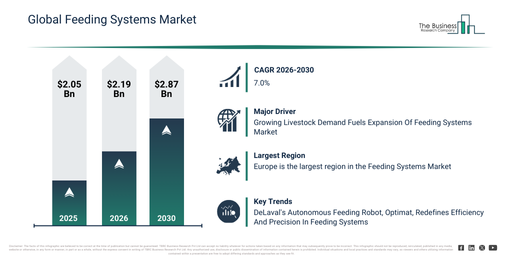
The feeding systems market has experienced robust growth in recent years. It is projected to expand from $2.05 billion in 2025 to $2.19 billion in 2026, demonstrating a compound annual growth rate (CAGR) of 7.1%. This historical expansion is primarily due to factors such as increasing livestock mechanization, larger herd sizes, the demand for labor efficiency, the initial integration of basic automatic feeders, and a heightened emphasis on operational consistency.
The feeding systems market is poised for significant expansion over the coming years. Its size is expected to reach $2.87 billion by 2030, growing at a compound annual growth rate (CAGR) of 7.0%. This projected growth during the forecast period is fueled by factors such as the increasing adoption of automated farm equipment, the rise of precision livestock farming, a growing demand for scalable feeding technologies, a noticeable shift towards smart farms, and the expansion of commercial animal production units. Major developments expected in this period include the increased deployment of automated feeding systems to cut labor costs, a heightened demand for precise feed allocation to enhance productivity, the rising integration of multi-function feeding modules across agricultural operations, the enlargement of large-scale livestock farms requiring high-capacity feeding solutions, and a transition towards continuous and consistent feeding operations to improve animal health.
Get A Free Sample Report With In-Depth Market Insights:
Feeding Systems Market Demand Drivers: What’s Powering Industry Growth?
The market for feeding systems is anticipated to expand due to increasing livestock demand. Livestock encompasses farm-raised animals used for diverse purposes like food production, fiber, labor, and other commodities. The growing demand for livestock products such as meat, milk, and eggs creates an intrinsic requirement for advanced feeding systems to optimize animal nutrition, health, and overall well-being. For example, in March 2023, the Australian Bureau of Statistics, an Australia-based government agency, reported an 11.3% increase in beef production, reaching 524,335 tons. Additionally, mutton production rose by 31.8% to 58,662 tons. Consequently, this elevated demand for livestock is a key factor boosting the expansion of the feeding systems market.
Feeding Systems Market Segment Landscape And Growth Outlook
The feeding systems market covered in this report is segmented –
1) By Type: Rail-Guided, Conveyor Belt, Self-Propelled
2) By Technology: Manual, Automated
3) By Function: Controlling, Mixing, Filling and Screening, Other Functions
4) By End Users: Swine Farm, Equine Farm, Dairy Farm, Poultry Farm
Subsegments:
1) By Rail-Guided: Automated Rail-Guided Systems, Manual Rail-Guided Systems
2) By Conveyor Belt: Flat Belt Conveyors, Modular Belt Conveyors, Roller Bed Conveyors
3) By Self-Propelled: Autonomous Mobile Feeding Systems, Semi-Automated Self-Propelled Systems
Feeding Systems Market Innovation Trends: What Developments Are Reshaping The Industry?
Companies operating in the feeding systems market are actively focusing on developing new technologies, such as real-time monitoring and diet deficiencies monitoring, among others, to boost profitability and strengthen their market position. For instance, in April 2023, DeLaval, a Sweden-based company specializing in dairy farming and milking equipment, launched its new autonomous feeding robot, DeLaval Optimat. The Optimat solution integrates a variety of functions including weighing, cutting, mixing, and delivering feed to the table, effectively streamlining and automating the entire feeding process on dairy farms. This advancement is set to reduce costs and labor associated with feeding, providing dairy farmers with a more efficient and technologically integrated solution for their operations.
Feeding Systems Market Competitive Landscape: Who Leads The Industry?
Major companies operating in the feeding systems market are Lely, VDL Agrotech, DeLaval, Pellon, GEA, Cormall, fimilk, Rovibec, Dairymaster, Steinsvik, Bauer Technics, BouMatic, GSI Group, AKVA Group, Daviesway, RO-MAN Manufacturing, Penta TMR, AgroLogic, Ottevanger, Van Aarsen, Fanway Fish Feed, Sioux Steel, Jaylor, Hanskamp, JF McKenna, SKIOLD GROUP
View The Full Feeding Systems Market Report:
Feeding Systems Market Regional Distribution: Which Areas Power Market Growth?
Europe was the largest region in the feeding systems market in 2025. The regions covered in the feeding systems market report are Asia-Pacific, South East Asia, Western Europe, Eastern Europe, North America, South America, Middle East, Africa.
Reach Out To Our Team:
The Business Research Company: https://www.thebusinessresearchcompany.com/
Americas: +1 310-496-7795
Asia: +44 7882 955267 & +91 8897263534
Europe: +44 7882 955267
Email us at: marketing@tbrc.info
Follow us on:
LinkedIn: https://in.linkedin.com/company/the-business-research-company
YouTube: https://www.youtube.com/channel/UC24_fI0rV8cR5DxlCpgmyFQ
Global Market Model: https://www.thebusinessresearchcompany.com/global-market-model

Wasay has over a decade of experience in market research, data modelling, and analytics, with prior experience at GlobalData and Decision Tree Consulting Services. At The Business Research Company , he leads research operations across syndicated studies, customized consulting engagements, and the Global Market Model platform. His professional experience includes supporting organizations such as Boston Consulting Group, KPMG, and Ernst & Young. Wasay holds a degree in Electronics and Communications Engineering, postgraduate management qualifications from International Management Institute Belgium and Indian School of Business and Entrepreneurship, and completed the Integrated Program in Business Analytics from Indian Institute of Management Indore.