Featuring market attractiveness scoring, total addressable market sizing, company benchmarking matrices, interactive Excel dashboards, deeper supply chain intelligence, emerging startup tracking, and granular product-level insights, The Business Research Company’s 2026 market reports are built to deliver research that is both more actionable and more strategically valuable.
Ground Penetrating Radar Soil Sensor Market Value Analysis: What Growth Lies Ahead Over The Forecast Period?
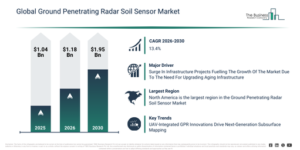
The ground penetrating radar soil sensor market size has witnessed rapid expansion in recent years. It is projected to grow from $1.04 billion in 2025 to $1.18 billion in 2026, exhibiting a compound annual growth rate (CAGR) of 13.6%. This historical growth can be attributed to the early use of GPR in construction surveys, increasing environmental assessment requirements, the rising adoption of soil analysis tools, growing archaeological mapping activities, and initial deployment in agricultural soil testing.
The ground penetrating radar soil sensor market is anticipated to experience swift expansion over the coming years. Its size is projected to reach $1.95 billion by 2030, exhibiting a compound annual growth rate (CAGR) of 13.4%. This growth during the forecast period is primarily driven by an escalating requirement for accurate soil monitoring, an increase in infrastructure projects, a broadening need for subsurface utility identification, the rising uptake of drone-integrated GPR, and the expanding application of high-frequency radar technologies. Key trends anticipated for the forecast period encompass a greater reliance on non-invasive methods for soil mapping, the increasing acceptance of instruments for evaluating soil moisture and composition, the enhanced incorporation of GPR sensors into agricultural land appraisals, the broadened scope of subsurface environmental observation uses, and a higher demand for sophisticated construction site evaluation instruments.
Get A Free Sample Report With In-Depth Market Insights:
Ground Penetrating Radar Soil Sensor Market Growth Catalysts And Demand Drivers
The expansion of infrastructure developments is anticipated to drive the growth of the ground penetrating radar (GPR) soil sensor market. These infrastructure projects encompass large-scale construction and development activities such as roads, bridges, tunnels, railways, and utilities, which necessitate thorough subsurface analysis to ensure safety and operational efficiency. The increase in infrastructure projects is attributed to the urgent requirement for upgrading existing aging infrastructure, demanding advanced technologies to guarantee long-term safety, efficiency, and resilience. Ground penetrating radar (GPR) soil sensors aid these projects by offering non-invasive subsurface mapping capabilities, identifying underground utilities, and evaluating soil conditions to mitigate construction risks and potential delays. For instance, in July 2025, the Office for National Statistics, a UK-based statistics authority, reported that infrastructure investment reached $26.8 billion (£20.3 billion) in 2024 (in 2022 chained volume measures), marking a 16.9% increase compared with 2023. Consequently, the rising number of infrastructure projects is propelling the growth of the ground penetrating radar (GPR) soil sensor market.
Ground Penetrating Radar Soil Sensor Market Segment Breakdown: Which Categories Lead On Revenue?
The ground penetrating radar soil sensor market covered in this report is segmented –
1) By Product Type: Handheld, Cart-Based, Vehicle-Mounted, Drone-Based
2) By Technology: Single Frequency, Multi-Frequency, 3D Ground-Penetrating Radar (GPR)
3) By Frequency Range: Low Frequency, Mid Frequency, High Frequency
4) By End-User: Agriculture, Construction, Environmental, Research Institutes, Utilities, Other End-Users
Subsegments:
1) By Handheld: Compact Units, Multi-Frequency Handheld, Single-Frequency Handheld
2) By Cart-Based: 2D Cart Systems, 3D Or Multichannel Cart Systems, Modular Cart Systems
3) By Vehicle-Mounted: Utility Vehicle-Mounted, Truck-Mounted, All-Terrain Vehicle (ATV) Or Utility Task Vehicle (UTV)-Mounted
4) By Drone-Based: Fixed-Wing Drone Ground Penetrating Radar (GPR), Multirotor Drone Ground Penetrating Radar (GPR), Hybrid Drone Ground Penetrating Radar (GPR)
Ground Penetrating Radar Soil Sensor Market Trends Shaping Long-Term Demand
Leading companies within the ground penetrating radar (GPR) soil sensor market are directing efforts towards creating innovative solutions, such as advanced UAV-integrated GPR systems, to address the increasing need for high-resolution subsurface mapping, safer field operations, and efficient data acquisition across surveying, engineering, and environmental applications. UAV-based GPR units provide quicker coverage and better access to challenging or hazardous terrain compared to conventional cart-based GPR units, simultaneously offering stable altitude control and superior-quality imaging through contemporary signal-processing technologies. For instance, in November 2025, SPH Engineering, a Latvia-based drone technology firm, enhanced its drone-based GPR portfolio with two novel 600 MHz UAV-integrated antennas: the MALÅ GeoDrone 600 and Zond Aero 600 NG, specifically designed to deliver high-resolution subsurface mapping for engineering, utilities, archaeology, environmental, and geophysical applications. Both models balance near-surface resolution with penetration depths of up to ~2 meters, aided by the company’s True Terrain Following technology for consistent data quality over uneven terrain. The MALÅ GeoDrone 600, a 2.7 kg shielded antenna incorporating MALÅ HDR technology and a 250–900 MHz bandwidth, is specifically tailored for precision engineering and utility detection. Meanwhile, the lighter 1.7 kg Zond Aero 600 NG, operating at 300–950 MHz with Real-Time Sampling and enhanced stacking, is optimized for geophysical and environmental surveys requiring strong signal performance at low altitudes.
Ground Penetrating Radar Soil Sensor Market Leading Players And Competitive Positioning
Major companies operating in the ground penetrating radar soil sensor market are Hexagon AB, Leica Geosystems AG, Screening Eagle Technologies Inc, Guideline Geo AB, Geophysical Survey Systems Inc, Sensors & Software Inc, Edaphic Scientific Pty Ltd, Radiodetection Ltd, Stanlay Instruments Pvt Ltd, Suncon Engineers Pvt Ltd, Aimil Ltd, Utsi Electronics Ltd, Geomatrix Earth Science Ltd, US Radar Inc, Geoscanners AB, Penetradar Pty Ltd, Sandmeier Geophysical Research GmbH, SPH Engineering OÜ, Shijay Projects India Pvt Ltd, Ingegneria dei Sistemi Srl.
View The Full Ground Penetrating Radar Soil Sensor Market Report:
Ground Penetrating Radar Soil Sensor Market Regional Breakdown: Where Is Demand Concentrated?
North America was the largest region in the ground penetrating radar soil sensor market in 2025. Asia-Pacific is expected to be the fastest-growing region in the forecast period. The regions covered in the ground penetrating radar soil sensor market report are Asia-Pacific, South East Asia, Western Europe, Eastern Europe, North America, South America, Middle East, Africa.
Reach Out To Our Team:
The Business Research Company: https://www.thebusinessresearchcompany.com/
Americas: +1 310-496-7795
Asia: +44 7882 955267 & +91 8897263534
Europe: +44 7882 955267
Email us at: marketing@tbrc.info
Follow us on:
LinkedIn: https://in.linkedin.com/company/the-business-research-company
YouTube: https://www.youtube.com/channel/UC24_fI0rV8cR5DxlCpgmyFQ
Global Market Model: https://www.thebusinessresearchcompany.com/global-market-model

Wasay has over a decade of experience in market research, data modelling, and analytics, with prior experience at GlobalData and Decision Tree Consulting Services. At The Business Research Company , he leads research operations across syndicated studies, customized consulting engagements, and the Global Market Model platform. His professional experience includes supporting organizations such as Boston Consulting Group, KPMG, and Ernst & Young. Wasay holds a degree in Electronics and Communications Engineering, postgraduate management qualifications from International Management Institute Belgium and Indian School of Business and Entrepreneurship, and completed the Integrated Program in Business Analytics from Indian Institute of Management Indore.