Built to provide research that’s more actionable and strategically valuable, The Business Research Company’s 2026 market reports include market attractiveness analysis, total addressable market sizing, company benchmarking matrices, interactive Excel dashboards, broader supply chain intelligence, emerging startup tracking, and in-depth product insights.
Vertical Take-Off And Landing (VTOL) UAV Market Growth Analysis: How Will Revenue Trend Over The Forecast Period?
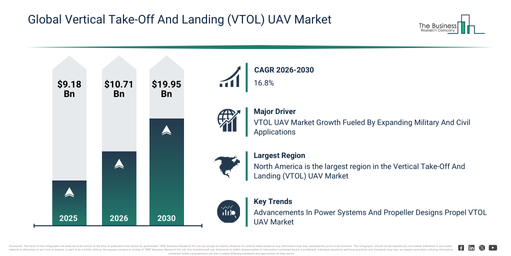
The vertical take-off and landing (vtol) uav market has experienced significant expansion recently. Projections indicate it will grow from $9.18 billion in 2025 to $10.71 billion by 2026, achieving a compound annual growth rate (CAGR) of 16.7%. Historically, this expansion was driven by an increasing demand for UAVs capable of hovering and vertical take-off in inspection and surveillance roles, alongside technological advancements in multirotor and tiltrotor designs. Further contributions came from the growing adoption in military and defense applications, early deployment in industrial and infrastructure monitoring, and improvements in flight stability and control systems for fixed-wing and tail-sitter vtol UAVs.
The vertical take-off and landing (vtol) uav market is projected to experience substantial growth over the coming years, reaching $19.95 billion by 2030, at a compound annual growth rate (CAGR) of 16.8%. This anticipated growth is driven by factors such as the expansion of VTOL UAVs into commercial delivery and logistics, the integration of AI and autonomous flight systems for improved operational efficiency, the development of hybrid propulsion and extended-range VTOL UAVs, increasing adoption in urban air mobility and smart city applications, and a rising demand for versatile UAVs that combine multirotor and fixed-wing capabilities for inspection and surveying. Key trends expected in this period include autonomous flight with AI-assisted navigation, the integration of VTOL UAVs into smart mobility and urban air transport, advanced cybersecurity for UAV communication and data transfer, IoT-connected UAV systems for real-time monitoring and inspection, electric propulsion and battery optimization for VTOL drones, multi-mission VTOL UAV deployment for civil and commercial uses, enhanced ISR payloads for military operations, and hybrid VTOL design innovations focusing on efficiency and endurance.
Get A Free Sample Report With In-Depth Market Insights:
Vertical Take-Off And Landing (VTOL) UAV Market Demand Drivers: What’s Powering Industry Growth?
The expansion of military and civil uses is projected to boost the vertical take-off and landing (VTOL) UAV market in the future. These military and civil applications encompass diverse uses where technologies, products, or services are deployed by either military organizations or civilian bodies such as businesses, governments, or individuals. VTOL UAVs are employed in these applications for inspecting infrastructure like bridges, power lines, and pipelines. Their versatility, maneuverability, and operational flexibility make vertical take-off and landing (VTOL) unmanned aerial vehicles (UAVs) extensively suitable for intelligence, surveillance, target acquisition, and reconnaissance (ISTAR) across a wide array of military and civil contexts. As an illustration, in August 2025, figures from The Ministry of Defence, a UK-based Government department, showed that applications to the British Army Regular Forces reached a total of 170,380 in the year ending 30 September 2024. This represented a substantial 94.0% increase from 87,840 applications recorded in the year ending 30 September 2023. Consequently, the increasing military and civil applications are propelling the growth of the vertical take-off and landing (VTOL) UAV market.
Vertical Take-Off And Landing (VTOL) UAV Market Segment Analysis Spotlighting Growth Areas
The vertical take-off and landing (vtol) uav market covered in this report is segmented –
1) By Type: Helicopter, Multicopter, Hybrid
2) By Size: Large, Medium, Small, Micro
3) By Payloads: Intelligence Surveillance Reconnaissance (ISR), Cameras, Telemetry, Sensors, Autopilot
4) By Application: Military, Home And Security, Civil And Commercial
Subsegments:
1) By Helicopter: Single-Rotor Helicopters, Multi-Rotor Helicopters
2) By Multicopter: Quadcopters, Hexacopters, Octocopters
3) By Hybrid: Fixed-Wing Hybrid VTOL, Rotorcraft Hybrid VTOL
Vertical Take-Off And Landing (VTOL) UAV Market Innovation Trends: What Developments Are Reshaping The Industry?
Leading companies within the vertical take-off and landing (VTOL) UAV market are combining their expertise to create sophisticated solutions, integrating highly dependable power systems and innovative locking propeller designs to secure a competitive advantage. These reliable power systems and locking propeller designs enable efficient missions while preserving vertical takeoff and landing capabilities. For instance, in June 2023, T-DRONES, a China-based manufacturer of industrial UAVs, launched the VA25, a new fixed-wing VTOL unmanned aerial vehicle. This innovative VA25 is a long-endurance fixed-wing VTOL drone specifically engineered for industrial use, boasting a wingspan of 2.5m, a takeoff weight of 13kg, and a flight time of up to 210 minutes with a 1kg payload. Its frame is constructed from carbon fiber composite PVC and incorporates a highly reliable power system along with a locking propeller design, which substantially prolongs its flight duration. The standard drone package includes the frame and the T-MOTOR power system.
Vertical Take-Off And Landing (VTOL) UAV Market Leading Companies: Who Holds The Strongest Market Presence?
Major companies operating in the vertical take-off and landing (vtol) uav market are Boeing Co., Airbus SE, Honeywell International Inc., Thales Group, Bell Textron Inc., Textron Systems, SZ DJI Technology Co. Ltd., Yuneec International Inc., AeroVironment Inc., Joby Aviation Inc., Lilium GmbH, Volocopter GmbH, Aurora Flight Sciences, Vertical Aerospace, Quantum Systems GmbH, Wingcopter GmbH, Elroy Air Inc., SkyDrive Inc., Terrafugia Inc., 3D Robotics Inc., Urban Aeronautics, Kitty Hawk Corporation, ALTI UAS, EHang Holding, Zero Zero Robotics Inc.
View The Full Vertical Take-Off And Landing (VTOL) UAV Market Report:
Vertical Take-Off And Landing (VTOL) UAV Market Top Region: Where Does Most Revenue Come From?
North America was the largest region in the vertical take-off and landing (VTOL) UAV market in 2025. Asia-Pacific is expected to be the fastest-growing region in the forecast period. The regions covered in the vertical take-off and landing (vtol) uav market report are Asia-Pacific, South East Asia, Western Europe, Eastern Europe, North America, South America, Middle East, Africa.
Reach Out To Our Team:
The Business Research Company: https://www.thebusinessresearchcompany.com/
Americas: +1 310-496-7795
Asia: +44 7882 955267 & +91 8897263534
Europe: +44 7882 955267
Email us at: marketing@tbrc.info
Follow us on:
LinkedIn: https://in.linkedin.com/company/the-business-research-company
YouTube: https://www.youtube.com/channel/UC24_fI0rV8cR5DxlCpgmyFQ
Global Market Model: https://www.thebusinessresearchcompany.com/global-market-model

Wasay has over a decade of experience in market research, data modelling, and analytics, with prior experience at GlobalData and Decision Tree Consulting Services. At The Business Research Company , he leads research operations across syndicated studies, customized consulting engagements, and the Global Market Model platform. His professional experience includes supporting organizations such as Boston Consulting Group, KPMG, and Ernst & Young. Wasay holds a degree in Electronics and Communications Engineering, postgraduate management qualifications from International Management Institute Belgium and Indian School of Business and Entrepreneurship, and completed the Integrated Program in Business Analytics from Indian Institute of Management Indore.