
Backed by market attractiveness analysis, total addressable market sizing, company benchmarking matrices, interactive Excel dashboards, wider supply chain intelligence, emerging startup coverage, and detailed product-level insights, The Business Research Company’s 2026 market reports are designed to offer research that is more actionable and strategically valuable than ever.
Connected Forestry Equipment Market Set To Climb From $7.04 Billion In 2026 To $11.44 Billion By 2030
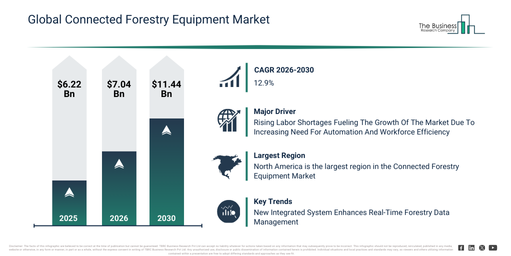
The size of the connected forestry equipment market has experienced significant growth over recent years. The market is anticipated to expand from $6.22 billion in 2025 to reach $7.04 billion in 2026, with a compound annual growth rate (CAGR) of 13.2%. During the historic period, this growth can be ascribed to several factors, including the rise in mechanized logging, growth in commercial forestry operations, the increasing need for safety compliance, the expansion of large-scale forest management programs, and rising timber harvesting volumes.
The connected forestry equipment market size is set to experience substantial growth over the next few years. It is expected to expand to $11.44 billion by 2030, with a compound annual growth rate (CAGR) of 12.9%. This projected growth can be linked to the increasing adoption of connected machinery, mounting regulatory pressure for sustainable forestry, a rising need for automation in distant forest regions, the widening scope of data-driven decision-making, and increased investment in digital forestry platforms. Prominent trends within the forecast period involve a heightened focus on real-time equipment performance monitoring, a growing demand for improved worker safety in forestry operations, an increasing necessity for sustainable and low-impact logging practices, the broader implementation of predictive maintenance in forestry machinery, and the greater integration of remote operations into forest management.
Get A Free Sample Report With In-Depth Market Insights:
Connected Forestry Equipment Market Growth Backed By Core Demand Fundamentals
The anticipated expansion of the connected forestry equipment market is significantly influenced by the increasing prevalence of labor shortages. A labor shortage denotes an insufficiency of qualified personnel to occupy open positions, materializing when the demand for labor surpasses its availability. This escalation in labor scarcity stems from an aging demographic, leading to more retirements, which consequently diminishes the active workforce and forms voids within crucial sectors. During periods of labor scarcity, connected forestry equipment offers crucial assistance through remote monitoring capabilities and automated processes, thereby lessening reliance on human labor. Such equipment boosts productivity via real-time data analysis and optimized machinery, guaranteeing uninterrupted and effective forestry operations even when workforce numbers are constrained. Illustratively, in October 2025, data from the Parliament of the United Kingdom, the UK’s top legislative authority, indicated that the UK’s unemployment rate reached 4.8%, with around 1.74 million individuals aged 16 and over unemployed, marking an approximate increase of 297,000 from the preceding year. Consequently, the expanding challenge of labor shortages is indeed propelling the advancement of the connected forestry equipment market.
Connected Forestry Equipment Market Segment Analysis And Revenue Potential
The connected forestry equipment market covered in this report is segmented –
1) By Product Type: Harvesters, Forwarders, Skidders, Feller Bunchers, Loaders, Other Product Types
2) By Technology: Telematics, Global Positioning System, Internet Of Things Sensors, Remote Monitoring, Other Technologies
3) By Application: Logging, Silviculture, Forest Management, Fire Management, Other Applications
4) By End-User: Commercial, Government, Other End-Users
Subsegments:
1) By Harvesters: Single Grip Harvesters, Dual Grip Harvesters, Tracked Harvesters, Wheeled Harvesters
2) By Forwarders: Small Forwarders, Medium Forwarders, Large Forwarders, Wheeled Forwarders
3) By Skidders: Cable Skidders, Grapple Skidders, Tracked Skidders, Wheeled Skidders
4) By Feller Bunchers: Tracked Feller Bunchers, Wheeled Feller Bunchers
5) By Loaders: Knuckleboom Loaders, Wheel Loaders, Tracked Loaders, Swing Boom Loaders
6) By Other Product Types: Chippers, Mulchers, Delimbers, Log Processors, Slashers, Stump Grinders
Connected Forestry Equipment Market Growth Trends Reshaping The Competitive Landscape
Leading companies in the connected forestry equipment market are concentrating on developing technologically advanced solutions, such as integrated forestry platforms, to enhance efficiency, improve data visibility, and optimize resource management. These integrated forestry platforms are cloud-based systems that connect various operational stages, from planning and harvesting to hauling and financial analysis, into a single, unified data environment. For instance, in May 2025, Trimble Inc., a US-based technology company, launched Trimble Forestry One, a unified integrated forestry platform designed to connect and optimize forestry operations. It consolidates operational, spatial, and environmental data to provide real-time inventory oversight, timber tracking, and regulatory compliance. The platform includes features for harvest planning, machine monitoring, production tracking, and logistics, facilitating seamless information flow across different teams and reducing operational silos.
Connected Forestry Equipment Market Key Players Shaping Industry Direction
Major companies operating in the connected forestry equipment market are Caterpillar Inc., Deere & Company (John Deere), Komatsu Ltd., CNH Industrial N.V., Liebherr-International Deutschland GmbH, Sumitomo Forestry Co. Ltd., Husqvarna Group AB, Hitachi Construction Machinery Co. Ltd., Ponsse Plc, Tigercat Industries Inc., Andreas Stihl AG & Co. KG, Logset Oy, Terraformation Inc., Rottne Industri AB, Trimble Forestry, Chloris Geospatial Inc., Kesla Oyj, Kodama Systems Inc., Forest Metrix LLC, Neuson Forest GmbH
View The Full Connected Forestry Equipment Market Report:
Connected Forestry Equipment Market Geographic Spread And Regional Opportunities
North America was the largest region in the connected forestry equipment market in 2025. Asia-Pacific is expected to be the fastest-growing region in the forecast period. The regions covered in the connected forestry equipment market report are Asia-Pacific, South East Asia, Western Europe, Eastern Europe, North America, South America, Middle East, Africa.
Reach Out To Our Team:
The Business Research Company: https://www.thebusinessresearchcompany.com/
Americas: +1 310-496-7795
Asia: +44 7882 955267 & +91 8897263534
Europe: +44 7882 955267
Email us at: marketing@tbrc.info
Follow us on:
LinkedIn: https://in.linkedin.com/company/the-business-research-company
YouTube: https://www.youtube.com/channel/UC24_fI0rV8cR5DxlCpgmyFQ
Global Market Model: https://www.thebusinessresearchcompany.com/global-market-model

Wasay has over a decade of experience in market research, data modelling, and analytics, with prior experience at GlobalData and Decision Tree Consulting Services. At The Business Research Company , he leads research operations across syndicated studies, customized consulting engagements, and the Global Market Model platform. His professional experience includes supporting organizations such as Boston Consulting Group, KPMG, and Ernst & Young. Wasay holds a degree in Electronics and Communications Engineering, postgraduate management qualifications from International Management Institute Belgium and Indian School of Business and Entrepreneurship, and completed the Integrated Program in Business Analytics from Indian Institute of Management Indore.
