
Backed by market attractiveness analysis, total addressable market sizing, company benchmarking matrices, interactive Excel dashboards, wider supply chain intelligence, emerging startup coverage, and detailed product-level insights, The Business Research Company’s 2026 market reports are designed to offer research that is more actionable and strategically valuable than ever.
Digital Farming Software Market Revenue Growth On Track For A 14.5% CAGR Through 2030
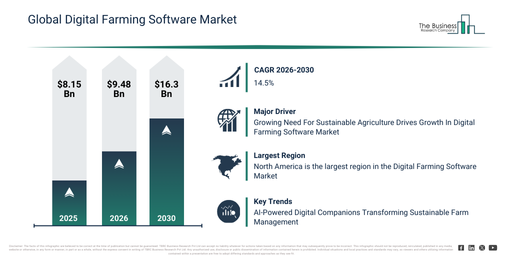
The digital farming software market size has experienced rapid expansion in recent years. It is anticipated to expand from $8.15 billion in 2025 to $9.48 billion in 2026, demonstrating a compound annual growth rate (CAGR) of 16.3%. The previous period’s growth stemmed from factors including insufficient access to real-time farm data, increasing scarcity of labor, a rising imperative for yield optimization, the early deployment of remote sensing instruments, and enhanced digital literacy among agriculturalists.
The digital farming software market is anticipated to undergo significant growth over the next few years. It is projected to reach $16.3 billion by 2030, progressing at a compound annual growth rate (CAGR) of 14.5%. This anticipated expansion can be ascribed to several factors, including the increasing adoption of smart farming practices, heightened investment in agri-software platforms, enhanced governmental backing for digital agricultural initiatives, a burgeoning requirement for cost-effective farm management, and a surging demand for farming solutions that can withstand climatic challenges. Key developments expected during this period encompass a heightened need for tools that optimize resource utilization, a greater embrace of data-driven approaches for crop decisions, the expanded incorporation of farm financial management systems, the proliferation of multi-enterprise farm collaboration platforms, and an increased application of predictive analytics to monitor crop health.
Get A Free Sample Report With In-Depth Market Insights:
Digital Farming Software Market Growth Drivers: What’s Behind The Acceleration?
The increasing demand for sustainable agriculture is projected to drive the expansion of the digital farming software market in the future. Sustainable agriculture involves methods designed to satisfy current food requirements without jeopardizing the capacity of future generations to meet their own, encompassing organic farming that avoids synthetic inputs to foster ecological well-being and biological diversity. The uptake of sustainable agricultural practices is increasing, driven by heightened awareness of environmental consequences, consumer desires for wholesome and ethically sourced food, and the imperative to combat climate change and preserve natural resources. Digital farming software supports sustainable agriculture through optimizing resource utilization, real-time monitoring of crop and soil conditions, facilitating precision farming techniques such as precise irrigation and nutrient application, and offering data-driven intelligence for sound choices. For example, data from May 2024, released by the UK’s Department for Environment, Food and Rural Affairs (Defra), indicated that in 2023, 498,000 hectares of farmland in the UK were organically managed. Specifically, 60% of this was located in England, 23% in Scotland, 15% in Wales, and 1.4% in Northern Ireland. In the same year, the land area in the UK dedicated to organic cereal cultivation saw a 1.6% increase, reaching 50,000 hectares, with other organic arable crops expanding by 3.1% to a total of 11,000 hectares. Consequently, the increasing requirement for sustainable agriculture is a key factor propelling the expansion of digital farming software.
Digital Farming Software Market Segment Landscape And Growth Outlook
The digital farming software market covered in this report is segmented –
1) By Components: Software, Services
2) By Technology: Remote Sensing, Guidance Technology, Variable Rate Technology, Machine Learning, Wireless Connectivity, Other Technologies
3) By Applications: Drone Analytics, Precision Farming, Agriculture Robots, Livestock Monitoring, Greenhouse Management, Supply Chain Management, Financial Management, Other Applications
Subsegments:
1) By Software: Farm Management Software, Precision Agriculture Software, Livestock Management Software, Irrigation Management Software, Crop Monitoring And Forecasting Software
2) By Services: Consulting Services, Installation And Integration Services, Training And Support Services, Data Analytics And Cloud Services
Digital Farming Software Market Trends: What’s Defining The Industry’s Next Phase?
Major companies operating in the digital farming software market are focusing on developing innovative solutions such as artificial intelligence (AI)-powered digital companions to optimize farm management and boost sustainable agricultural practices. These artificial intelligence (AI)-powered digital companions are intelligent software tools that leverage AI to deliver personalized guidance, real-time recommendations, and data-driven insights to farmers, thereby assisting them in making improved decisions, optimizing crop management, and efficiently adopting sustainable farming practices. For instance, in October 2025, Klim Technologies Limited, a UK-based technology company, introduced its ‘digital companion’ tool, which is designed to eliminate uncertainty from regenerative agriculture for UK farmers and food & beverage businesses. The platform provides tailored, field-level recommendations, helps farmers select and monitor sustainable practices, and consolidates data across supply chains. Farmers are only required to input their farm data once a year, which simplifies and makes planning more efficient, while also enabling both farmers and F&B companies to accurately and cost-effectively measure the impact of regenerative practices, track progress toward sustainability goals, optimize crop and resource management, and generate reliable reports to support decision-making and supply chain transparency.
Digital Farming Software Market Competitive Landscape: Who Leads The Industry?
Major companies operating in the digital farming software market are Bayer AG, Deere & Company, Yara International ASA, Granular Inc., AGCO Corporation, CropX Inc., Trimble Inc., Topcon Positioning Systems Inc., Raven Industries Inc., Iteris Inc., Ag Leader Technology Inc., Taranis Visual Ltd., FarmWise Labs Inc., Farmers Edge Inc., Agworld Pty Ltd, FieldIn Ltd., Agrian Inc., Farmobile LLC, FarmLogs Inc., AgJunction Inc., AgriWebb Pty Ltd., Prospera Technologies Ltd., SST Software, Arable labs Inc., Gamaya SA, VanderSat B.V., Farmwave LLC, CropIn Technology Solutions Pvt Ltd., FluroSat Pty Ltd
View The Full Digital Farming Software Market Report:
Digital Farming Software Market Regional Breakdown: Where Is Demand Concentrated?
North America was the largest region in the digital farming software market in 2025. The regions covered in the digital farming software market report are Asia-Pacific, South East Asia, Western Europe, Eastern Europe, North America, South America, Middle East, Africa.
Reach Out To Our Team:
The Business Research Company: https://www.thebusinessresearchcompany.com/
Americas: +1 310-496-7795
Asia: +44 7882 955267 & +91 8897263534
Europe: +44 7882 955267
Email us at: marketing@tbrc.info
Follow us on:
LinkedIn: https://in.linkedin.com/company/the-business-research-company
YouTube: https://www.youtube.com/channel/UC24_fI0rV8cR5DxlCpgmyFQ
Global Market Model: https://www.thebusinessresearchcompany.com/global-market-model

Wasay has over a decade of experience in market research, data modelling, and analytics, with prior experience at GlobalData and Decision Tree Consulting Services. At The Business Research Company , he leads research operations across syndicated studies, customized consulting engagements, and the Global Market Model platform. His professional experience includes supporting organizations such as Boston Consulting Group, KPMG, and Ernst & Young. Wasay holds a degree in Electronics and Communications Engineering, postgraduate management qualifications from International Management Institute Belgium and Indian School of Business and Entrepreneurship, and completed the Integrated Program in Business Analytics from Indian Institute of Management Indore.
