
Featuring market attractiveness scoring, total addressable market sizing, company benchmarking matrices, interactive Excel dashboards, deeper supply chain intelligence, emerging startup tracking, and granular product-level insights, The Business Research Company’s 2026 market reports are built to deliver research that is both more actionable and more strategically valuable.
#Space Technology (SpaceTech) Market Revenue Outlook: What CAGR Lies Ahead Through 2030?#_x000D_
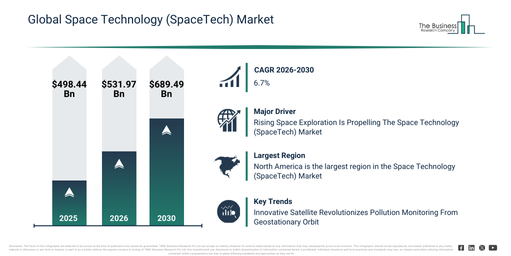
The space technology (spacetech) market has seen substantial growth over the past few years. This market is projected to expand from $498.44 billion in 2025 to $531.97 billion in 2026, exhibiting a compound annual growth rate (CAGR) of 6.7%. Historically, this growth has been fueled by factors such as increased government and private investments in satellite and spacecraft development, significant technological advancements in spacecraft components and payload instruments, a surging demand for earth observation and navigation services, the expansion of space debris tracking and management initiatives, and the initial adoption of space tourism and commercial spaceflight services._x000D_
_x000D_
The space technology (spacetech) market is anticipated to experience substantial expansion in the coming years. This market is projected to reach a size of $689.49 billion by 2030, showing a compound annual growth rate (CAGR) of 6.7%. This projected growth is driven by several factors, including the increasing scope of private and commercial space exploration, the incorporation of AI and robotics for self-governing space operations, the growing deployment of sophisticated satellites and instruments for scientific investigation, the creation of economical spacecraft and recoverable launch systems, and the wider use of space technology for communication, navigation, and worldwide connectivity. Key trends anticipated during this period encompass a heightened demand for the launch of small satellites and constellations, the emergence of private space tourism initiatives, improvements in technologies for tracking and reducing space debris, the broadening of deep-space exploration endeavors, and an increasing embrace of in-space manufacturing and resource exploitation._x000D_
_x000D_
#Get A Free Sample Report With In-Depth Market Insights:#_x000D_
_x000D_
#Space Technology (SpaceTech) Market Growth Catalysts And Demand Drivers#_x000D_
The increasing prevalence of space exploration is anticipated to fuel the expansion of the space technology (SpaceTech) market going forward. Space exploration involves the investigation and study of outer space, accomplished through the application of space technology, satellites, probes, and crewed missions. It leverages space technology by utilizing satellites, rovers, telescopes, and various spacecraft to collect data, conduct research, and facilitate human endeavors beyond Earth’s atmosphere. For instance, in June 2024, as reported by the US-based Satellite Industry Association, the commercial satellite industry achieved record growth in 2023, deploying 2,781 satellites, which was a 20% increase from 2022. The space industry also reached a significant milestone with 190 total launches, the highest number ever recorded. By the close of the year, the count of operational satellites stood at 9,691, indicating a 361% rise over the last five years. Thus, the growth in space exploration is propelling the SpaceTech market._x000D_
_x000D_
#Space Technology (SpaceTech) Market Segment Breakdown: Which Categories Lead On Revenue?#_x000D_
The space technology (spacetech) market covered in this report is segmented – _x000D_
_x000D_
1) By Type: Space Vehicles, Spacecraft, Space Stations, Orbital Launch Vehicles, Deep-Space Communications, In-Space Propulsion, Other Types_x000D_
2) By Application: Navigation And Mapping, Meteorology, Disaster Management, Satellite Communication, Satellite Television, Remote Sensing, Science And Engineering, Military And National Security, Internet Services, Other Applications_x000D_
3) By End-Use: Government, Military, Commercial_x000D_
_x000D_
Subsegments:_x000D_
1) By Space Vehicles: Manned Space Vehicles, Unmanned Space Vehicles, Lunar Rovers and Landers _x000D_
2) By Spacecraft: Satellites (Communication, Earth Observation, Navigation), Space Probes and Exploration Craft, Space Tugs and Orbital Platforms _x000D_
3) By Space Stations: International Space Station (ISS), Future Space Habitats, Orbital Research Stations _x000D_
4) By Orbital Launch Vehicles: Reusable Rockets, Space Exploration Launch Vehicles, Small Satellite Launchers _x000D_
5) By Deep-Space Communications: Deep-Space Network (DSN) Technologies, High-Speed Communication Systems for Space Missions, Laser Communication Systems _x000D_
6) By In-Space Propulsion: Electric Propulsion Systems, Chemical Propulsion Systems, Nuclear Thermal Propulsion _x000D_
7) By Other Types: Space Robotics and Automation, Space Tourism Technologies, Space Mining and Resource Utilization Technologies_x000D_
_x000D_
#Space Technology (SpaceTech) Market Trends Shaping Long-Term Demand#_x000D_
Major companies operating within the space technology (SpaceTech) market are prioritizing the development of innovative products, such as aerospace pollution monitoring instruments, to strengthen their standing. These instruments utilize sensors and detectors to measure and analyze air, water, or soil quality for environmental assessment. As an illustration, in April 2023, Ball Aerospace & Technologies Corp., a US-based manufacturer of spacecraft, instruments and sensors, radio frequency, and microwave technologies, launched the tropospheric emissions monitoring of pollution (TEMPO). This system will observe air quality in geostationary orbit during daylight hours. It offers high spatial resolution measurements of pollutants like nitrogen dioxide, formaldehyde, and ozone across North America. With its capability to track pollution at micro-urban scales every hour, TEMPO improves air quality prediction accuracy by 50%._x000D_
_x000D_
#Space Technology (SpaceTech) Market Leading Players And Competitive Positioning#_x000D_
Major companies operating in the space technology (spacetech) market are The Boeing Company, Lockheed Martin Corporation, Airbus SE, China Aerospace Science and Technology Corporation, General Dynamics Corporation, Northrop Grumman Corporation, Honeywell International Inc., NEC Corporation, Safran S.A., Thales Group, Ball Corporation, Leonardo SpA, SpaceX, Hindustan Aeronautics Limited, Viasat Inc., SES S.A., Maxar Technologies, Eutelsat Communications SA, Sierra Nevada Corporation, OHB System AB, MDA Space, Telesat, Rocket Lab USA Inc, ICEYE Inc, Blue Origin LLC, Beijing Commsat Technology Development Co. Ltd, Astra Space Inc, Virgin Galactic, Hedron _x000D_
_x000D_
#View The Full Space Technology (SpaceTech) Market Report:#_x000D_
_x000D_
#Space Technology (SpaceTech) Market Geographic Landscape: Which Region Leads Industry Growth?#_x000D_
North America was the largest region in the space technology (SpaceTech) market in 2025. Asia-Pacific is expected to be the fastest-growing region in the forecast period. The regions covered in the space technology (spacetech) market report are Asia-Pacific, South East Asia, Western Europe, Eastern Europe, North America, South America, Middle East, Africa._x000D_
_x000D_
#Reach Out To Our Team:#_x000D_
_x000D_
The Business Research Company: https://www.thebusinessresearchcompany.com/_x000D_
Americas: +1 310-496-7795_x000D_
Asia: +44 7882 955267 & +91 8897263534_x000D_
Europe: +44 7882 955267_x000D_
Email us at: marketing@tbrc.info_x000D_
_x000D_
#Follow us on:#_x000D_
_x000D_
LinkedIn: https://in.linkedin.com/company/the-business-research-company_x000D_
YouTube: https://www.youtube.com/channel/UC24_fI0rV8cR5DxlCpgmyFQ_x000D_
Global Market Model: https://www.thebusinessresearchcompany.com/global-market-model

Wasay has over a decade of experience in market research, data modelling, and analytics, with prior experience at GlobalData and Decision Tree Consulting Services. At The Business Research Company , he leads research operations across syndicated studies, customized consulting engagements, and the Global Market Model platform. His professional experience includes supporting organizations such as Boston Consulting Group, KPMG, and Ernst & Young. Wasay holds a degree in Electronics and Communications Engineering, postgraduate management qualifications from International Management Institute Belgium and Indian School of Business and Entrepreneurship, and completed the Integrated Program in Business Analytics from Indian Institute of Management Indore.
