Built to provide research that’s more actionable and strategically valuable, The Business Research Company’s 2026 market reports include market attractiveness analysis, total addressable market sizing, company benchmarking matrices, interactive Excel dashboards, broader supply chain intelligence, emerging startup tracking, and in-depth product insights.
#Spacecraft Autonomy Market CAGR Outlook And Future Development#_x000D_
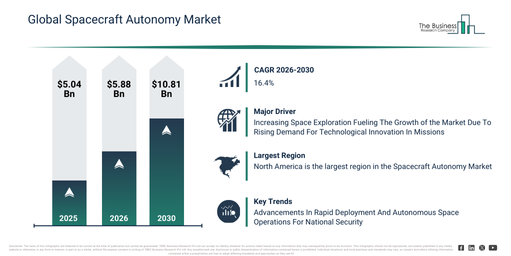
The spacecraft autonomy market has experienced considerable expansion in recent years. This market is projected to increase from $5.04 billion in 2025 to $5.88 billion in 2026, demonstrating a compound annual growth rate (CAGR) of 16.7%. Throughout its historical period, this growth can be ascribed to the early establishment of autonomous navigation and control systems for spacecraft, the integration of technologies for onboard fault detection and correction, financial support from government bodies and space agencies for intelligent spacecraft programs, the implementation of AI-based guidance software in missions, and the initial utilization of machine learning modules for decision-making in space systems._x000D_
_x000D_
The spacecraft autonomy market size is projected to experience rapid expansion in the coming years. It is anticipated to reach $10.81 billion in 2030, demonstrating a compound annual growth rate (CAGR) of 16.4%. The expansion observed throughout the forecast period can be attributed to several factors, including a rising need for fully autonomous deep-space and orbital missions, the proliferation of AI-driven mission planning and simulation services, the development of advanced onboard diagnostics and lifecycle management systems, the adoption of next-generation machine learning algorithms for adaptive spacecraft operations, and increased collaboration between aerospace firms and software developers for autonomous space systems. Key trends for the forecast period include onboard fault detection and self-healing capabilities, enhanced mission planning and simulation software, the integration of machine learning for adaptive navigation, real-time remote monitoring and diagnostics, and lifecycle support and maintenance automation._x000D_
_x000D_
#Get A Free Sample Report With In-Depth Market Insights:#_x000D_
_x000D_
#Spacecraft Autonomy Market Demand Drivers: What’s Powering Industry Growth?#_x000D_
The projected growth of the spacecraft autonomy market is anticipated to be propelled by the rising frequency of space explorations. Space exploration encompasses both governmental and private operations conducted beyond Earth’s atmosphere, involving activities such as satellite deployments, lunar missions, and interplanetary voyages, all of which necessitate sophisticated propulsion systems. The increase in space exploration missions is attributed to a growing global interest in scientific discovery, which continually pushes the boundaries of knowledge and technology. Spacecraft autonomy empowers these missions to operate with enhanced efficiency, improved safety, and greater cost-effectiveness. As an illustration, in January 2024, data from the Space Foundation, a US-based nonprofit organization, indicated that global launch activity reached record levels for the third consecutive year, tallying 223 launch attempts and 212 successes in 2023; furthermore, commercial launches experienced a 50% increase compared to 2022. Thus, the escalating pace of space exploration is a significant driver for the expansion of the spacecraft autonomy market._x000D_
_x000D_
#Spacecraft Autonomy Market Segment Landscape: Which Areas Lead Development?#_x000D_
The spacecraft autonomy market covered in this report is segmented – _x000D_
_x000D_
1) By Component: Hardware, Software, Services_x000D_
2) By Autonomy Level: Fully Autonomous, Semi-Autonomous_x000D_
3) By Application: Earth Observation, Communication, Navigation, Scientific Exploration, Other Applications_x000D_
4) By End-User: Commercial, Government, Defense, Other End-Users_x000D_
_x000D_
Subsegments:_x000D_
1) By Hardware: Sensors, Actuators, Onboard Computers, Power Systems, Communication Modules_x000D_
2) By Software: Autonomy Algorithms, Mission Planning Software, Fault Detection And Recovery Software, Navigation And Guidance Systems, Simulation And Testing Software_x000D_
3) By Services: Integration And Testing Services, Maintenance And Support, Data Analysis And Processing, Customization Services, Training And Consulting Services_x000D_
_x000D_
#Spacecraft Autonomy Market Innovation Trends: What Developments Are Reshaping The Industry?#_x000D_
Prominent companies operating in the spacecraft autonomy market are prioritizing the development of sophisticated technologies, including rapid launch integration systems, to enable a more expedited and flexible deployment of autonomous orbital vehicles for both defense and commercial assignments. A rapid launch integration system is specifically designed to ready, enclose, and launch spacecraft quickly by streamlining the entire sequence from payload readiness through to liftoff, thereby ensuring minimal delays in mission responsiveness. For example, in October 2024, Firefly Aerospace Inc., a US-based aerospace firm, and True Anomaly Inc., a US-based aerospace company, formed a partnership to execute three launch missions using Firefly’s Alpha rocket, which included the deployment of True Anomaly’s Jackal Autonomous Orbital Vehicle (AOV) as part of the US Space Force’s VICTUS HAZE tactically responsive space mission. The Jackal AOV will undergo its final testing and fueling procedures at Firefly’s SLC-2 facility before being encapsulated within the Alpha rocket’s payload fairing and held in standby. Once the US Space Force issues the launch command, Firefly will be given 24 hours to transport the fairing, integrate it with the Alpha rocket, fuel the launch vehicle, and initiate liftoff. This rapid-launch structure is crucial for supporting military needs for quick-response space operations and significantly enhances autonomous mission capabilities across Low Earth Orbit (LEO) and Medium Earth Orbit (MEO)._x000D_
_x000D_
#Spacecraft Autonomy Market Industry Leaders And Competitive Landscape#_x000D_
Major companies operating in the spacecraft autonomy market are Raytheon Technologies Corporation, Lockheed Martin Corporation, Airbus Defence and Space GmbH, Northrop Grumman Corporation, BAE Systems plc, Thales Alenia Space S.A., Leonardo S.p.A., Ball Aerospace & Technologies Corp., Space Exploration Technologies Corp., Blue Origin LLC, Maxar Technologies Inc., Rocket Lab USA Inc., Relativity Space Inc., Spire Global Inc., True Anomaly Inc., Blue Canyon Technologies LLC, Xona Space Systems Inc., Shield AI Inc., Astrobotic Technology Inc., Orbital Services LLC _x000D_
_x000D_
#View The Full Spacecraft Autonomy Market Report:#_x000D_
_x000D_
#Spacecraft Autonomy Market Largest Region By Revenue And Market Share#_x000D_
North America was the largest region in the spacecraft autonomy market in 2025. Asia-Pacific is expected to be the fastest-growing region in the forecast period. The regions covered in the spacecraft autonomy market report are Asia-Pacific, South East Asia, Western Europe, Eastern Europe, North America, South America, Middle East, Africa._x000D_
_x000D_
#Reach Out To Our Team:#_x000D_
_x000D_
The Business Research Company: https://www.thebusinessresearchcompany.com/_x000D_
Americas: +1 310-496-7795_x000D_
Asia: +44 7882 955267 & +91 8897263534_x000D_
Europe: +44 7882 955267_x000D_
Email us at: marketing@tbrc.info_x000D_
_x000D_
#Follow us on:#_x000D_
_x000D_
LinkedIn: https://in.linkedin.com/company/the-business-research-company_x000D_
YouTube: https://www.youtube.com/channel/UC24_fI0rV8cR5DxlCpgmyFQ_x000D_
Global Market Model: https://www.thebusinessresearchcompany.com/global-market-model

Wasay has over a decade of experience in market research, data modelling, and analytics, with prior experience at GlobalData and Decision Tree Consulting Services. At The Business Research Company , he leads research operations across syndicated studies, customized consulting engagements, and the Global Market Model platform. His professional experience includes supporting organizations such as Boston Consulting Group, KPMG, and Ernst & Young. Wasay holds a degree in Electronics and Communications Engineering, postgraduate management qualifications from International Management Institute Belgium and Indian School of Business and Entrepreneurship, and completed the Integrated Program in Business Analytics from Indian Institute of Management Indore.