
Built to provide research that’s more actionable and strategically valuable, The Business Research Company’s 2026 market reports include market attractiveness analysis, total addressable market sizing, company benchmarking matrices, interactive Excel dashboards, broader supply chain intelligence, emerging startup tracking, and in-depth product insights.
#Space-Qualified Propellant Tank Market Forecast: What Value Will The Market Reach By 2030?#_x000D_
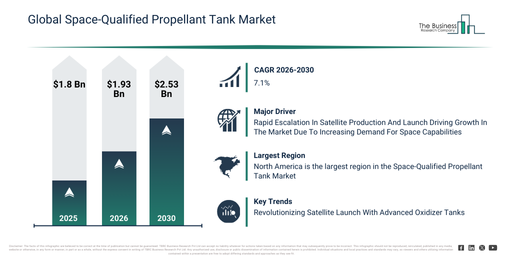
The market for space-qualified propellant tanks has experienced robust expansion over recent years. This market is projected to expand from $1.8 billion in 2025 to reach $1.93 billion by 2026, demonstrating a compound annual growth rate (CAGR) of 7.1%. Historically, this expansion has been driven by several factors, including the rising demand for cryogenic and metallic propellant tanks used in space missions, improvements in composite overwrapped pressure vessel technology, the increase in satellite and spacecraft launch initiatives, the creation of reusable and highly dependable storage systems, and enhanced cooperation between aerospace producers and space organizations._x000D_
_x000D_
The space-qualified propellant tank market is projected to experience substantial growth in the upcoming years, with its valuation expected to climb to $2.53 billion by 2030, demonstrating a compound annual growth rate (CAGR) of 7.1%. This expansion over the forecast period is primarily driven by an emphasis on lightweight and high-strength composite materials, the increasing scale of commercial space exploration and satellite deployment, the incorporation of advanced monitoring and telemetry systems for propellant management, the design of modular and multi-use tank systems, and the adoption of next-generation propulsion technologies that require specific storage solutions. Noteworthy trends for this period include the widespread adoption of lightweight composite propellant tanks to improve launch efficiency, a rising demand for pressure vessels that support electric propulsion systems, an increase in tank manufacturing for small satellite constellations, the broader application of cryogenic tanks for deep space missions, and the innovation of green and non-toxic propellant storage solutions._x000D_
_x000D_
#Get A Free Sample Report With In-Depth Market Insights:#_x000D_
_x000D_
#Space-Qualified Propellant Tank Market Development Factors: What’s Supporting Demand?#_x000D_
The increasingly rapid escalation of satellite production and launch is projected to drive the growth of the space-qualified propellant tank market going forward. This refers to the comprehensive process of designing, manufacturing, testing, and deploying satellites into orbit using launch vehicles. The swift increase in satellite production and launch is primarily fueled by the growing demand for communication, navigation, and earth observation capabilities. Space-qualified propellant tanks are indispensable in this rapid escalation of satellite production and launch, as they are responsible for storing and managing the fuel vital for satellite propulsion, maneuvering, and orbital stability. For instance, in July 2023, data from The United Nations Office for Outer Space Affairs (UNOOSA), an Austria-based organization that promotes international cooperation in the peaceful use and exploration of outer space, revealed that as of June 2023, there were 11,330 individual satellites orbiting Earth, marking a significant 37.94% growth since January 2022. Therefore, the accelerating rate of satellite deployment will increase the demand for space-qualified propellant tanks._x000D_
_x000D_
#Space-Qualified Propellant Tank Market Segment Analysis And Revenue Potential#_x000D_
The space-qualified propellant tank market covered in this report is segmented – _x000D_
_x000D_
1) By Propellant Tank Type: Diaphragm Tanks, High Pressure Tanks, Helium, Nitrogen, And Xenon Tanks, Other Propellant Tank Types_x000D_
2) By Material: Carbon Fiber, Aluminium and Titanium Alloys, Thermoset and Thermoplastic, Nanomaterials, Other Materials_x000D_
3) By Satellite: Nano And Microsatellite, Small Satellite, Medium Satellite, Large Satellite_x000D_
_x000D_
Subsegments:_x000D_
1) By Diaphragm Tanks: Single Diaphragm Tanks, Double Diaphragm Tanks, Flexible Diaphragm Tanks_x000D_
2) By High Pressure Tanks: Composite Material Tanks, Metal Alloy Tanks, Hybrid Tanks_x000D_
3) By Helium, Nitrogen, And Xenon Tanks: Helium Tanks, Nitrogen Tanks, Xenon Tanks_x000D_
4) By Other Propellant Tank Types: Cryogenic Propellant Tanks, Hypergolic Propellant Tanks, Green Propellant Tanks, Pressurized Fluid Tanks_x000D_
_x000D_
#Space-Qualified Propellant Tank Market Transformation Trends: What Innovations Are Driving Change?#_x000D_
Leading companies in the space-qualified propellant tank market are concentrating on technological innovations, such as cryogenic oxidizer tanks, to enhance fuel efficiency, lower launch expenditures, and improve the reliability and safety of space missions. A cryogenic oxidizer tank serves as a specialized vessel crafted to store oxidizing propellants in liquid form at extremely low temperatures, typically for integration into rocket propulsion systems. For example, in July 2024, Scorpius Space Launch, an aerospace company based in the US, formed a partnership with Vaya Space, a US-based space firm, to engineer their largest Class V linerless cryogenic oxidizer tank to date. This tank, with a six-foot-diameter and 22.6-foot-long design, is intended for Vaya’s Dauntless launch vehicle and employs non-toxic, recycled HDPE fuel, with the aim of reducing launch costs and increasing safety._x000D_
_x000D_
#Space-Qualified Propellant Tank Market Key Players Shaping Industry Direction#_x000D_
Major companies operating in the space-qualified propellant tank market are Lockheed Martin Corporation, Northrop Grumman Corporation, Mitsubishi Heavy Industries (MHI), Eaton Corporation plc, IHI Aerospace Co., Space Exploration Technologies Corp (SpaceX), Rafael Advanced Defense Systems, Moog Inc., ArianeGroup SAS, MT Aerospace AG, OHB SE, RUAG Space, Nammo AS, Firefly Aerospace Inc., AVIO S.p.A., Dawn Aerospace B.V., Agile Space Industries, Antrix Corporation, Microcosm Inc, Innovative Space Carrier Inc. _x000D_
_x000D_
#View The Full Space-Qualified Propellant Tank Market Report:#_x000D_
_x000D_
#Space-Qualified Propellant Tank Market Largest Region: Which Geography Holds The Highest Market Share?#_x000D_
North America was the largest region in the space-qualified propellant tank market in 2025. Asia-Pacific is expected to be the fastest-growing region in the forecast period. The regions covered in the space-qualified propellant tank market report are Asia-Pacific, South East Asia, Western Europe, Eastern Europe, North America, South America, Middle East, Africa._x000D_
_x000D_
#Reach Out To Our Team:#_x000D_
_x000D_
The Business Research Company: https://www.thebusinessresearchcompany.com/_x000D_
Americas: +1 310-496-7795_x000D_
Asia: +44 7882 955267 & +91 8897263534_x000D_
Europe: +44 7882 955267_x000D_
Email us at: marketing@tbrc.info_x000D_
_x000D_
#Follow us on:#_x000D_
_x000D_
LinkedIn: https://in.linkedin.com/company/the-business-research-company_x000D_
YouTube: https://www.youtube.com/channel/UC24_fI0rV8cR5DxlCpgmyFQ_x000D_
Global Market Model: https://www.thebusinessresearchcompany.com/global-market-model

Wasay has over a decade of experience in market research, data modelling, and analytics, with prior experience at GlobalData and Decision Tree Consulting Services. At The Business Research Company , he leads research operations across syndicated studies, customized consulting engagements, and the Global Market Model platform. His professional experience includes supporting organizations such as Boston Consulting Group, KPMG, and Ernst & Young. Wasay holds a degree in Electronics and Communications Engineering, postgraduate management qualifications from International Management Institute Belgium and Indian School of Business and Entrepreneurship, and completed the Integrated Program in Business Analytics from Indian Institute of Management Indore.
