Backed by market attractiveness analysis, total addressable market sizing, company benchmarking matrices, interactive Excel dashboards, wider supply chain intelligence, emerging startup coverage, and detailed product-level insights, The Business Research Company’s 2026 market reports are designed to offer research that is more actionable and strategically valuable than ever.
Petrochemicals Market Size And Revenue Outlook Through 2030
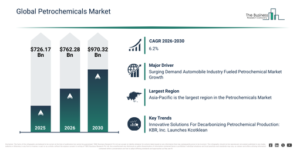
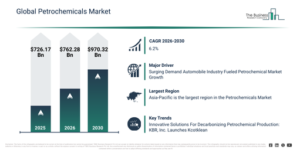
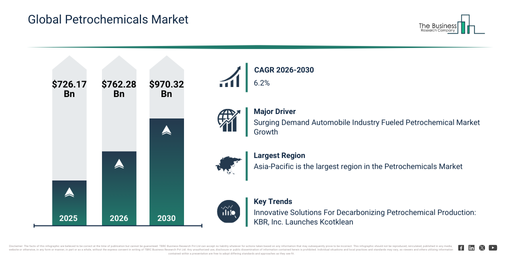
The petrochemicals market has experienced consistent expansion over recent years. It is projected to expand from $726.17 billion in 2025 to $762.28 billion in 2026, demonstrating a compound annual growth rate (CAGR) of 5.0%. This historical growth can be ascribed to several factors, including the expanding plastics and polymer industry, the development of automotive and construction sectors, the sustained availability of fossil fuel feedstocks, increasing demand for synthetic materials, and ongoing industrialization across developing regions.
The petrochemicals market is projected to experience substantial expansion in the coming years. By 2030, this market is anticipated to reach $970.32 billion, demonstrating a compound annual growth rate (CAGR) of 6.2%. The projected growth during this period is driven by several factors, including the escalating demand for lightweight materials, the expansion of electric vehicles and battery technologies, increased investments in petrochemical production capacity, the broadening scope of packaging and consumer goods industries, and a heightened emphasis on high-value petrochemical derivatives. Key trends expected during the forecast timeframe encompass the surging demand for polymer-based products, the increasing utilization of petrochemicals in packaging applications, wider adoption in synthetic fibers, the growth of specialty petrochemicals, and an intensified focus on enhancing process efficiency and scaling operations.
Get A Free Sample Report With In-Depth Market Insights:
Petrochemicals Market Industry Drivers: What’s Behind The Revenue Growth?
The petrochemicals market is anticipated to benefit from the expansion of the automobile industry throughout the forecast period. An automobile, being a motorized vehicle, is primarily designed for conveying passengers or cargo on roads, commonly powered by an internal combustion engine or an electric motor. The push for automobile production is consequently driving up the demand for petrochemical products, which are vital for manufacturing components like brake parts, radiators, and various other parts. For instance, the European Automobile Manufacturers Association, a Belgium-based automobile industry association, indicated in January 2024 that in 2023, the EU car market observed a 13.9% growth compared to 2022, reaching total annual sales of 10.5 million vehicles. Therefore, the increasing growth of automobiles is projected to heighten the demand for petrochemicals during the forecast period.
Petrochemicals Market Segment Landscape And Growth Outlook
The petrochemicals market covered in this report is segmented –
1) By Type: Ethylene-Petrochemicals, Propylene-Petrochemicals, Benzene-Petrochemicals, Xylene
2) By Application: Polymers, Paints & Coatings, Solvents, Rubber, Adhesives & Sealants, Surfactants, Fibers & Fabrics, Other Applications
3) By End User Industry: Textile, Paints And Coatings, Synthetic Rubber And Fibers, Plastic Materials And Resins, Other End Users
Subsegments:
1) By Ethylene-Petrochemicals: Ethylene Glycol, Ethylene Oxide, Polyethylene (PE)
2) By Propylene-Petrochemicals: Propylene Glycol, Polypropylene (PP), Acrylonitrile
3) By Benzene-Petrochemicals: Styrene, Phenol, Cyclohexane, Xylene
4) By Xylene: Para-Xylene, Ortho-Xylene, Meta-Xylene
#Petrochemicals Market Growth Trends: What’s Shaping The Future Outlook?
Major companies in the petrochemicals market are increasingly prioritizing the development of innovative solutions, such as decarbonizing petrochemical production, to reduce their carbon footprint and adhere to stringent environmental regulations. Decarbonizing petrochemical production refers to the method of decreasing carbon dioxide (CO2) emissions associated with the manufacturing of petrochemical products. For instance, in July 2024, KBR, Inc., a US-based company operating in science, technology, and engineering, launched KCOTKlean, a suite of low- and zero-carbon technologies aimed at decarbonizing the catalytic olefins process in the petrochemical industry. This innovative solution combines KBR’s K-COT technology with CPOx (catalytic partial oxidation) technology from the Korea Institute of Machinery and Materials (KIMM). KCOTKleanTM focuses on mitigating carbon emissions through the adoption of circular feeds, cleaner fuels, electrification, and effective carbon capture methods.
Petrochemicals Market Competitive Landscape: Who Leads The Industry?
Major companies operating in the petrochemicals market are Royal Dutch Shell PLC, Saudi Basic Industries Corporation (SABIC), The Dow Chemical Company, China Petroleum & Chemical Corporation (Sinopec), LyondellBasell Industries N.V., LG Chem Ltd., Chevron Phillips Chemical Company LLC, INEOS Group Holdings S.A., BASF SE, GS Caltex Corporation, Haldia Petrochemicals Ltd, Kuwait Petroleum Corporation, Imperial Oil Limited, Duqm Refinery & Petrochemical Industries, Mitsui Chemicals, PKN ORLEN, China National Offshore Oil Corporation, Sumitomo Chemical Co., Inc, LUKOIL, Nizhnekamskneftekhim, NOVA Chemicals Corporation, Keiyo Ethylene Co Ltd, Rongsheng Petrochemical, Reliance Industries Limited, Manali Petrochemicals Ltd, DCW Limited, China National Petroleum Corporation, Supreme Petrochem Ltd, Sasol, Total, Egyptian Petrochemicals Holding Company (ECHEM), RusGazDobycha, Borealis AG, BP plc, Cepsa, Gazprom, Mitsubishi Chemical Corp, Saudi Aramco, Versalis, Osaka Petrochemical Industries Ltd, Maruzen Petrochemical Co., Idemitsu Kosan Co., Rosneft, Repsol, Sidi Kerir Petrochemicals Company (SIDPEC), ADNOC, ExxonMobil Petroleum & Chemical, Zhejiang Hengyi, Carbon Holdings Limited, SIBUR, Finolex Industries Limited
View The Full Petrochemicals Market Report:
Petrochemicals Market Top Region: Where Does Most Revenue Come From?
Asia-Pacific was the largest region in the petrochemicals market in 2025. Middle East was the second largest region in the petrochemicals market. The regions covered in the petrochemicals market report are Asia-Pacific, South East Asia, Western Europe, Eastern Europe, North America, South America, Middle East, Africa
Reach Out To Our Team:
The Business Research Company: https://www.thebusinessresearchcompany.com/
Americas: +1 310-496-7795
Asia: +44 7882 955267 & +91 8897263534
Europe: +44 7882 955267
Email us at: marketing@tbrc.info
Follow us on:
LinkedIn: https://in.linkedin.com/company/the-business-research-company
YouTube: https://www.youtube.com/channel/UC24_fI0rV8cR5DxlCpgmyFQ
Global Market Model: https://www.thebusinessresearchcompany.com/global-market-model

Wasay has over a decade of experience in market research, data modelling, and analytics, with prior experience at GlobalData and Decision Tree Consulting Services. At The Business Research Company , he leads research operations across syndicated studies, customized consulting engagements, and the Global Market Model platform. His professional experience includes supporting organizations such as Boston Consulting Group, KPMG, and Ernst & Young. Wasay holds a degree in Electronics and Communications Engineering, postgraduate management qualifications from International Management Institute Belgium and Indian School of Business and Entrepreneurship, and completed the Integrated Program in Business Analytics from Indian Institute of Management Indore.