Backed by market attractiveness analysis, total addressable market sizing, company benchmarking matrices, interactive Excel dashboards, wider supply chain intelligence, emerging startup coverage, and detailed product-level insights, The Business Research Company’s 2026 market reports are designed to offer research that is more actionable and strategically valuable than ever.
Rhizobium Bacteria Fertilizers Market Revenue Growth On Track For A 9.8% CAGR Through 2030
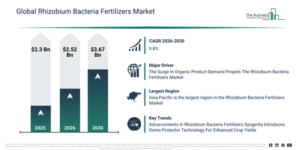
The market for rhizobium bacteria fertilizers has demonstrated strong growth over recent years. It is anticipated to expand from $2.3 billion in 2025 to $2.52 billion in 2026, achieving a compound annual growth rate (CAGR) of 9.6%. This historical expansion can be linked to the increased application of biofertilizers in pulse cultivation, a heightened recognition of soil fertility management, the proliferation of organic farming methods, the increasing expenses of synthetic nitrogen fertilizers, and the availability of carrier-based biofertilizers.
The rhizobium bacteria fertilizers market is anticipated to experience robust growth over the next few years, with its size projected to reach $3.67 billion in 2030, demonstrating a compound annual growth rate (CAGR) of 9.8%. This expansion during the forecast period is driven by factors such as the increasing adoption of sustainable agriculture practices, a rising demand for residue-free crop inputs, the broadening of bio-based fertilizer policies, a heightened focus on carbon-neutral farming, and increased investments in microbial formulation technologies. Major trends expected in this period include the wider adoption of biological nitrogen fixation solutions, a growing demand for crop-specific biofertilizer formulations, the increasing use of liquid biofertilizers, the expansion of sustainable soil health practices, and an enhanced emphasis on yield improvement in leguminous crops.
Get A Free Sample Report With In-Depth Market Insights:
Rhizobium Bacteria Fertilizers Market Growth Drivers: What’s Behind The Acceleration?
The increasing consumer demand for organic items is projected to propel the expansion of the rhizobium bacteria fertilizers market moving forward. Organic products are those derived from organic farming or agricultural materials. This escalating demand for organic goods will directly benefit rhizobium bacteria fertilizer. Rhizobium bacteria are capable of reducing the reliance on artificial fertilizers by fixing atmospheric nitrogen, which is essential for crop production. The use of biofertilizers such as rhizobium bacteria fertilizers can help in fulfilling the nutritional food needs of the world’s growing population. For example, in May 2023, the Organic Trade Association, a US-based organic industry body, reported that total organic sales in 2022, including organic non-food products, reached a landmark $60 billion. By 2023, this amount had climbed to a record $67.6 billion, demonstrating considerable growth in the organic sector’s market value. Thus, the rising demand for organic products is acting as a key driver for the growth of rhizobium bacteria fertilizers.
Rhizobium Bacteria Fertilizers Market Segment Performance And Emerging Opportunities
The rhizobium bacteria fertilizers market covered in this report is segmented –
1) By Type: Rhizobium Inoculants, Bradyrhizobium Inoculants, Mesorhizobium Inoculants, Sinorhizobium (Ensifer) Inoculants, Crop-Specific Rhizobium Strains, Multi-Strain Rhizobium Formulations
2) By Crop: Leguminous Pulses, Leguminous Oilseeds, Forage Legumes, Green Manure Legumes, Other Leguminous Crops
3) By Technology: Carrier Enriched Biofertilizers, Liquid Biofertilizers
4) By Application: Seed Inoculation, Soil Application, Root Dip Application, Furrow Application At Sowing, Other Applications
Subsegments:
1) By Rhizobium Inoculants: Rhizobium leguminosarum, Rhizobium trifolii, Rhizobium phaseoli
2) By Bradyrhizobium Inoculants: Bradyrhizobium japonicum, Bradyrhizobium elkanii, Bradyrhizobium diazoefficiens
3) By Mesorhizobium Inoculants: Mesorhizobium ciceri, Mesorhizobium loti, Mesorhizobium mediterraneum
4) By Sinorhizobium (Ensifer) Inoculants: Ensifer meliloti, Ensifer fredii, Ensifer medicae
5) By Crop-Specific Rhizobium Strains: Soybean-Specific Strains, Chickpea-Specific Strains, Pea-Specific Strains, Lentil-Specific Strains, Groundnut-Specific Strains
6) By Multi-Strain Rhizobium Formulations: Dual-Strain Rhizobium Blends, Multi-Species Rhizobium Consortia, Broad-Spectrum Legume Inoculants
Rhizobium Bacteria Fertilizers Market Trends: What’s Defining The Industry’s Next Phase?
Major companies in the rhizobium bacteria fertilizers market are concentrating on creating sophisticated solutions, such as osmo protector technology, to enhance the resilience and effectiveness of rhizobium bacteria under challenging conditions like drought and salinity, ensuring superior nitrogen fixation and increased crop yields. Osmoprotector technology assists rhizobium bacteria fertilizers by boosting their resistance to environmental stressors like drought, thereby improving their capacity to fix nitrogen and promote plant growth. For instance, in September 2024, Syngenta, a Switzerland-based agricultural technology company, introduced atuva inoculants for pulse and soybean crops. These inoculants incorporate rhizobia bacteria applied to seeds and soil, which improves nodulation and nitrogen fixation. The range offers granular and liquid options, featuring osmoprotector technology (OPT) for extended seed survival and stress protection, enabling efficient application. This addition reinforces Syngenta’s position in the rhizobium bacteria fertilizer market by offering advanced solutions for growers.
Rhizobium Bacteria Fertilizers Market Key Players: Which Companies Lead Industry Competition?
Major companies operating in the rhizobium bacteria fertilizers market are Novozymes A/S, BASF SE, Chr. Hansen Holding A/S, Rizobacter Argentina S.A., Lallemand Plant Care, Isagro S.p.A., ABiTEP GmbH, Andermatt Biocontrol AG, UPL Limited, MBI International LLC, Legume Technology Ltd, Kan Biosys Pvt Ltd, IPL Biologicals, Camson Biotech, Biostadt Agro, T. Stanes & Company Ltd, National Fertilizers Limited, Gujarat State Fertilizers & Chemicals Ltd, Madras Fertilizers Limited, Soygro (Pty) Ltd, Rashtriya Chemicals & Fertilizers Ltd, Permafrost Bio
View The Full Rhizobium Bacteria Fertilizers Market Report:
Rhizobium Bacteria Fertilizers Market Geographic Distribution And Regional Opportunities
Asia-Pacific was the largest region in the rhizobium bacteria fertilizers market in 2025. The regions covered in the rhizobium bacteria fertilizers market report are Asia-Pacific, South East Asia, Western Europe, Eastern Europe, North America, South America, Middle East, Africa
Reach Out To Our Team:
The Business Research Company: https://www.thebusinessresearchcompany.com/
Americas: +1 310-496-7795
Asia: +44 7882 955267 & +91 8897263534
Europe: +44 7882 955267
Email us at: marketing@tbrc.info
Follow us on:
LinkedIn: https://in.linkedin.com/company/the-business-research-company
YouTube: https://www.youtube.com/channel/UC24_fI0rV8cR5DxlCpgmyFQ
Global Market Model: https://www.thebusinessresearchcompany.com/global-market-model

Wasay has over a decade of experience in market research, data modelling, and analytics, with prior experience at GlobalData and Decision Tree Consulting Services. At The Business Research Company , he leads research operations across syndicated studies, customized consulting engagements, and the Global Market Model platform. His professional experience includes supporting organizations such as Boston Consulting Group, KPMG, and Ernst & Young. Wasay holds a degree in Electronics and Communications Engineering, postgraduate management qualifications from International Management Institute Belgium and Indian School of Business and Entrepreneurship, and completed the Integrated Program in Business Analytics from Indian Institute of Management Indore.