Backed by market attractiveness analysis, total addressable market sizing, company benchmarking matrices, interactive Excel dashboards, wider supply chain intelligence, emerging startup coverage, and detailed product-level insights, The Business Research Company’s 2026 market reports are designed to offer research that is more actionable and strategically valuable than ever.
Phenolic Resins Market Revenue Growth On Track For A 7% CAGR Through 2030
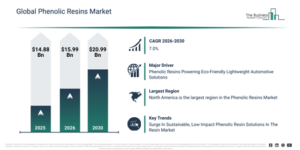
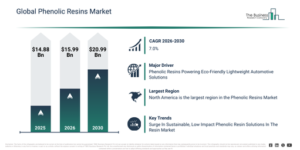
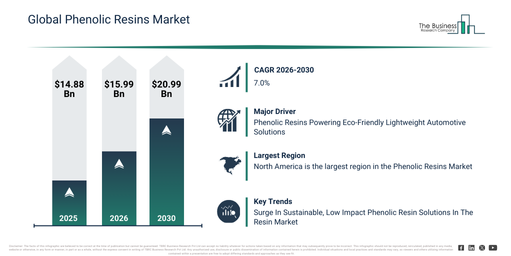
The phenolic resins market size has seen robust expansion in recent years. It is anticipated to expand from $14.88 billion in 2025 to $15.99 billion in 2026, achieving a compound annual growth rate (CAGR) of 7.5%. The historical growth in this sector is largely due to factors such as the increased manufacturing of automotive components, the development of construction and insulation materials, a rising adoption in electrical laminates, the growing need for durable adhesives, and the availability of economical phenolic formulations.
The phenolic resins market is projected to experience substantial expansion over the coming years. Its valuation is anticipated to reach $20.99 billion by 2030, progressing at a compound annual growth rate (CAGR) of 7.0%. This anticipated growth during the forecast timeframe is primarily driven by factors such as the increasing integration into electric vehicle parts, a heightened need for eco-friendly resin substitutes, the expansion of electronics production, escalating investments in heat-resistant substances, and a greater emphasis on solutions involving circular materials. Key developments expected within this period involve a rise in the application of high-performance thermoset resins, increased utilization in automotive weight reduction initiatives, a growing requirement for fire-resistant products, broader application of phenolic resins in electrical insulation, and a stronger focus on thermoset materials that can be recycled.
Get A Free Sample Report With In-Depth Market Insights:
Phenolic Resins Market Growth Momentum: What Factors Are Shaping Demand?
The increasing demand for lightweight and environmentally friendly synthetic structures in the automotive industry is set to drive the phenolic resin market forward. The automotive sector involves the design, manufacturing, distribution, and sales of automobiles. Automotive manufacturers continuously utilize lightweight materials to improve fuel efficiency. Phenolic resins are employed in creating lightweight tires, brake pedals, and other under-the-hood automotive parts. For instance, in January 2024, according to the U.S. Department of Energy, a US-based government agency, plug-in electric vehicles made up 9.8% of all light-duty vehicle sales in December 2023, an increase from 7.8% in December 2022. Throughout 2023, plug-in vehicles consistently accounted for at least 8% of monthly sales, whereas in 2022 their proportion ranged between 5.5% and 7.8%. Therefore, the expanding adoption of lightweight materials in the automotive industry is propelling the phenolic resin market.
Phenolic Resins Market Segment Trends And Revenue Contributors
The phenolic resins market covered in this report is segmented –
1) By Type: Resol, Novolac, Other Types
2) By Application: Wood Adhesives, Molding, Insulation, Laminates, Paper Impregnation, Friction Materials, Refractory Materials, Other Applications
3) By End-User: Building and Construction, Furniture, Automotive, Electrical and Electronics, Other End Users
Subsegments:
1) By Resol: Low-Viscosity Resol Resins, High-Viscosity Resol Resins
2) By Novolac: Liquid Novolac Resins, Solid Novolac Resins, Thermosetting Novolac Resins
3) By Other Types: Modified Phenolic Resins, Bakelite Resins, Phenolic Foam Resins
Phenolic Resins Market Trends Redefining Industry Growth
Leading companies within the phenolic resins market are concentrating on creating sophisticated solutions, including bio-circular epoxy resin systems, to improve environmental sustainability and decrease the carbon footprint in resin-based products. These bio-circular epoxy resin systems utilize renewable or mass-balanced feedstocks, incorporate safer chemical makeup, and employ waterborne or low volatile organic compound (VOC) formulations, ensuring performance comparable to conventional resins while significantly lessening environmental effects. As an illustration, Westlake Epoxy, a U.S. resin and epoxy producer, introduced EpoVIVE in March 2025, a fresh collection encompassing bio-circular and low-emission epoxy phenolic resins and their corresponding curing agents. The EpoVIVE range contributes to a reduced carbon footprint by employing ISCC PLUS mass-balanced renewable raw materials, utilizing energy-efficient manufacturing processes, offering waterborne low-VOC dispersions, and providing materials that are safer, free from Substances of Very High Concern (SVHC), and Carcinogenic, Mutagenic or Reprotoxic (CMR) substances. This product suite features resin grades like EPIKOTE 901 and 902, alongside solvent-free AQUAREOUS systems, which are well-suited for applications such as flooring coatings, concrete or metal protective layers, and advanced adhesives. Furthermore, this portfolio supports circular economy principles through formulations specifically crafted for reuse, recycling, or repurposing, thus allowing sectors like automotive, aerospace, coatings, composites, and construction to achieve their sustainability targets without compromising product performance.
Phenolic Resins Market Competitive Landscape: Which Companies Lead The Industry?
Major companies operating in the phenolic resins market are Hexion Inc., Sumitomo Bakelite Co., Ltd., SI Group Inc., BASF SE, DIC Corporation, Kolon Industries, Georgia‑Pacific Chemicals, Aica Kogyo Co., Ltd., Jinan Shengquan Group Co., Ltd., Shandong Laiwu Runda New Material Co., Ltd., Prefere Resins GmbH, Metadynea International GmbH, Chang Chun Group, Sbhpp (Shanghai BHH Phenolic Polymers?), Plenco LLC, UCP Chemicals AG, Lerg SA, Mitsui Chemicals, Inc., Ashland Global Holdings Inc., Changshu South‑East Plastic Co., Ltd., Allnex
View The Full Phenolic Resins Market Report:
Phenolic Resins Market Geographic Analysis: Where Is Demand Rising Fastest?
North America was the largest region in the phenolic resins market in 2025. Asia-Pacific is expected to be the fastest-growing region in the forecast period. The regions covered in the phenolic resins market report are Asia-Pacific, South East Asia, Western Europe, Eastern Europe, North America, South America, Middle East, Africa
Reach Out To Our Team:
The Business Research Company: https://www.thebusinessresearchcompany.com/
Americas: +1 310-496-7795
Asia: +44 7882 955267 & +91 8897263534
Europe: +44 7882 955267
Email us at: marketing@tbrc.info
Follow us on:
LinkedIn: https://in.linkedin.com/company/the-business-research-company
YouTube: https://www.youtube.com/channel/UC24_fI0rV8cR5DxlCpgmyFQ
Global Market Model: https://www.thebusinessresearchcompany.com/global-market-model

Wasay has over a decade of experience in market research, data modelling, and analytics, with prior experience at GlobalData and Decision Tree Consulting Services. At The Business Research Company , he leads research operations across syndicated studies, customized consulting engagements, and the Global Market Model platform. His professional experience includes supporting organizations such as Boston Consulting Group, KPMG, and Ernst & Young. Wasay holds a degree in Electronics and Communications Engineering, postgraduate management qualifications from International Management Institute Belgium and Indian School of Business and Entrepreneurship, and completed the Integrated Program in Business Analytics from Indian Institute of Management Indore.