Built to provide research that’s more actionable and strategically valuable, The Business Research Company’s 2026 market reports include market attractiveness analysis, total addressable market sizing, company benchmarking matrices, interactive Excel dashboards, broader supply chain intelligence, emerging startup tracking, and in-depth product insights.
Polyisobutylene Market CAGR Outlook And Future Development
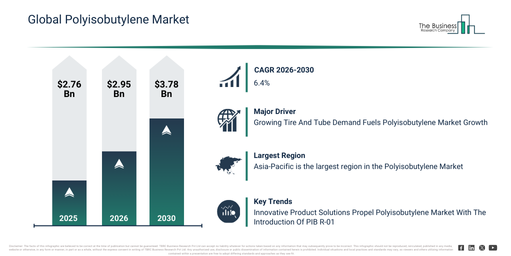
The polyisobutylene market has seen robust growth over recent years. It is projected to expand from $2.76 billion in 2025 to $2.95 billion in 2026, achieving a compound annual growth rate (CAGR) of 6.9%. This historical expansion can be attributed to several factors, including the increase in automotive manufacturing, the growing demand for tire inner liners, the wider application of industrial sealants, the rising consumption of specialty lubricants, and the consistent availability of isobutylene feedstock.
The polyisobutylene market is projected to achieve significant expansion in the coming years, with its size expected to reach $3.78 billion by 2030, demonstrating a compound annual growth rate (CAGR) of 6.4%. This anticipated growth throughout the forecast period is driven by factors such as the increasing integration into electric vehicle components, a heightened need for durable industrial materials, the widening scope of high-barrier packaging applications, an escalating emphasis on performance polymers, and greater capital expenditure in advanced elastomer formulations. Noteworthy trends during this period are expected to include a surging demand for high-performance elastomers, their increased application in automotive sealants, growing incorporation into lubricant additives, the broadening of gas-barrier applications, and a sharpened focus on chemical resistance properties.
Get A Free Sample Report With In-Depth Market Insights:
Polyisobutylene Market Opportunity Drivers: What’s Unlocking New Revenue Potential?
The polyisobutylene market is projected to expand due to increasing demand for tires and tubes. These automotive components facilitate transportation, and polyisobutylene, a synthetic rubber, is essential in manufacturing tire inner tubes for various vehicles such as buses, cars, lorries, and airplanes. Its effectiveness as an oxygen barrier means that a surge in the need for tires and tubeless tires directly stimulates the demand for polyisobutylene. For example, the Japan Automobile Tyre Manufacturers Association, a Japan-based trade association for tire producers, reported in December 2024 that worldwide rubber consumption for tires and related products reached an estimated 18.04 million tons in 2024, marking a 2% increase compared to the prior year. Consequently, the growing demand within the tires and tubes market is a key factor driving the polyisobutylene market’s growth. The polyisobutylene market is anticipated to grow due to expanding demand from the construction industry. This sector focuses on developing new infrastructure. Polyisobutylene finds extensive application in the construction field for manufacturing anticorrosion coatings, pastes, glues, and various other coatings. Consequently, a rise in construction activity directly boosts the need for polyisobutylene. For example, the Office for National Statistics (ONS), a non-ministerial department based in the UK, reported that in November 2024, monthly construction output saw an estimated increase of 0.4% in volume terms. Therefore, the heightened demand from the construction industry is a primary factor fueling the polyisobutylene market.
Polyisobutylene Market Segment Performance And Emerging Opportunities
The polyisobutylene market covered in this report is segmented –
1) By Product: Conventional PIB, Highly Reactive PIB
2) By Molecular Weight: Low Molecular Weight, Medium Molecular Weight, High Molecular Weight
3) By Application: Tires And Tubes, Adhesives, Sealants, Lubricants, Electrical Insulation, Stretch Wrap
4) By End User Industry: Industrial, Food, Other End User Industries
Subsegments:
1) By Conventional PIB: Low Molecular Weight PIB, High Molecular Weight PIB
2) By Highly Reactive PIB: Modified PIB, Functionalized PIB
Polyisobutylene Market Innovation Trends Shaping Future Development
Key companies operating within the polyisobutylene sector are concentrating on developing innovative approaches, such as expanding production capabilities and implementing advanced manufacturing technologies, to address the increasing need for high-performance elastomers utilized in adhesives, sealants, lubricants, and fuel additives. These developments assist manufacturers in improving product availability, optimizing process efficiency, and strengthening supply dependability compared to conventional production methods. For instance, in August 2023, BASF, a specialty chemicals manufacturer based in Germany, announced a 25% boost in production capacity for its medium-molecular-weight polyisobutenes, marketed under the tradename OPPANOL B, at its Ludwigshafen site. OPPANOL B is a flexible polyisobutylene recognized for its outstanding flexibility, resistance to chemicals, impermeability, and adhesive characteristics. It finds broad application in areas such as pressure-sensitive adhesives, protective films, lubricants, sealants, and packaging materials. This capacity increase bolsters BASF’s ability to meet escalating global demand, guarantees a stable supply, and reinforces the company’s position as a prominent polyisobutylene producer.
Polyisobutylene Market Key Players: Which Companies Lead Industry Competition?
Major companies operating in the polyisobutylene market are Badische Anilin und Soda Fabrik Societas Europaea, TPC Group, Lubrizol Corporation, INEOS Group Limited, Kothari Petrochemicals Limited, Braskem, ENEOS Corporation, Janex S.A., RB Products Inc., Chevron Corporation, Mayzo Inc., Reliance Industries Limited, Evonik Industries AG, KEMAT N.V, Daelim Industrial Company Ltd, ExxonMobil, Lanxess, Dowpol Corporation, Infineum, Shandong Hongrui New Material Technology, Afton Chemical Corporation, Zhejiang Shunda New Material, SABIC, Kemipex, FERRO-PLAST S.r.l., Jilin Petrochemical Company, Efremov Synthetic Rubber Enterprise Company, Naxant, JXTG Nippon Oil & Energy Corporation
View The Full Polyisobutylene Market Report:
Polyisobutylene Market Regional Analysis: Which Region Leads By Revenue?
Asia-Pacific was the largest region in the polyisobutylene market in 2025. Asia-Pacific is expected to be the fastest-growing region in the polyisobutylene market during the forecast period. The regions covered in the polyisobutylene market report are Asia-Pacific, South East Asia, Western Europe, Eastern Europe, North America, South America, Middle East, Africa
Reach Out To Our Team:
The Business Research Company: https://www.thebusinessresearchcompany.com/
Americas: +1 310-496-7795
Asia: +44 7882 955267 & +91 8897263534
Europe: +44 7882 955267
Email us at: marketing@tbrc.info
Follow us on:
LinkedIn: https://in.linkedin.com/company/the-business-research-company
YouTube: https://www.youtube.com/channel/UC24_fI0rV8cR5DxlCpgmyFQ
Global Market Model: https://www.thebusinessresearchcompany.com/global-market-model

Wasay has over a decade of experience in market research, data modelling, and analytics, with prior experience at GlobalData and Decision Tree Consulting Services. At The Business Research Company , he leads research operations across syndicated studies, customized consulting engagements, and the Global Market Model platform. His professional experience includes supporting organizations such as Boston Consulting Group, KPMG, and Ernst & Young. Wasay holds a degree in Electronics and Communications Engineering, postgraduate management qualifications from International Management Institute Belgium and Indian School of Business and Entrepreneurship, and completed the Integrated Program in Business Analytics from Indian Institute of Management Indore.