Featuring market attractiveness scoring, total addressable market sizing, company benchmarking matrices, interactive Excel dashboards, deeper supply chain intelligence, emerging startup tracking, and granular product-level insights, The Business Research Company’s 2026 market reports are built to deliver research that is both more actionable and more strategically valuable.
Synthetic Fibers Market Set To Climb From $135.34 Billion In 2026 To $160.57 Billion By 2030
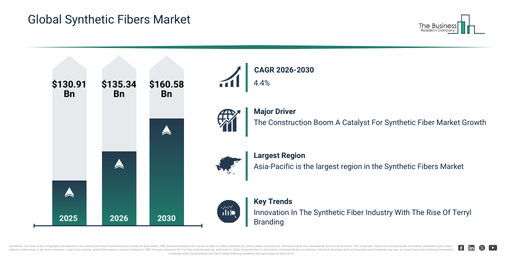
The synthetic fibers market has experienced consistent expansion over recent years. It is anticipated to expand from $130.91 billion in 2025 to $135.34 billion in 2026, achieving a compound annual growth rate (CAGR) of 3.4%. This historical growth can be attributed to several factors including the growth of textile industry, demand for durable fabrics, expansion of apparel manufacturing, adoption of synthetic alternatives, and cost efficiency advantages.
The synthetic fibers market size is anticipated to experience steady growth in the coming years. It is projected to expand to $160.58 billion by 2030, demonstrating a compound annual growth rate (CAGR) of 4.4%. This growth during the forecast period is attributable to factors like the development of technical textiles, the increasing use in electric vehicle interiors, escalating demand for filtration, advancements in fiber chemistry, and material shifts motivated by sustainability. Notable trends for this period involve a rising need for performance textiles, broader application in automotive interiors, expanding utilization in filtration materials, increased integration into home furnishings, and a focus on lightweight, durable fibers.
Get A Free Sample Report With In-Depth Market Insights:
Synthetic Fibers Market Growth Catalysts And Demand Drivers
The synthetic fibers market is expected to grow in the future, propelled by the increasing demand from the construction sector. Construction encompasses the planning, design, building, and assembly of physical structures, facilities, or infrastructure, and it serves as a vital engine for economic development. Synthetic fibers offer benefits like corrosion resistance, high strength-to-weight ratios, and versatility, making them highly valuable in contemporary construction methods. For instance, in June 2025, according to Eurostat, a Luxembourg-based statistical office of the European Union, construction production in April 2025 rose by 3.0% in the euro area and by 2.5% in the EU compared with April 2024. Therefore, the escalating demand for construction is a key factor driving the expansion of the synthetic fibers market.
Synthetic Fibers Market Segment Performance And Emerging Opportunities
The synthetic fibers market covered in this report is segmented –
1) By Type: Polyester, Nylon, Acrylics, Polyolefin, Other Types
2) By Application: Clothing, Home Furnishing, Automotive, Filtration, Other Applications
3) By Distribution Channel: Online, Offline
Subsegments:
1) By Polyester: PET (Polyethylene Terephthalate), PBT (Polybutylene Terephthalate)
2) By Nylon: Nylon 6, Nylon 66
3) By Acrylics: Polyacrylonitrile (PAN)
4) By Polyolefin: Polypropylene (PP), Polyethylene (PE)
5) By Other Types: Aramid, Spandex
Synthetic Fibers Market Trends Shaping Long-Term Demand
Leading synthetic fiber firms are creating new products, such as the TERRYL brand, to boost market revenue. The TERRYL brand provides a diverse range of services, including wellness programs, travel, dining experiences, retail opportunities, and payment solutions. As an example, in 2023, Cathay introduced the TERRYL brand. This new brand, also named Cathay, signifies the company’s transformation into a comprehensive travel and lifestyle entity, expanding beyond its traditional airline services. This rebranding strategy seeks to increase customer expenditure across various platforms and enhance engagement between the company and its clientele.
Synthetic Fibers Market Key Players: Which Companies Lead Industry Competition?
Major companies operating in the synthetic fibers market are Bombay Dyeing & Manufacturing Company Limited, DuPont de Nemours Inc., Indorama Corporation, Lenzing AG, Mitsubishi Chemical Group Corporation, Reliance Industries Limited, Sinopec Corp, Teijin Limited, Toray Chemical Korea Inc., Toyobo Co. Ltd., Dow Chemical Company, Toho Tenax Co. Ltd., Koch Industries Inc., Formosa Plastics Corporation, TUNTEX Group Co. Ltd., Asahi Kasei Corporation, Kolon Industries Inc., Hyosung Corporation, Radici Group, Far Eastern New Century Corporation, Indorama Ventures PCL, Nan Ya Plastics Corporation, Formosa Chemicals & Fibre Corporation, China National Chemical Fiber Corp., Huvis Corporation, Unifi Inc., FiberVisions Corporation, Trevira GmbH, Advansa BV, Wellman International Ltd., Kuraray Co. Ltd., Grasim Industries Ltd., Thai Polyester Co. Ltd., JBF Industries Ltd., Polygenta Technologies Limited, Shinkong Synthetic Fibers Corporation
View The Full Synthetic Fibers Market Report:
Synthetic Fibers Market Leading Geography: Which Region Contributes The Most Revenue?
Asia-Pacific was the largest region in the synthetic fibers market in 2025. Western Europe was the second-largest region in the global synthetic fibers market share. The regions covered in the synthetic fibers market report are Asia-Pacific, South East Asia, Western Europe, Eastern Europe, North America, South America, Middle East, Africa
Reach Out To Our Team:
The Business Research Company: https://www.thebusinessresearchcompany.com/
Americas: +1 310-496-7795
Asia: +44 7882 955267 & +91 8897263534
Europe: +44 7882 955267
Email us at: marketing@tbrc.info
Follow us on:
LinkedIn: https://in.linkedin.com/company/the-business-research-company
YouTube: https://www.youtube.com/channel/UC24_fI0rV8cR5DxlCpgmyFQ
Global Market Model: https://www.thebusinessresearchcompany.com/global-market-model

Wasay has over a decade of experience in market research, data modelling, and analytics, with prior experience at GlobalData and Decision Tree Consulting Services. At The Business Research Company , he leads research operations across syndicated studies, customized consulting engagements, and the Global Market Model platform. His professional experience includes supporting organizations such as Boston Consulting Group, KPMG, and Ernst & Young. Wasay holds a degree in Electronics and Communications Engineering, postgraduate management qualifications from International Management Institute Belgium and Indian School of Business and Entrepreneurship, and completed the Integrated Program in Business Analytics from Indian Institute of Management Indore.