Featuring market attractiveness scoring, total addressable market sizing, company benchmarking matrices, interactive Excel dashboards, deeper supply chain intelligence, emerging startup tracking, and granular product-level insights, The Business Research Company’s 2026 market reports are built to deliver research that is both more actionable and more strategically valuable.
Flame Retardants Market Size Forecast: How Big Could The Market Get By 2030?
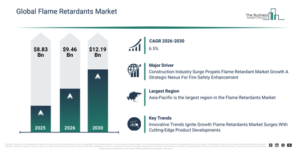
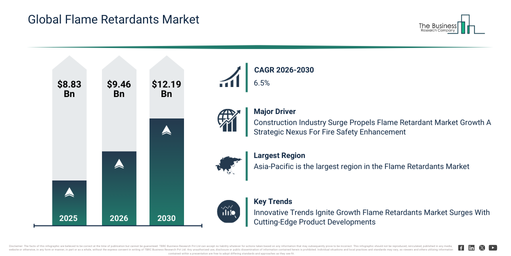
The flame retardants market has shown significant expansion in recent years. Its value is expected to rise from $8.83 billion in 2025 to $9.46 billion in 2026, with a compound annual growth rate (CAGR) of 7.1%. The historical growth of this market is attributable to several factors, including stricter fire safety regulations, the expansion of construction activities, the growth of electronics manufacturing, increasing use in automotive components, and the availability of inorganic flame retardants.
The market for flame retardants is projected to experience robust expansion over the coming years. This market is anticipated to reach $12.19 billion by 2030, demonstrating a compound annual growth rate (CAGR) of 6.5%. The projected growth during this period stems from several factors, including the escalating need for environmentally friendly fire protection, increased integration into electric mobility applications, the proliferation of lightweight flame-retardant substances, a heightened emphasis on formulations with reduced toxicity, and greater investment in advanced materials. Key trends foreseen for the forecast timeframe encompass the increasing acceptance of halogen-free flame retardants, heightened requirements from electric vehicles, broader application in construction materials, the broadening scope of fire-safe electronics applications, and a stronger emphasis on adhering to regulatory standards.
Get A Free Sample Report With In-Depth Market Insights:
Flame Retardants Market Growth Factors: What’s Supporting Expansion?
The expanding construction sector is anticipated to boost the flame retardant market’s growth in the foreseeable future. This industry encompasses diverse operations such as planning, developing, designing, and erecting structures, infrastructure, and various buildings. Flame retardants are crucial for enhancing fire safety in construction, as they are integrated into numerous materials and products to lessen ignition risks, retard flame propagation, and mitigate smoke generation. For example, data released in November 2023 by the U.S. Census Bureau, a key U.S. federal agency for population and economic statistics, indicated that the seasonally adjusted annual rate of construction spending in September 2023 reached $1,996.5 billion. This figure signifies an 8.7 percent (±1.8%) rise compared to the September 2022 estimate of $1,836.9 billion. Consequently, the expanding construction industry is a primary driver for the flame retardant market.
Flame Retardants Market Segment Outlook: Which Categories Are Growing Fastest?
The flame retardants market covered in this report is segmented –
1) By Type: Alumina Trihydrate, Brominated Flame Retardants, Antimony Trioxide, Phosphorous Flame Retardants, Other Types
2) By Application: Unsaturated Polyester Resins, Epoxy Resins, PVC, Rubber, Polyolefins, Other Applications (Engineering Thermoplastics And PET)
3) By End User: Construction, Automotive And Transportation, Electronics, Other End-Users (Textiles, Aerospace, And Adhesives)
Subsegments:
1) By Alumina Trihydrate: Natural Alumina Trihydrate, Synthetic Alumina Trihydrate
2) By Brominated Flame Retardants: Tetrabromobisphenol A (TBBPA), Decabromodiphenyl Ether (DecaBDE), Hexabromocyclododecane (HBCD), Other Brominated Compounds
3) By Antimony Trioxide: Antimony Trioxide (Sb2O3), Other Antimony Compounds
4) By Phosphorous Flame Retardants: Organophosphate Esters, Red Phosphorus, Phosphinate, Other Phosphorous Compounds
5) By Other Types: Inorganic Flame Retardants, Nitrogen-Based Flame Retardants, Intumescent Flame Retardants, Other Specialized Flame Retardants
Flame Retardants Market Industry Trends: What’s Reshaping Demand?
Major companies within the flame retardants market are dedicated to developing innovative solutions, such as advanced high-performance flame-retardant materials, to satisfy the increasing demand for enhanced thermal protection, safety, and durability in high-risk applications. These newly engineered flame-retardant products deliver superior heat resistance and improved processing flexibility when compared to conventional solutions, supporting evolving industrial requirements, particularly in electric vehicle batteries, electronics, and construction. For instance, in September 2024, Asahi Kasei Corporation, a Japan-based chemical company, launched LASTAN flame-retardant nonwoven fabric. This fabric showcases exceptional flame resistance, capable of withstanding temperatures up to 1,300°C with a limiting oxygen index (LOI) of 50 or higher, thereby ensuring high levels of safety in EV battery applications. Its lightweight and flexible design permits easy processing into complex shapes, positioning it as a superior alternative to traditional materials for effective thermal runaway protection and enhanced durability against particle impacts.
Flame Retardants Market Leading Companies And Competitive Benchmarking
Major companies operating in the flame retardants market are BASF SE, ICL Group Limited, Albemarle Corporation, J.M. Huber Corporation, Italmatch Chemicals S.p.A., Nabaltec AG, Du Pont de Nemours and Company, Koninklijke DSM NV, Israel Chemicals Limited, Budenheim Chemicals KG, Eastman Chemical Company, Hangzhou Lingrui Chemical Company Limited, Hongbaoli Group Company Limited, Huntsman International LLC, Daihachi Chemical Industry Co. Ltd., DIC Corporation, Dow Chemical Company, Nyacol Nano Technologies Inc., Rinkagaku Kogyo Co. Ltd., RTP Company, Sanwa Chemical Co. Ltd., Shandong Brother Sci. & Tech. Co. Ltd., Tor Minerals International Inc., Tosoh Corporation, UFP Industries Inc., Lubrizol Corporation, Akzo Nobel NV, Clariant International Ltd., Sinopec Shanghai Petrochemical Company Limited
View The Full Flame Retardants Market Report:
Flame Retardants Market Geographic Landscape: Which Region Leads Industry Growth?
Asia-Pacific was the largest region in the flame retardants market in 2025. Asia-Pacific is expected to be the fastest-growing region in the forecast period. The regions covered in the flame retardants market report are Asia-Pacific, South East Asia, Western Europe, Eastern Europe, North America, South America, Middle East, Africa
Reach Out To Our Team:
The Business Research Company: https://www.thebusinessresearchcompany.com/
Americas: +1 310-496-7795
Asia: +44 7882 955267 & +91 8897263534
Europe: +44 7882 955267
Email us at: marketing@tbrc.info
Follow us on:
LinkedIn: https://in.linkedin.com/company/the-business-research-company
YouTube: https://www.youtube.com/channel/UC24_fI0rV8cR5DxlCpgmyFQ
Global Market Model: https://www.thebusinessresearchcompany.com/global-market-model

Wasay has over a decade of experience in market research, data modelling, and analytics, with prior experience at GlobalData and Decision Tree Consulting Services. At The Business Research Company , he leads research operations across syndicated studies, customized consulting engagements, and the Global Market Model platform. His professional experience includes supporting organizations such as Boston Consulting Group, KPMG, and Ernst & Young. Wasay holds a degree in Electronics and Communications Engineering, postgraduate management qualifications from International Management Institute Belgium and Indian School of Business and Entrepreneurship, and completed the Integrated Program in Business Analytics from Indian Institute of Management Indore.