Featuring market attractiveness scoring, total addressable market sizing, company benchmarking matrices, interactive Excel dashboards, deeper supply chain intelligence, emerging startup tracking, and granular product-level insights, The Business Research Company’s 2026 market reports are built to deliver research that is both more actionable and more strategically valuable.
Glycerol Derivatives Market Size And Revenue Outlook Through 2030
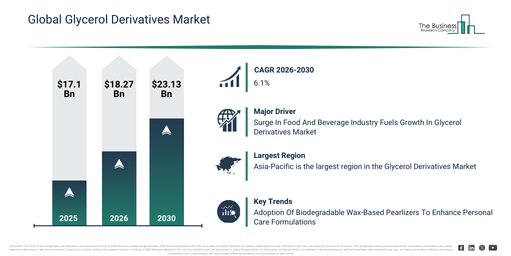
The glycerol derivatives market has experienced substantial growth in recent years. It is projected to increase from $17.1 billion in 2025 to $18.27 billion in 2026, exhibiting a compound annual growth rate (CAGR) of 6.8%. This historic growth can be attributed to factors such as the rising production of biodiesel, the ample availability of crude glycerol, the expansion within the personal care industry, its utilization in pharmaceutical formulations, and the demand for food grade solvents.
The glycerol derivatives market is projected to experience robust expansion over the coming years, with its valuation anticipated to reach $23.13 billion by 2030, driven by a compound annual growth rate (CAGR) of 6.1%. This projected growth during the forecast period is primarily due to factors such as increasing biodiesel production capacity, a surge in demand for bio-based chemicals, the proliferation of clean label products, innovations in glycerol conversion technologies, and the expansion of sustainable packaging solutions. Key trends expected during this period involve the increasing demand for bio-based glycerol derivatives, their growing application in cosmetics and personal care products, the broadening of pharmaceutical-grade uses, increased integration into food and beverage processing, and a heightened emphasis on renewable and sustainable feedstocks.
Get A Free Sample Report With In-Depth Market Insights:
Glycerol Derivatives Market Expansion Drivers: What’s Shaping Future Growth?
The expansion of the food and beverage sector is anticipated to drive the future development of the glycerol derivatives market. This industry encompasses the production, processing, distribution, and sale of various food and drink items. Its growth can be attributed to factors such as increasing urbanization, economic prosperity, higher disposable incomes, emerging health and wellness trends, global integration, and the impact of social media. Glycerol derivatives play a crucial role within this industry, providing numerous functions that enhance product quality, ensure stability, and boost consumer attractiveness. For example, in April 2024, figures released by the National Association of Convenience Stores (NACS), a US-based trade body, indicated that total industry foodservice sales constituted 26.9% of in-store sales in 2023, marking an increase from 25.6% in 2022. During the same period, prepared food sales saw a rise of 12.2% per store per month, establishing it as the top in-store category. Furthermore, in May 2024, the 2024 ANNUAL REPORT from the British Soft Drinks Association, a UK-based trade association, reported that the overall volume of soft drinks consumed reached 15,343 million liters in 2023, up from an interim total of 14,912 million liters in 2022. Consequently, the expanding food and beverage sector is serving as a key impetus for the development of the glycerol derivatives market.
Glycerol Derivatives Market Segment Outlook: Which Categories Are Growing Fastest?
The glycerol derivatives market covered in this report is segmented –
1) By Product: 4-(Hydroxymethyl)-1 3-Dioxolan-2-One, Polyglycerol, Propane-1 2 3-Triyl Triacetate, 1 3 Propanediol, Propylene Glycol, Other Products
2) By Grade: Bio-Based, Petroleum-Based
3) By End-Use: Food And Beverage, Pharmaceuticals, Cosmetics And Personal Care, Construction, Other End-Users
Subsegments:
1) By 4-(Hydroxymethyl)-1,3-Dioxolan-2-One: Industrial-Grade, Pharmaceutical-Grade
2) By Polyglycerol: Polyglycerol-4, Polyglycerol-6, Polyglycerol-10, Others
3) By Propane-1,2,3-Triyl Triacetate: Food-Grade, Pharmaceutical-Grade, Industrial-Grade
4) By 1,3 Propanediol: Bio-Based 1,3 Propanediol, Petroleum-Based 1,3 Propanediol
5) By Propylene Glycol: Food-Grade Propylene Glycol, Pharmaceutical-Grade Propylene Glycol, Industrial-Grade Propylene Glycol
6) By Other Products: Glycerol Esters, Glycerol Monoesters, Glycerol Fatty Acid Esters, Other Glycerol Derivatives
Glycerol Derivatives Market Strategic Trends: What Defines The Next Growth Phase?
Leading companies within the glycerol derivatives market are concentrating on developing technological advancements, such as wax-based opacifier dispersions, to enhance formulation performance, improve visual appeal, and support sustainability objectives. A wax-based opacifier dispersion incorporates naturally derived glycerol esters, including glyceryl oleate, alongside other ingredients to achieve a pearlescent or creamy white appearance, while also maintaining biodegradability and surfactant compatibility. For instance, in April 2025, BASF SE, a Germany-based chemical company, introduced Lamesoft OP Plus, a wax-based opacifier dispersion created for rinse-off personal care formulations. This ingredient is designed to deliver strong opacity and a rich, creamy look, thereby enhancing the sensory profile and visual appeal of products such as shampoos and body washes. Lamesoft OP Plus is readily biodegradable and compatible with modern sulfate-free and ethylene-oxide-free surfactant systems, aligning with the rising demand for “clean beauty” solutions. By combining aesthetic advantages with sustainability-focused attributes, this launch assists personal care brands in seeking high-performance, eco-friendly ingredients for their next-generation cleansing products.
Glycerol Derivatives Market Leading Companies And Competitive Benchmarking
Major companies operating in the glycerol derivatives market are Shell Plc, Cargill Incorporated, Archer Daniels Midland Company, BASF SE, The Procter & Gamble Company, The Dow Chemical Company, Mitsubishi Chemical Corporation, Saudi Basic Industries Corporation, Merck KGaA, Evonik Industries AG, Solvay SA, Sasol Limited, Arkema SA, Akzo Nobel N.V., Kerry Group plc, Huntsman Corporation, Lonza Group AG, Nouryon, Clariant AG, Stepan Company, Croda International Plc, Tokyo Chemical Industry Co. Ltd., Sakamoto Yakuhin Kogyo Co. Ltd., Acuro Organics Limited, Haihang Industry Co. Ltd.
View The Full Glycerol Derivatives Market Report:
Glycerol Derivatives Market Regional Analysis And Top Geography
Asia-Pacific was the largest region in the glycerol derivatives market in 2025. The regions covered in the glycerol derivatives market report are Asia-Pacific, South East Asia, Western Europe, Eastern Europe, North America, South America, Middle East, Africa
Reach Out To Our Team:
The Business Research Company: https://www.thebusinessresearchcompany.com/
Americas: +1 310-496-7795
Asia: +44 7882 955267 & +91 8897263534
Europe: +44 7882 955267
Email us at: marketing@tbrc.info
Follow us on:
LinkedIn: https://in.linkedin.com/company/the-business-research-company
YouTube: https://www.youtube.com/channel/UC24_fI0rV8cR5DxlCpgmyFQ
Global Market Model: https://www.thebusinessresearchcompany.com/global-market-model

Wasay has over a decade of experience in market research, data modelling, and analytics, with prior experience at GlobalData and Decision Tree Consulting Services. At The Business Research Company , he leads research operations across syndicated studies, customized consulting engagements, and the Global Market Model platform. His professional experience includes supporting organizations such as Boston Consulting Group, KPMG, and Ernst & Young. Wasay holds a degree in Electronics and Communications Engineering, postgraduate management qualifications from International Management Institute Belgium and Indian School of Business and Entrepreneurship, and completed the Integrated Program in Business Analytics from Indian Institute of Management Indore.