Featuring market attractiveness scoring, total addressable market sizing, company benchmarking matrices, interactive Excel dashboards, deeper supply chain intelligence, emerging startup tracking, and granular product-level insights, The Business Research Company’s 2026 market reports are built to deliver research that is both more actionable and more strategically valuable.
Grain Fumigants Market CAGR Outlook And Future Development
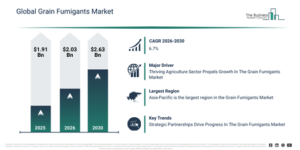
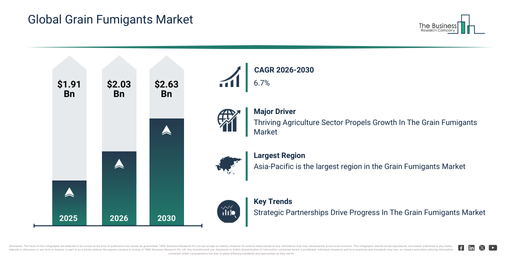
The grain fumigants market has experienced robust expansion in recent years. This market is projected to grow from $1.91 billion in 2025 to $2.03 billion in 2026, demonstrating a compound annual growth rate (CAGR) of 6.3%. The growth witnessed in the past can be attributed to the increase in global grain production, the proliferation of commercial grain storage facilities, heightened pest infestation risks, expanding international grain trade, and the accessibility of chemical fumigation solutions.
The market size for grain fumigants is expected to witness robust growth in the upcoming years. It is forecast to expand to $2.63 billion by 2030, driven by a compound annual growth rate (CAGR) of 6.7%. This projected growth can be attributed to several factors such as an increasing demand for residue-free pest control, the rising adoption of alternative fumigants, the expansion of food security initiatives, growing investments in modern storage systems, and increasing regulatory restrictions on toxic fumigants. Furthermore, significant trends anticipated during the forecast period include the increasing adoption of eco-friendly fumigants, a rising demand for phosphine-based grain protection, a growing focus on reducing post-harvest losses, the expansion of large-scale grain storage infrastructure, and enhanced regulatory compliance in grain protection.
Get A Free Sample Report With In-Depth Market Insights:
Grain Fumigants Market Growth Factors Behind Sustained Expansion
The expansion of the agriculture sector is anticipated to propel the grain fumigants market in the foreseeable future. This sector, often referred to as agribusiness, involves all practices related to land cultivation, crop production, and animal husbandry for generating food, raw materials, and various other agricultural goods. An expanding agriculture sector necessitates grain fumigants, which are crucial for maintaining the quality of harvested grains, ensuring global food security, and adhering to the requirements of a modern and globalized agricultural system. For example, Official statistics, a UK government agency, reported in June 2025 that the UK’s total income from farming (TIFF) reached £7.7 billion ($9.78 billion) in 2024, representing an increase of approximately £1.6 billion ($2.1165 billion) over 2023. Consequently, the burgeoning agriculture sector is a key driver for the growth of the grain fumigants market.
Grain Fumigants Market Driver: Rising Pest Infestations Driving Growth In The Market Due To Climate Change, Urbanization, And Globalization
The growing occurrence of pest infestations is projected to fuel the expansion of the grain fumigants market moving forward. Pest infestation describes the presence and rapid multiplication of undesirable organisms like insects, rodents, or other animals within a specific location, leading to harm or destruction of property, agricultural crops, or the health of humans and other living things. The increase in pest infestations stems from several factors, including climate change, globalization, and urbanization, which establish ideal conditions for pests to flourish and disperse. Grain fumigants are effective in targeting a range of pests, such as insects, fungi, and rodents, enabling the eradication of multiple threats with one application. For example, in April 2024, the Direct Line Group, a UK-based insurance company, reported a significant increase in residential service calls for both cockroaches and bedbugs in 2023. Local councils noted a 23% increase in bedbug-related visits, going from 11,819 in 2022 to 14,587. Likewise, call-outs for cockroaches experienced a 3% rise, increasing from 8,455 to 8,706 visits compared to the previous year. Consequently, the escalating outbreaks of pests are stimulating the growth of the grain fumigants market into the future.
Grain Fumigants Market Segment Analysis Spotlighting Growth Areas
The grain fumigants market covered in this report is segmented –
1) By Product Type: Methyl Bromide, Phosphine, Sulfuryl Fluoride, Other Products
2) By Crop Type: Fruits And Vegetables, Cereals And Grains, Oilseeds And Pulses, Other Crop Types
3) By Application: Residential, Commercial
Subsegments:
1) By Methyl Bromide: Commodity Fumigation, Structural Fumigation, Quarantine And Pre-Shipment Treatment
2) By Phosphine: Solid Phosphine Tablets, Gas Phosphine, Phosphine Generators
3) By Sulfuryl Fluoride: Structural Fumigation, Commodity Fumigation, Insect Control In Food Storage
4) By Other Products: Carbon Dioxide, Nitrogen, Other Fumigant Products
Grain Fumigants Market Industry Trends Fueling Future Revenue Growth
Leading entities within the grain fumigants market are embracing strategic collaborations to jointly develop sustainable and economical pest management solutions centered on ethyl formate. Such partnerships involve organizations utilizing their respective capabilities and assets to secure shared advantages and prosperous outcomes. An example of this is the collaboration formed in May 2023 between Cooperative Bulk Handling Ltd. (CBH Group), an Australia-based cooperative for grain growers, and Universal Biosecurity Ltd. (UBL), an Australia-based supplier of grain fumigants. This alliance seeks to expand CBH Group’s selection of eco-friendly insect control options, thereby ensuring the company meets client and market expectations concerning chemical traces in grain. The agreement empowers both parties to collectively pursue the creation of innovative, sustainable technological advancements. Should these solutions prove effective, they possess the potential for commercial deployment across diverse markets, encompassing Australia, North and South America, the European Union, and key producing Asian regions.
Grain Fumigants Market Leading Companies: Who Holds The Strongest Market Presence?
Major companies operating in the grain fumigants market are BASF, Bayer, Syngenta, Corteva Agriscience, FMC Corporation, UPL, ADAMA, Nufarm, Sumitomo Chemical, Degesch Group, Detia Degesch, Ikeda Corporation, Nippon Soda, Nissan Chemical, Sharda Cropchem, Douglas Products, AMVAC Chemical Corporation, Rentokil Initial, Ensystex, Royal Group Technologies, ScottsMiracle-Gro, Valent BioSciences
View The Full Grain Fumigants Market Report:
Grain Fumigants Market Regional Outlook: Where Is Opportunity Concentrated?
Asia-Pacific was the largest region in the grain fumigants market in 2025. The regions covered in the grain fumigants market report are Asia-Pacific, South East Asia, Western Europe, Eastern Europe, North America, South America, Middle East, Africa
Reach Out To Our Team:
The Business Research Company: https://www.thebusinessresearchcompany.com/
Americas: +1 310-496-7795
Asia: +44 7882 955267 & +91 8897263534
Europe: +44 7882 955267
Email us at: marketing@tbrc.info
Follow us on:
LinkedIn: https://in.linkedin.com/company/the-business-research-company
YouTube: https://www.youtube.com/channel/UC24_fI0rV8cR5DxlCpgmyFQ
Global Market Model: https://www.thebusinessresearchcompany.com/global-market-model

Wasay has over a decade of experience in market research, data modelling, and analytics, with prior experience at GlobalData and Decision Tree Consulting Services. At The Business Research Company , he leads research operations across syndicated studies, customized consulting engagements, and the Global Market Model platform. His professional experience includes supporting organizations such as Boston Consulting Group, KPMG, and Ernst & Young. Wasay holds a degree in Electronics and Communications Engineering, postgraduate management qualifications from International Management Institute Belgium and Indian School of Business and Entrepreneurship, and completed the Integrated Program in Business Analytics from Indian Institute of Management Indore.