Backed by market attractiveness analysis, total addressable market sizing, company benchmarking matrices, interactive Excel dashboards, wider supply chain intelligence, emerging startup coverage, and detailed product-level insights, The Business Research Company’s 2026 market reports are designed to offer research that is more actionable and strategically valuable than ever.
Cosmetic Chemicals Market Revenue Outlook: What CAGR Lies Ahead Through 2030?
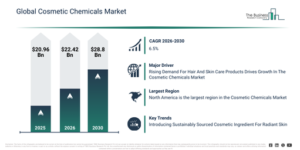
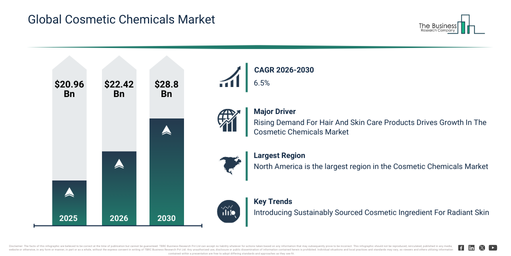
The cosmetic chemicals market has experienced strong growth in recent years. It is forecast to grow from $20.96 billion in 2025 to $22.42 billion in 2026, exhibiting a compound annual growth rate (CAGR) of 7.0%. The expansion observed in the historic period can be ascribed to increased consumption of personal care products, the broadening of the global cosmetics industry, growing consumer awareness regarding ingredient safety, the rising adoption of synthetic surfactants and emollients, and the availability of diverse chemical formulations.
The cosmetic chemicals market size is anticipated to undergo significant expansion over the next few years. It is predicted to attain a valuation of $28.8 billion by 2030, exhibiting a compound annual growth rate (CAGR) of 6.5%. This projected growth during the forecast period stems from factors such as the escalating demand for sustainable beauty products, increased investments in green chemistry, the broadening of premium skincare and haircare segments, a heightened concentration on regulatory-compliant formulations, and the rising adoption of customized cosmetic solutions. Prominent trends identified for this period encompass an increasing preference for natural and bio-based ingredients, a growing utilization of multifunctional cosmetic chemicals, the expanded adoption of clean label formulations, the proliferation of advanced emulsifiers and preservatives, and an intensified focus on skin-compatible ingredients.
Get A Free Sample Report With In-Depth Market Insights:
Cosmetic Chemicals Market Growth Drivers: What’s Behind The Acceleration?
The increasing appeal of hair and skin care products is anticipated to propel the expansion of the cosmetic chemicals market going forward. A skin care product refers to a cosmetic preparation, which could be an antiseptic, tonic, lotion, cream, or other form, utilized for massaging, cleansing, stimulating, manipulating, performing non-invasive hair removal, beautifying, or similar activities on any person’s body. Hair and skin care items are products developed to enhance, protect, and modify the external appearance of bodies. Cosmetic chemicals are primary components employed in hair and skin care products. For instance, in 2024, as per the Cosmetic, Toiletry and Perfumery Association Limited (CTPA), a UK-based trade association, beauty sectors grew to £10.3 billion (USD 13.2 billion), marking an 8.4% increase year-on-year. Additionally, skincare sales climbed +12.2%, driven by strong performance in prestige and healthcare skincare, closely followed by color cosmetics which saw a +10.4% year-on-year growth, and fragrance experiencing a +8.6% increase in value, with mass fragrance performing exceptionally well. Therefore, the escalating popularity of hair and skin care products will continue to drive the growth of the cosmetic chemicals market.
Cosmetic Chemicals Market Segment Performance And Emerging Opportunities
The cosmetic chemicals market covered in this report is segmented –
1) By Product Type: Surfactants, Emollients And Moisturizers, Colorants And Pigments, Preservatives, Emulsifying And Thickening Agents
2) By Application: Perfumes And Fragrances, Hair Care And Skincare, Color Cosmetic Chemicals, Other Applications
3) By End-Use Industry: Skin Care Products, Hair Care Products, Color Cosmetics, Fragrances & Perfumes, Oral Care, Personal Hygiene Products, Other End-Use Categories
Subsegments:
1) By Surfactants: Anionic Surfactants, Cationic Surfactants, Non-Ionic Surfactants, Amphoteric Surfactants
2) By Emollients And Moisturizers: Natural Emollients, Synthetic Emollients, Humectants
3) By Colorants And Pigments: Organic Colorants, Inorganic Pigments, Natural Colorants
4) By Preservatives: Parabens, Phenoxyethanol, Natural Preservatives
5) By Emulsifying And Thickening Agents: Natural Emulsifiers, Synthetic Emulsifiers, Thickening Polymers
Cosmetic Chemicals Market Trends: What’s Defining The Industry’s Next Phase?
Major companies operating in the cosmetic chemicals market are focusing on launching innovative solutions, specifically sustainably sourced cosmetic ingredients, to boost their revenues. Sustainably sourced cosmetic ingredients refer to raw materials used in cosmetic formulations that are derived from renewable resources and are produced in an environmentally responsible way. For example, in September 2023, BASF Personal Care, a Germany-based manufacturer of ingredients for cosmetics, released Epispot, a new sustainably sourced cosmetic ingredient. Epispot is an extract from the French plant Epilobium angustifolium, which is responsibly acquired. It can be utilized for various products, including face serums, cleansers, and other cosmetic formulations. By tackling the underlying reasons for imbalances affecting microbiota, lipids, and the skin’s defense mechanism, Epispot reduces shine, refines the look of facial pores, and supports a healthy complexion. Consistent with the #NoFilter skincare trend, this new ingredient satisfies consumer demand for a natural, ideal appearance without employing digital beauty filters.
Cosmetic Chemicals Market Key Players: Which Companies Lead Industry Competition?
Major companies operating in the cosmetic chemicals market are Dow Chemical Company, Givaudan SA, Ashland Global Holdings Inc., Eastman Chemical Company, Lonza Group Limited, BASF SE, Lanxess AG, P&G Chemicals, Solvay SA, Evonik Industries AG, Bayer AG, Croda International PLC, Stephan Company, Symrise AG, Cargill Inc., Lubrizol Corporation, Cobiosa, Genomatica Inc., Pharmacos, Wacker Chemie AG, Synthomer PLC, Celanese Corporation, Arkema Inc., ARLANXEO Holding BV, Apcotex Industries Limited, Asahi Kasei Corporation, KCC Corporation, Bluestar Silicones USA Corp., Clariant AG, Huntsman Corporation, Momentive Performance Materials Inc., Nippon Shokubai Co. Ltd., OMNOVA Solutions Inc., Shin-Etsu Chemical Co. Ltd.
View The Full Cosmetic Chemicals Market Report:
Cosmetic Chemicals Market Leading Geography: Which Region Contributes The Most Revenue?
North America was the largest region in the cosmetic chemicals market in 2025. Asia-Pacific is expected to be the fastest-growing region in the global cosmetic chemicals market during the forecast period. The regions covered in the cosmetic chemicals market report are Asia-Pacific, South East Asia, Western Europe, Eastern Europe, North America, South America, Middle East, Africa
Reach Out To Our Team:
The Business Research Company: https://www.thebusinessresearchcompany.com/
Americas: +1 310-496-7795
Asia: +44 7882 955267 & +91 8897263534
Europe: +44 7882 955267
Email us at: marketing@tbrc.info
Follow us on:
LinkedIn: https://in.linkedin.com/company/the-business-research-company
YouTube: https://www.youtube.com/channel/UC24_fI0rV8cR5DxlCpgmyFQ
Global Market Model: https://www.thebusinessresearchcompany.com/global-market-model

Wasay has over a decade of experience in market research, data modelling, and analytics, with prior experience at GlobalData and Decision Tree Consulting Services. At The Business Research Company , he leads research operations across syndicated studies, customized consulting engagements, and the Global Market Model platform. His professional experience includes supporting organizations such as Boston Consulting Group, KPMG, and Ernst & Young. Wasay holds a degree in Electronics and Communications Engineering, postgraduate management qualifications from International Management Institute Belgium and Indian School of Business and Entrepreneurship, and completed the Integrated Program in Business Analytics from Indian Institute of Management Indore.