Built to provide research that’s more actionable and strategically valuable, The Business Research Company’s 2026 market reports include market attractiveness analysis, total addressable market sizing, company benchmarking matrices, interactive Excel dashboards, broader supply chain intelligence, emerging startup tracking, and in-depth product insights.
Hydrodesulfurization Catalyst Market Size Outlook: How Quickly Will Revenue Expand Through 2030?
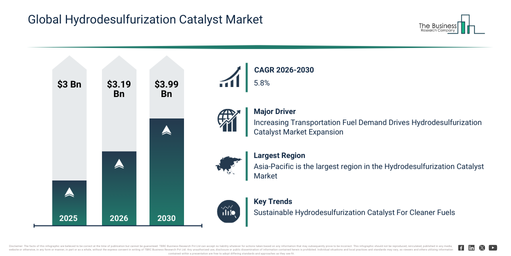
The hydrodesulfurization catalyst market has seen substantial growth over recent years. Its value is expected to increase from $3 billion in 2025 to $3.19 billion in 2026, achieving a compound annual growth rate (CAGR) of 6.3%. This historical expansion is attributable to factors such as more stringent sulfur emission regulations, the expansion of global refining capacity, an increase in the processing of sour crude oil, higher diesel fuel consumption, and enhancements in refinery catalyst formulations.
The hydrodesulfurization catalyst market is anticipated to experience substantial expansion in the coming years. This market is projected to reach $3.99 billion by 2030, expanding at a compound annual growth rate (CAGR) of 5.8%. This growth during the forecast period is driven by factors such as the rising demand for cleaner transportation fuels, stricter global fuel quality standards, the increasing scope of refinery upgrades for heavy feedstocks, growing investments in advanced catalyst technologies, and an intensified focus on optimizing refinery efficiency. Key trends anticipated over this period encompass breakthroughs in high-activity desulfurization catalysts, a heightened emphasis on producing ultra-low sulfur fuels, an increasing need for catalyst regeneration and optimization, the broader adoption of high-performance alumina supports, and improved catalyst stability for processing heavy feedstocks.
Get A Free Sample Report With In-Depth Market Insights:
Hydrodesulfurization Catalyst Market Development Factors: What’s Supporting Demand?
The future expansion of the hydrodesulfurization catalyst market is expected to be driven by the increasing need for transportation fuels. These fuels are energy sources utilized to power motor vehicles that incorporate internal combustion engines. Examples of such fuels include gasoline/petrol, diesel, LPG (liquefied petroleum gas), jet fuel, and marine fuel. Hydrodesulfurization catalysts are employed in crude oil refineries to eliminate harmful organosulfur compounds, thereby yielding cleaner final products suitable for use as transportation fuel. For instance, in September 2024, the American Public Transportation Association, a US-based non-profit organization, reported that public transit ridership reached 7.1 billion total trips in 2023, marking a 16% increase compared to 2022. Thus, the growing demand for transportation fuel is propelling the growth of the hydrodesulfurization catalyst market.
Hydrodesulfurization Catalyst Market Segment Trends And Revenue Contributors
The hydrodesulfurization catalyst market covered in this report is segmented –
1) By Type: Cobalt-Molybdenum, Nickel-Based, Other Types
2) By Feedstock: Natural Gas, Naphtha, Heavy Oil, Diesel Oil, Kerosene, Other Feed Stocks
3) By End Use Industry: Petrochemicals, Natural Gas Processing
Subsegments:
1) By Cobalt-Molybdenum: Cobalt-Molybdenum On Alumina Support, Cobalt-Molybdenum On Zeolite Support
2) By Nickel-Based: Nickel-Molybdenum Catalysts, Nickel-Tungsten Catalysts
3) By Other Types: Platinum-Based Catalysts, Palladium-Based Catalysts, Iron-Based Catalysts
Hydrodesulfurization Catalyst Market Transformation Trends: What Innovations Are Driving Change?
Leading companies in the hydrodesulfurization catalyst market are focusing on developing technologically advanced solutions, such as sustainable hydrodesulfurization catalysts, to meet the increasing demand for cleaner fuels and stricter environmental regulations. A sustainable hydrodesulfurization catalyst refers to a type of catalyst utilized in the hydrodesulfurization (HDS) process that is designed to remove sulfur compounds from fossil fuels in a more environmentally conscious and efficient manner. For instance, in March 2024, Evonik, a Germany-based chemical company, launched Octamax, an innovative catalyst specifically designed to enhance sulfur removal in refinery fuels, particularly for cracked gasoline hydrodesulfurization (HDS) units. This product incorporates a unique combination of NiMo and CoMo catalysts that improves sulfur elimination while preserving octane levels, making it an economical solution for refiners facing stringent regulatory requirements. Additionally, Octamax supports sustainability by enabling the regeneration and reuse of spent catalysts, thereby reducing waste and reliance on fresh materials.
Hydrodesulfurization Catalyst Market Competitive Landscape: Which Companies Lead The Industry?
Major companies operating in the hydrodesulfurization catalyst market are Albemarle Corporation, Advanced Refining Technologies LLC, China Petroleum & Chemical Corporation, Haldor Topsoe Holding A/S, Shell PLC., PetroChina Company Limited, Axens SA, JGC C&C, Honeywell UOP, Johnson Matthey PLC., BASF SE, Clariant AG, Dorf Ketal Chemicals, ART Hydroprocessing, Repsol S.A, W R Grace & Co, Chiyoda Corporation, Chevron Phillips Chemical Company, Redkino Catalyst Company, Criterion Catalysts & Technologies, CRI Catalyst Leuna GmbH, Delta Catalysts
View The Full Hydrodesulfurization Catalyst Market Report:
Hydrodesulfurization Catalyst Market Largest Region: Which Geography Holds The Highest Market Share?
Asia-Pacific was the largest region in the hydrodesulfurization catalyst market in 2025. North America is expected to be the highest-growing region in the hydrodesulfurization catalyst market during the forecast period. The regions covered in the hydrodesulfurization catalyst market report are Asia-Pacific, South East Asia, Western Europe, Eastern Europe, North America, South America, Middle East, Africa
Reach Out To Our Team:
The Business Research Company: https://www.thebusinessresearchcompany.com/
Americas: +1 310-496-7795
Asia: +44 7882 955267 & +91 8897263534
Europe: +44 7882 955267
Email us at: marketing@tbrc.info
Follow us on:
LinkedIn: https://in.linkedin.com/company/the-business-research-company
YouTube: https://www.youtube.com/channel/UC24_fI0rV8cR5DxlCpgmyFQ
Global Market Model: https://www.thebusinessresearchcompany.com/global-market-model

Wasay has over a decade of experience in market research, data modelling, and analytics, with prior experience at GlobalData and Decision Tree Consulting Services. At The Business Research Company , he leads research operations across syndicated studies, customized consulting engagements, and the Global Market Model platform. His professional experience includes supporting organizations such as Boston Consulting Group, KPMG, and Ernst & Young. Wasay holds a degree in Electronics and Communications Engineering, postgraduate management qualifications from International Management Institute Belgium and Indian School of Business and Entrepreneurship, and completed the Integrated Program in Business Analytics from Indian Institute of Management Indore.