Enhanced with market attractiveness analysis, total addressable market evaluation, company benchmarking matrices, interactive Excel dashboards, expanded supply chain intelligence, emerging startup coverage, and detailed product insights, The Business Research Company’s 2026 market reports deliver more actionable and strategically valuable research.
Industrial Hemp Market Size Forecast: How Large Could The Market Become By 2030?
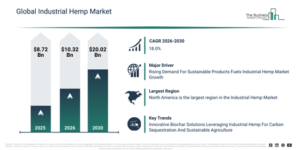
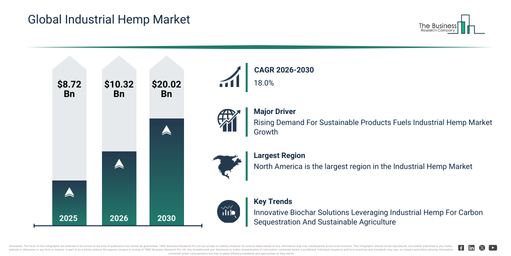
The industrial hemp market has seen rapid expansion in recent years. Its value is forecast to increase from $8.72 billion in 2025 to $10.32 billion by 2026, achieving a compound annual growth rate (CAGR) of 18.4. The factors contributing to this historic growth include early legalization efforts, a heightened understanding of hemp’s sustainable qualities, initial integration into textiles, demand for plant-based nutritional products, and the wider use of natural fiber applications.
The industrial hemp market is anticipated to experience rapid expansion in the coming years. It is projected to reach $20.02 billion in 2030, driven by a compound annual growth rate (CAGR) of 18.0. This significant growth during the forecast period is primarily fueled by a growing demand for hemp-based construction materials, increased adoption in pharmaceuticals, a rising preference for organic hemp cultivation, the development of advanced hemp composites, and the broadening availability of hemp-derived personal care products. Significant trends expected during this period encompass the continued expansion of hemp-based construction materials, a rising adoption of hemp in textile manufacturing, increasing demand for nutrient-rich hemp seeds, greater use of hemp hurd in animal bedding, and growth in industrial applications of hemp bio-composites.
Download A Free Sample Report For Comprehensive Market Insights:
Industrial Hemp Market Industry Drivers: What Is Driving Revenue Growth?
The industrial hemp market is projected to expand due to the rising need for environmentally friendly and sustainable goods. These products aim to lessen environmental harm by utilizing renewable inputs, decreasing waste, and fostering ecological equilibrium. The surge in demand for such items stems from heightened environmental consciousness, governmental regulations, consumer preference for greener alternatives, and corporate pledges to lower carbon footprints. Industrial hemp is notable for its rapid growth with limited resource requirements. It needs fewer chemicals like pesticides and herbicides compared to traditional crops, which helps mitigate chemical contamination and soil erosion. For instance, the USDA National Agricultural Statistics Service (NASS), a U.S. government body, reported in April 2025 that open-field hemp fiber output reached an estimated 60.4 million pounds in 2024, marking a 23 increase over 2023. Consequently, the escalating desire for sustainable and eco-friendly products fuels the industrial hemp market.
Industrial Hemp Market Segment Breakdown: Which Categories Generate The Most Revenue?
The industrial hemp market covered in this report is segmented –
1) By Type: Hemp Seed, Hemp Seed Oil, Cannabidiol (CBD) Hemp Oil, Hemp Bast, Hemp Hurd
2) By Source: Conventional, Organic
3) By Application: Food And Beverages, Textiles, Pharmaceuticals, Personal Care Products, Animal Nutrition, Paper, Construction Materials, Other Applications
Subsegments:
1) By Hemp Seed: Whole Hemp Seeds, Hulled Hemp Seeds, Hemp Seed Protein Powder
2) By Hemp Seed Oil: Cold-Pressed Hemp Seed Oil, Refined Hemp Seed Oil, Hemp Seed Oil Capsules
3) By Cannabidiol (CBD) Hemp Oil: Full-Spectrum CBD Oil, Broad-Spectrum CBD Oil, CBD Isolate Oil
4) By Hemp Bast: Hemp Fiber, Hemp Textiles, Hemp Composites
5) By Hemp Hurd: Hemp Hurd For Bio-composites, Hemp Hurd For Animal Bedding, Hemp Hurd For Biofuels
Industrial Hemp Market Innovation Trends: Which Developments Are Transforming The Industry?
Major companies within the industrial hemp market are concentrating on creating inventive products, such as biochar sourced from industrial hemp, with the aim of capturing carbon, enhancing soil vitality, and generating income through carbon credits, thereby fostering sustainable farming practices. Biochar derived from industrial hemp notably boosts soil fertility and carbon sequestration, offering a sustainable remedy beneficial for both agriculture and the environment within this sector. As an illustration, in June 2024, Hempalta Corp., an agricultural technology company based in Canada, introduced a biochar product. This material is rich in carbon and is produced from organic substances, including industrial hemp, through a process called pyrolysis, which entails heating biomass to high temperatures in an environment with restricted oxygen to trap carbon. The resulting product significantly improves soil fertility and overall health by elevating organic carbon levels, enhancing water retention, and encouraging beneficial microbial activity. Furthermore, it transforms agricultural waste into a valuable asset, enabling farmers to earn money through carbon credits, given that biochar qualifies for carbon removal initiatives. Its diverse uses span landscaping, its inclusion in construction materials like hempcrete, and environmental cleanup efforts, establishing it as an environmentally friendly option that promotes agricultural output and aids in mitigating climate change.
Industrial Hemp Market Leading Companies Driving Competitive Growth
Major companies operating in the industrial hemp market are Curaleaf Holdings Inc., Aurora Cannabis Inc., Konoplex Group, Plains Industrial Hemp Processing Ltd., Manitoba Harvest Hemp Foods Information, Ecofibre Limited, Elixinol, HempFlax Group BV, PureHemp Technology, Zelios, Parkland Industrial Hemp Growers Cooperative Ltd., Marijuana Company of America Inc., IND HEMP LLC, Blue Sky Hemp Ventures Ltd., Bombay Hemp Company, Panda Biotech LLC, HempMeds Brasil, Hempro International GmbH, Dun Agro Hemp Group, Greenfield Paper Company, Hempco Food and Fiber Inc., Bast Fibre Technologies Inc., Treehouse Biotech, The Hemp Mine, Bastcore Inc., Bluebird Botanicals, South Hemp Tecno Srl
Access The Complete Industrial Hemp Market Report:
#Industrial Hemp Market Largest Region: Which Geography Holds The Highest Market Share?
North America was the largest region in the industrial hemp market in 2025. The regions covered in the industrial hemp market report are Asia-Pacific, South East Asia, Western Europe, Eastern Europe, North America, South America, Middle East, Africa.
Access a Customized Industrial Hemp Market Report for Deeper Competitive Insights
Get in touch with us:
The Business Research Company: https://www.thebusinessresearchcompany.com/?utm_source=BlogsPR&utm_medium=Paid&utm_campaign=home_page_test
Americas: +1 310-496-7795
Asia: +44 7882 955267 & +91 8897263534
Europe: +44 7882 955267
Email us at: marketing@tbrc.info
Follow us on:
LinkedIn: https://in.linkedin.com/company/the-business-research-company
YouTube: https://www.youtube.com/channel/UC24_fI0rV8cR5DxlCpgmyFQ
Global Market Model: https://www.thebusinessresearchcompany.com/global-market-model

Wasay has over a decade of experience in market research, data modelling, and analytics, with prior experience at GlobalData and Decision Tree Consulting Services. At The Business Research Company , he leads research operations across syndicated studies, customized consulting engagements, and the Global Market Model platform. His professional experience includes supporting organizations such as Boston Consulting Group, KPMG, and Ernst & Young. Wasay holds a degree in Electronics and Communications Engineering, postgraduate management qualifications from International Management Institute Belgium and Indian School of Business and Entrepreneurship, and completed the Integrated Program in Business Analytics from Indian Institute of Management Indore.