Enhanced with market attractiveness analysis, total addressable market evaluation, company benchmarking matrices, interactive Excel dashboards, expanded supply chain intelligence, emerging startup coverage, and detailed product insights, The Business Research Company’s 2026 market reports deliver more actionable and strategically valuable research.
Irrigation Automation Market Expected To Reach $17.06 Billion By 2030 At 18.7% CAGR
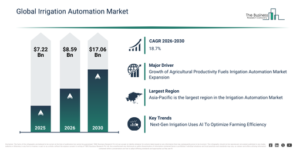
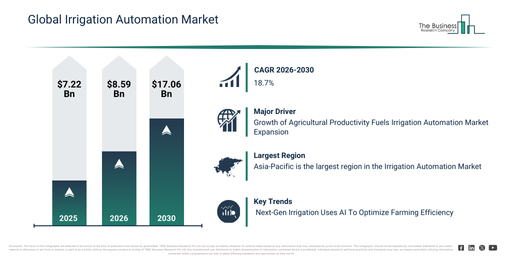
The irrigation automation market has seen rapid expansion in recent years. This market is expected to increase from $7.22 billion in 2025 to $8.59 billion in 2026, reflecting a compound annual growth rate (CAGR) of 19.0. Historically, this growth has been driven by increasing water scarcity, a rise in agricultural automation adoption, early integration of IoT-based monitoring, labor shortages in farming operations, and government programs promoting efficient irrigation.
The irrigation automation market is poised for significant expansion in the foreseeable future, with its size projected to reach $17.06 billion by 2030, exhibiting a compound annual growth rate (CAGR) of 18.7. This anticipated growth is driven by factors such as the proliferation of precision agriculture, the rise of AI-driven irrigation analytics, increasing climate variability, a growing emphasis on sustainable water use, and the adoption of cloud-based irrigation platforms. Key trends expected during this period include the implementation of smart irrigation scheduling, climate-adaptive water management strategies, the integration of soil and weather sensors, the expansion of remote and cloud-based irrigation control systems, and the development of water-efficient irrigation techniques.
Download A Free Sample Report For Comprehensive Market Insights:
Irrigation Automation Market Expansion Supported By Key Demand Factors
Future expansion of the irrigation automation market is anticipated due to rising agricultural productivity. This productivity gain stems from technological progress, refined farming techniques, advanced irrigation setups, development of high-yield crops, improved pest and disease control, and judicious application of fertilizers and pesticides. Irrigation automation enhances agricultural output through optimized water consumption, precise and uniform watering, decreased manual labor, and improved crop vitality, resulting in increased harvests and more efficient resource utilization. For example, in January 2025, the Italian National Institute of Statistics, a government body in Italy, reported projections for 2024 indicating a 1.4 volume growth in agricultural output and a 3.5 increase in gross value added. This growth is predominantly fueled by a projected 1.5 rise in crop production. Consequently, the expansion of agricultural productivity is a key catalyst for the irrigation automation market.
Irrigation Automation Market Segment Analysis And Revenue Opportunities
The irrigation automation market covered in this report is segmented –
1) By Automation Type: Time-Based Systems, Volume-Based Systems, Real-Time Feedback Systems, Computer-Based Irrigation Control Systems
2) By Component: Controllers, Sensors, Valves, Sprinklers, Other Components
3) By Irrigation Type: Drip Irrigation, Sprinkler Irrigation, Surface Irrigation
4) By End-Use: Agricultural, Non-Agricultural
Subsegments:
1) By Time-Based Systems: Fixed Time-Based Irrigation Systems, Programmable Time-Based Irrigation Systems, Smart Time-Based Irrigation Controllers
2) By Volume-Based Systems: Flow Meter-Integrated Systems, Volume-Measurement Irrigation Systems, Variable-Volume Irrigation Controllers
3) By Real-Time Feedback Systems: Soil Moisture Monitoring Systems, Weather-Based Irrigation Controllers, Sensor-Driven Irrigation Systems
4) By Computer-Based Irrigation Control Systems: PC-Connected Irrigation Systems, Cloud-Based Irrigation Control Platforms, Remote Monitoring and Control Systems
Irrigation Automation Market Innovation Trends Driving Future Development
Leading companies in the irrigation automation market are concentrating on leveraging innovative technologies, such as artificial intelligence (AI)-driven smart irrigation, to optimize water usage, boost crop yields, and decrease operational expenditures. This AI-powered smart irrigation system utilizes AI algorithms, sensors, and real-time data to autonomously manage watering schedules, effectively reducing water waste, lowering energy costs, and enhancing crop yield and quality. For example, in January 2025, Full Nature Farms Limited, a China-based agriculture technology startup, introduced its Rocket 2.0 Smart Irrigation Platform at CES 2025. This system is engineered to minimize agricultural water waste by employing AI-driven sensors and weather data to provide precise, automated irrigation control. The platform aims to reduce water costs by up to 30, improve crop yields, and cut energy consumption, making it a scalable solution applicable to vertical farms, open fields, vineyards, and community farms. The Rocket 2.0 system incorporates a variety of internally developed technologies, including soil and crop sensors, precision grow pipes, automation controllers, and an intuitive farm management dashboard. Farmers and operators can monitor soil health, crop growth, and climate conditions in real time, allowing irrigation schedules to adapt dynamically based on actual field conditions.
Irrigation Automation Market Company Landscape And Strategic Competition
Major companies operating in the irrigation automation market are The Toro Company, Valmont Industries Inc., Netafim Ltd., Lindsay Corporation, Jain Irrigation Systems Ltd., Hunter Industries Inc., Rivulis Irrigation Ltd., Rain Bird Corporation, Orbit Irrigation Products Inc., HydroPoint Data Systems Inc., Mahindra EPC Irrigation Limited, Weathermatic, Azud, T-L Irrigation Company, Nelson Irrigation Corporation, NaanDanJain irrigation Ltd., Rubicon Water Limited, Galcon Ltd., Calsense, AgriDrip, Growlink Inc., Ranch Systems Inc., Superior Automatic Sprinkler Corporation, Viridix Ltd, AquaSpy Inc.
Access The Complete Irrigation Automation Market Report:
Irrigation Automation Market Geographic Analysis: Where Is Demand Growing The Fastest?
Asia-Pacific was the largest region in the irrigation automation market in 2025. North America is expected to be the fastest-growing region in the forecast period. The regions covered in the irrigation automation market report are Asia-Pacific, South East Asia, Western Europe, Eastern Europe, North America, South America, Middle East, Africa.
Access a Customized Irrigation Automation Market Report for Deeper Competitive Insights
Get in touch with us:
The Business Research Company: https://www.thebusinessresearchcompany.com/?utm_source=BlogsPR&utm_medium=Paid&utm_campaign=home_page_test
Americas: +1 310-496-7795
Asia: +44 7882 955267 & +91 8897263534
Europe: +44 7882 955267
Email us at: marketing@tbrc.info
Follow us on:
LinkedIn: https://in.linkedin.com/company/the-business-research-company
YouTube: https://www.youtube.com/channel/UC24_fI0rV8cR5DxlCpgmyFQ
Global Market Model: https://www.thebusinessresearchcompany.com/global-market-model

Wasay has over a decade of experience in market research, data modelling, and analytics, with prior experience at GlobalData and Decision Tree Consulting Services. At The Business Research Company , he leads research operations across syndicated studies, customized consulting engagements, and the Global Market Model platform. His professional experience includes supporting organizations such as Boston Consulting Group, KPMG, and Ernst & Young. Wasay holds a degree in Electronics and Communications Engineering, postgraduate management qualifications from International Management Institute Belgium and Indian School of Business and Entrepreneurship, and completed the Integrated Program in Business Analytics from Indian Institute of Management Indore.