Featuring market attractiveness scoring, total addressable market sizing, company benchmarking matrices, interactive Excel dashboards, deeper supply chain intelligence, emerging startup tracking, and granular product-level insights, The Business Research Company’s 2026 market reports are built to deliver research that is both more actionable and more strategically valuable.
Infrastructure Construction Market Size Outlook: How Quickly Will Revenue Expand Through 2030?
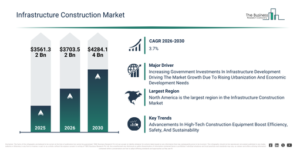
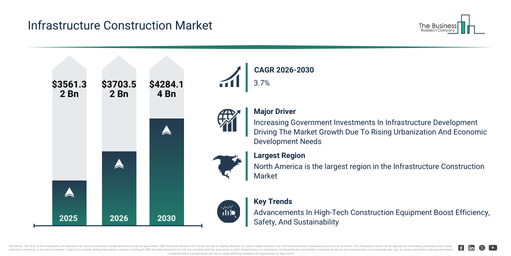
The infrastructure construction market has demonstrated consistent growth in recent years. It is forecast to increase from $3561.32 billion in 2025 to $3703.52 billion in 2026, achieving a compound annual growth rate (CAGR) of 4.0%. The expansion observed historically can be linked to factors like increasing urbanization and population numbers, elevated government spending on infrastructure, expanding private sector investments in industrial and commercial facilities, the advancement of transportation networks, and a greater embrace of conventional construction methods.
The infrastructure construction market is projected to experience consistent expansion in the coming years. This market is predicted to reach $4284.14 billion by 2030, exhibiting a compound annual growth rate (CAGR) of 3.7%. Key factors contributing to this expansion during the forecast period include the rising acceptance of smart construction technologies, the incorporation of green building and sustainable practices, the expansion of modular and prefabricated infrastructure, the growing utilization of BIM and digital planning tools, and the broader application of automated and robotic construction methods. Noteworthy trends anticipated in the same period involve the implementation of smart infrastructure monitoring systems, the uptake of AI-driven project planning tools, the seamless integration of modular infrastructure solutions, the widening scope of IOT-connected utilities and transportation networks, and the deployment of predictive maintenance and analytics strategies.
Get A Free Sample Report With In-Depth Market Insights:
Infrastructure Construction Market Expansion Drivers: What’s Shaping Future Growth?
Government outlays for infrastructure development are projected to drive the expansion of the infrastructure construction market going forward. These rising public investments in infrastructure primarily arise from the necessity to modernize aging infrastructure systems, given that outdated facilities in developed nations require substantial renovation and replacement to meet current safety standards and support economic growth. Government financial backing supports infrastructure construction by providing the essential funding, resources, and policy framework that enables the planning, development, and timely completion of projects, while also attracting private sector participation and ensuring long-term maintenance and sustainability. For instance, in July 2025, according to the Office for National Statistics (ONS), a UK-based government department, total general government investment in infrastructure climbed by 2.2% to $38.54 billion (£28.9 billion) at current prices in 2024, compared with 2023. Therefore, the increasing government financial contributions to infrastructure development are propelling the growth of the infrastructure construction market.
Infrastructure Construction Market Segment Performance And Emerging Opportunities
The infrastructure construction market covered in this report is segmented –
1) By Type: Transportation Infrastructure, Energy And Utilities Infrastructure, Water And Waste Management Infrastructure
2) By Material: Concrete, Steel, Wood, Other Materials
3) By Construction Method: Traditional Construction, Design-Build, Construction Management At Risk (CMAR), Integrated Project Delivery (IPD), Prefabrication
4) By Technology Adoption: Conventional Methods, Building Information Modeling (BIM), Smart Construction Technologies, Green Building Technologies, Drones And Robotics
5) By End-User Sector: Public Sector, Private Sector, Industrial Sector, Commercial Sector, Residential Sector
Subsegments:
1) By Transportation Infrastructure: Roads And Highways Construction, Bridges And Tunnels Construction, Railways Construction, Airports And Ports Construction
2) By Energy And Utilities Infrastructure: Power Plants Construction, Renewable Energy Infrastructure, Oil And Gas Pipelines, Electricity Transmission And Distribution Networks
3) By Water And Waste Management Infrastructure: Dams And Reservoirs Construction, Sewage And Wastewater Treatment Facilities, Water Supply Systems, Waste Management And Recycling Facilities
Infrastructure Construction Market Strategic Trends: What Defines The Next Growth Phase?
Leading corporations within the infrastructure construction market are concentrating on creating cutting-edge products, specifically advanced construction machinery, to enhance operational efficiency, output, and safety at job sites. This category of advanced equipment encompasses machinery outfitted with sophisticated technologies including automation, telematics, and smart engines, specifically engineered to elevate productivity, bolster operator safety, decrease fuel usage, and facilitate real-time tracking for more streamlined project oversight. As an illustration, in January 2025, CASE India, a machinery manufacturing firm based in India, introduced seven new construction equipment models at the Bharat Construction Equipment Expo; these offerings comprised two advanced vibratory compactors and five adaptable machines. These particular models, driven by their proprietary F28 engine that adheres to Bharat Stage CEV V emission regulations, deliver improved fuel efficiency and heightened productivity. Their integration with the myCASE Construction smart telematics platform allows for real-time monitoring, tracking of fuel consumption, analysis of usage patterns, and remote diagnostic capabilities, thereby guaranteeing peak performance and reduced periods of inactivity.
Infrastructure Construction Market Key Players: Which Companies Lead Industry Competition?
Major companies operating in the infrastructure construction market are China State Construction Engineering Corporation Ltd., China Communications Construction Company Limited, Power Construction Corporation of China, Vinci SA, Bouygues Construction SA, Hochtief AG, Hyundai Engineering & Construction Co. Ltd., Larsen & Toubro Limited, Kajima Corporation, Kiewit Corporation, Bechtel Corporation, Skanska AB, Obayashi Corporation, Fluor Corporation, Shimizu Corporation, Balfour Beatty plc, Ferrovial S.A., Laing O’Rourke Group Ltd., ACS Actividades de Construcción y Servicios S.A., Technip Energies N.V.
View The Full Infrastructure Construction Market Report:
Infrastructure Construction Market Regional Breakdown: Where Is Demand Concentrated?
North America was the largest region in the infrastructure construction market in 2025. Asia-Pacific is expected to be the fastest-growing region in the forecast period. The regions covered in the infrastructure construction market report are Asia-Pacific, South East Asia, Western Europe, Eastern Europe, North America, South America, Middle East, Africa.
Reach Out To Our Team:
The Business Research Company: https://www.thebusinessresearchcompany.com/
Americas: +1 310-496-7795
Asia: +44 7882 955267 & +91 8897263534
Europe: +44 7882 955267
Email us at: marketing@tbrc.info
Follow us on:
LinkedIn: https://in.linkedin.com/company/the-business-research-company
YouTube: https://www.youtube.com/channel/UC24_fI0rV8cR5DxlCpgmyFQ
Global Market Model: https://www.thebusinessresearchcompany.com/global-market-model

Wasay has over a decade of experience in market research, data modelling, and analytics, with prior experience at GlobalData and Decision Tree Consulting Services. At The Business Research Company , he leads research operations across syndicated studies, customized consulting engagements, and the Global Market Model platform. His professional experience includes supporting organizations such as Boston Consulting Group, KPMG, and Ernst & Young. Wasay holds a degree in Electronics and Communications Engineering, postgraduate management qualifications from International Management Institute Belgium and Indian School of Business and Entrepreneurship, and completed the Integrated Program in Business Analytics from Indian Institute of Management Indore.