Built to provide research that’s more actionable and strategically valuable, The Business Research Company’s 2026 market reports include market attractiveness analysis, total addressable market sizing, company benchmarking matrices, interactive Excel dashboards, broader supply chain intelligence, emerging startup tracking, and in-depth product insights.
Low Carbon Buildings Market Revenue Growth On Track For A 12.2% CAGR Through 2030
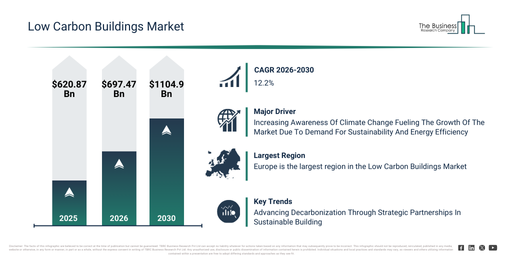
The low carbon buildings market has expanded significantly in recent years. Its value is anticipated to rise from $620.87 billion in 2025 to $697.47 billion in 2026, demonstrating a compound annual growth rate (CAGR) of 12.3%. This historical expansion can be linked to a growing emphasis on energy-efficient construction practices, the early adoption of low-carbon building materials, an increasing desire for green-certified structures, a rise in corporate sustainability commitments, and greater investment in carbon-reduction technologies.
The low carbon buildings market is anticipated to experience substantial growth in the upcoming years. It is projected to achieve a value of $1104.9 billion by 2030, demonstrating a compound annual growth rate (CAGR) of 12.2%. This projected expansion can be attributed to the increasing integration of renewable building systems, the growing adoption of circular-economy construction materials, the ongoing development of ultra-low-carbon concrete, the expansion of large-scale green infrastructure, and the rise of AI-driven building energy optimization. Significant trends during this forecast period are expected to include a greater emphasis on low-emission building materials, an increase in green-certified construction projects, the broader implementation of energy-efficient architectural design, wider adoption of renewable building systems, and an elevated demand for carbon-neutral construction technologies.
Get A Free Sample Report With In-Depth Market Insights:
Low Carbon Buildings Market Demand Drivers Opening New Revenue Streams
Heightened consciousness regarding climate change is anticipated to propel the expansion of the low-carbon buildings market going forward. This climate change awareness is fueled by escalating environmental concerns, widespread access to information, and intensified media coverage, which in turn leads to greater public involvement and a demand for sustainable practices. Low-carbon buildings contribute to reducing greenhouse gas emissions through their energy-efficient designs, sustainable materials, and renewable energy systems, thereby promoting sustainability and actively combating climate change. For instance, in 2023, according to the European Commission, a Belgium-based government body, 87% of Europeans will favor increasing renewable energy use, and 86% will support enhancing energy efficiency by 2030. Consequently, the rising awareness of climate change is a significant driver for the growth of the low-carbon buildings market.
Low Carbon Buildings Market Segmentation: How Does The Market Break Down By Category?
The low carbon buildings market covered in this report is segmented –
1) By Type: Low-Carbon Concrete, Mass Timber, Sustainable Steel
2) By Material: Low-Carbon Cement & Concrete, Engineered Wood (Mass Timber), Recycled Steel, Low-Carbon Steel
3) By Application: Commercial, Residential, Industrial
Subsegments:
1) By Low-Carbon Concrete: Supplementary Cementitious Material (SCM) Concrete, Carbon-Cured Concrete, Recycled Aggregate Concrete, Geopolymer Concrete
2) By Mass Timber: Cross-Laminated Timber (CLT), Glue-Laminated Timber (Glulam), Nail-Laminated Timber (NLT), Laminated Veneer Lumber (LVL)
3) By Sustainable Steel: Electric Arc Furnace (EAF) Steel, Recycled Steel Rebar, Low-Carbon Structural Steel, Green Hydrogen Steel
Low Carbon Buildings Market Trends Powering Strategic Industry Growth
Leading companies within the low-carbon buildings sector are prioritizing strategic collaborations to introduce decarbonization programs, aiming to hasten the shift towards sustainable construction, enhance energy efficiency, and curb carbon emissions. Such alliances are essential for broadening sustainable construction approaches, speeding up decarbonization initiatives, and nurturing innovation across the low-carbon buildings market. A case in point is the partnership formed in June 2024 between Mahindra Group, an India-based industrial company, and Johnson Controls, an Ireland-based industrial machinery manufacturing company, to unveil a net zero buildings initiative. This initiative aims to achieve decarbonization for commercial, urban, residential, and public buildings throughout India by providing complimentary toolkits and training sessions. It facilitates easier access to vital resources and optimal practices, thereby enabling organizations to deploy sustainable building remedies. Furthermore, the program endeavors to catalyze a sustainable transformation within the built environment and bolster India’s low-carbon development goals, offering guidance to building owners on conservation tactics, regulatory compliance, funding possibilities, and cutting-edge technologies.
Low Carbon Buildings Market Competitive Overview And Top Companies
Major companies operating in the low carbon buildings market are Holcim Group, Heidelberg Materials, CEMEX, Lafarge Canada, Vicat Group, CRH plc, Stora Enso, Binderholz GmbH, KLH Massivholz GmbH, Structurlam Mass Timber Corporation, Mayr-Melnhof Holz, Metsä Wood, Nippon Steel Corporation, SSAB AB, ArcelorMittal, Tata Steel Europe, Nucor Corporation, Steel Dynamics Inc., CarbonCure Technologies Inc., Ecocera Concrete Solutions.
View The Full Low Carbon Buildings Market Report:
Low Carbon Buildings Market Geographic Spread And Regional Opportunities
Europe was the largest region in the low-carbon buildings market in 2025. Asia-Pacific is expected to be the fastest-growing region in the forecast period. The regions covered in the low carbon buildings market report are Asia-Pacific, South East Asia, Western Europe, Eastern Europe, North America, South America, Middle East, Africa.
Reach Out To Our Team:
The Business Research Company: https://www.thebusinessresearchcompany.com/
Americas: +1 310-496-7795
Asia: +44 7882 955267 & +91 8897263534
Europe: +44 7882 955267
Email us at: marketing@tbrc.info
Follow us on:
LinkedIn: https://in.linkedin.com/company/the-business-research-company
YouTube: https://www.youtube.com/channel/UC24_fI0rV8cR5DxlCpgmyFQ
Global Market Model: https://www.thebusinessresearchcompany.com/global-market-model

Wasay has over a decade of experience in market research, data modelling, and analytics, with prior experience at GlobalData and Decision Tree Consulting Services. At The Business Research Company , he leads research operations across syndicated studies, customized consulting engagements, and the Global Market Model platform. His professional experience includes supporting organizations such as Boston Consulting Group, KPMG, and Ernst & Young. Wasay holds a degree in Electronics and Communications Engineering, postgraduate management qualifications from International Management Institute Belgium and Indian School of Business and Entrepreneurship, and completed the Integrated Program in Business Analytics from Indian Institute of Management Indore.