Built to provide research that’s more actionable and strategically valuable, The Business Research Company’s 2026 market reports include market attractiveness analysis, total addressable market sizing, company benchmarking matrices, interactive Excel dashboards, broader supply chain intelligence, emerging startup tracking, and in-depth product insights.
Low-Carbon Concrete Market Forecast: What Value Will The Market Reach By 2030?
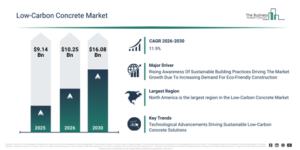
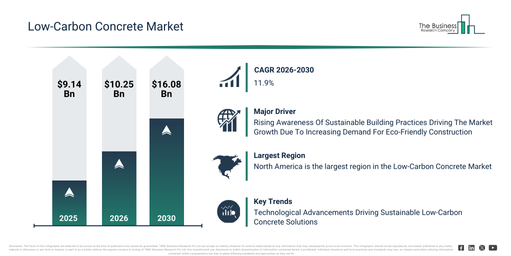
The low-carbon concrete market has demonstrated rapid expansion in recent years. Its value is anticipated to rise from $9.14 billion in 2025 to $10.25 billion in 2026, achieving a compound annual growth rate (CAGR) of 12.2%. This historical growth can be attributed to factors like the increasing application of low-carbon binders, the growing adoption of self-compacting concrete, the rise in green building projects, the expansion of sustainable construction materials, and a reliance on recycled aggregates.
The low-carbon concrete market is projected to experience substantial expansion in the coming years. This market is set to reach $16.08 billion by 2030, exhibiting an 11.9% compound annual growth rate (CAGR). The anticipated growth during this period stems from several factors, including the increased output of ultra-high-performance and self-compacting concrete, broader implementation of low-carbon concrete in infrastructure projects, the creation of prefabricated environmentally friendly items, the incorporation of intelligent monitoring into concrete manufacturing, and a greater reliance on hybrid low-carbon cementitious materials. Key trends anticipated for the forecast timeframe encompass the application of ultra-high-performance low-carbon concrete, the uptake of self-compacting low-carbon concrete, the incorporation of sustainable cementitious blocks, the deployment of intelligent production and oversight systems, and an increase in the utilization of recycled aggregates.
Get A Free Sample Report With In-Depth Market Insights:
Low-Carbon Concrete Market Development Factors: What’s Supporting Demand?
An increasing understanding of sustainable building practices is anticipated to fuel the expansion of the low-carbon concrete market in the future. These practices involve the design and construction of structures that reduce environmental footprint, preserve resources, and enhance the well-being and productivity of occupants. Their adoption is on the rise, driven by increasing worries about climate change, given their role in lowering greenhouse gas emissions and energy use. Low-carbon concrete supports sustainable building by cutting CO2 emissions during its manufacturing, lessening the ecological impact of construction, and contributing to energy-efficient, environmentally friendly infrastructure. As an illustration, in July 2024, data from the Green Building Council, a US-based non-profit, revealed that more than 46,000 residential developments achieved LEED green building certification, marking an almost 5% increase in new registrations compared to 2023. Consequently, the heightened awareness of sustainable building approaches is accelerating the expansion of the low-carbon concrete market.
Low-Carbon Concrete Market Segmentation And Category Overview
The low-carbon concrete market covered in this report is segmented –
1) By Binder Technology: Portland Limestone Cement (PLC)-Based, Geopolymer Concrete
2) By Product Type: Ready-Mix Concrete, Precast Concrete, Prefabricated Products, Other Product Type
3) By Material: Fly Ash-Based, Slag-Based, Limestone Calcined Clay Cement, Recycled Aggregates, Other Material
4) By Application: Residential, Commercial, Industrial, Infrastructure
5) By End-User: Construction, Transportation, Energy, Other End-User
Subsegments:
1) By Portland Limestone Cement (PLC)-Based: Blended Portland Limestone Cement, High-Limestone Portland Limestone Cement, Moderate-Limestone Portland Limestone Cement
2) By Geopolymer Concrete: Fly Ash-Based, Slag-Based, Hybrid
Low-Carbon Concrete Market Transformation Trends: What Innovations Are Driving Change?
Leading companies in the low-carbon concrete market are concentrating on developing technological advancements, such as low-clinker concrete admixtures, to minimize environmental impact while maintaining structural strength and durability. A low-clinker concrete admixture is an additive designed to reduce the cement clinker content in concrete, thereby lowering CO2 emissions and enhancing sustainability while preserving strength. For instance, in July 2023, CHRYSO Inc., a France-based construction company, launched EnviroMix, the first global range of admixture solutions and services specifically engineered to produce low-carbon concrete. This product improves early strength development, enabling faster construction timelines and cost savings even while utilizing higher proportions of sustainable supplementary cementitious materials (SCMs). EnviroMix further offers digital tools to calculate and optimize the environmental impact of concrete mixes. Its core purpose is to support the construction industry’s transition towards sustainable, low-carbon building practices with reliable, high-performance concrete solutions.
Low-Carbon Concrete Market Competitive Analysis Of Leading Industry Participants
Major companies operating in the low-carbon concrete market are China National Building Material Company Limited, CRH plc, LafargeHolcim Ltd., Adani Group, CEMEX S.A.B. de C.V., Siam Cement Group Public Company Limited, Sika AG, UltraTech Cement Ltd., Taiheiyo Cement Corporation, Vicat Group, Aditya Birla Group, Titan Cement Company S.A., Shree Cement Limited, Breedon Group plc, Sociedade de Cimentos de Portugal, Buzzi Unicem SpA, JSW Cement Limited, Kiran Global Chems Limited, Hoffman Green Technologies Ltd., CarbonCure Technologies Inc., Carbon Upcycling Technologies Inc., CarbiCrete Inc., Ecocem Ireland Ltd., CarbonBuilt Inc., Brimstone Energy Inc.
View The Full Low-Carbon Concrete Market Report:
Low-Carbon Concrete Market Regional Split: Which Areas Are Fueling Growth?
North America was the largest region in the low carbon concrete market in 2025. Asia-Pacific is expected to be the fastest-growing region in the forecast period. The regions covered in the low-carbon concrete market report are Asia-Pacific, South East Asia, Western Europe, Eastern Europe, North America, South America, Middle East, Africa.
Reach Out To Our Team:
The Business Research Company: https://www.thebusinessresearchcompany.com/
Americas: +1 310-496-7795
Asia: +44 7882 955267 & +91 8897263534
Europe: +44 7882 955267
Email us at: marketing@tbrc.info
Follow us on:
LinkedIn: https://in.linkedin.com/company/the-business-research-company
YouTube: https://www.youtube.com/channel/UC24_fI0rV8cR5DxlCpgmyFQ
Global Market Model: https://www.thebusinessresearchcompany.com/global-market-model

Wasay has over a decade of experience in market research, data modelling, and analytics, with prior experience at GlobalData and Decision Tree Consulting Services. At The Business Research Company , he leads research operations across syndicated studies, customized consulting engagements, and the Global Market Model platform. His professional experience includes supporting organizations such as Boston Consulting Group, KPMG, and Ernst & Young. Wasay holds a degree in Electronics and Communications Engineering, postgraduate management qualifications from International Management Institute Belgium and Indian School of Business and Entrepreneurship, and completed the Integrated Program in Business Analytics from Indian Institute of Management Indore.