Backed by market attractiveness analysis, total addressable market sizing, company benchmarking matrices, interactive Excel dashboards, wider supply chain intelligence, emerging startup coverage, and detailed product-level insights, The Business Research Company’s 2026 market reports are designed to offer research that is more actionable and strategically valuable than ever.
Compact Construction Equipment Market Forecast: What Value Will The Market Reach By 2030?
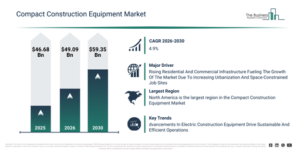
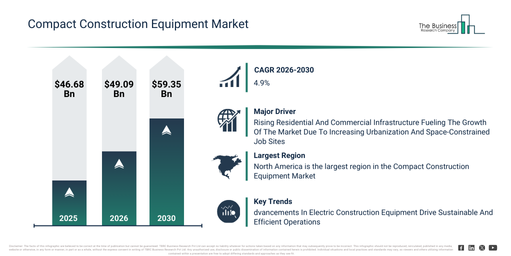
The compact construction equipment market size has experienced substantial growth in recent years. It is projected to increase from $46.68 billion in 2025 to $49.09 billion in 2026, demonstrating a compound annual growth rate (CAGR) of 5.2%. This historical expansion can be attributed to the increasing adoption of compact machinery for urban projects, a growing demand for lightweight and maneuverable equipment, reliance on imported hydraulic and engine systems, the expansion of small-site construction activities, and a rising demand within the equipment rental market.
The compact construction equipment market size is projected to experience consistent expansion over the upcoming years. This market is anticipated to reach $59.35 billion by 2030, exhibiting a compound annual growth rate (CAGR) of 4.9%. This projected increase during the forecast period stems from several factors, including the rising uptake of electric compact machinery, a growing need for autonomous and semi-autonomous equipment, the proliferation of smart fleet management technologies, the creation of high-efficiency compact powertrains, and heightened investment in sustainable construction machinery. Key trends expected over the forecast period encompass the incorporation of AI-based equipment control systems, an increase in autonomous compact machinery, progress in automated compact equipment production, the creation of low-emission compact machinery solutions, and the deployment of IoT-enabled fleet monitoring platforms.
Get A Free Sample Report With In-Depth Market Insights:
Compact Construction Equipment Market Growth Momentum: What Factors Are Shaping Demand?
The future expansion of the compact construction equipment market is anticipated to be propelled by the increasing development of residential and commercial infrastructure. This infrastructure encompasses physical structures and facilities like buildings, utilities, roads, and various services that support housing and business activities in communities and urban areas. This rise is primarily fueled by rapid urbanization, with expanding urban populations boosting the need for homes, offices, and public amenities. Compact construction equipment aids this development through its space-efficient designs, making it suitable for urban and restricted work sites. It boosts productivity by easily handling crucial tasks such as digging, lifting, and grading, thereby speeding up construction schedules. For example, Atradius, a Netherlands-based insurance provider, reported in March 2024 that global construction output is forecast to increase by 2.0% in 2024, a change from the 3.7% growth observed in 2023. Advanced economies are expected to see 1.8% growth, whereas emerging markets are predicted to experience a 2.2% rise in building activity. This year, non-residential output and civil engineering are projected to expand by 2.8% and 4.4%, respectively. The forecast for global construction growth in 2025 stands at 1.8%. Residential construction output is anticipated to recover by 2.4%, driven by better economic conditions and the impact of more relaxed monetary policies. Consequently, the expanding residential and commercial infrastructure is fueling the compact construction equipment market’s growth.
Compact Construction Equipment Market Segment Analysis: What Are The Core Market Categories?
The compact construction equipment market covered in this report is segmented –
1) By Type: Mini Excavators, Compact Wheel Loaders, Compact Track Loaders, Skid Steer Loaders, Other Types
2) By Application: Loading, Excavation, Material Handling, Lifting And Hoisting, Other Applications
3) By End User: Construction, Agriculture, Mining, Utility works, Other End Users
Subsegments:
1) By Mini Excavators: Electric Mini Excavators, Diesel Mini Excavators, Zero-Tail Swing Mini Excavators, Conventional Tail Swing Mini Excavators
2) By Compact Wheel Loaders: Articulated Compact Wheel Loaders, Rigid Frame Compact Wheel Loaders, Electric Compact Wheel Loaders
3) By Compact Track Loaders: Radial Lift Track Loaders, Vertical Lift Track Loaders, Electric Compact Track Loaders
4) By Skid Steer Loaders: Wheeled Skid Steer Loaders, Tracked Skid Steer Loaders, Stand-On Skid Steer Loaders
5) By Other Types: Compact Backhoe Loaders, Compact Dozers, Compact Telehandlers, Compact Asphalt Pavers, Compact Motor Graders
Compact Construction Equipment Market Trends Redefining Industry Growth
Major companies within the compact construction equipment market are increasingly focused on developing advanced products, such as electric mini excavators, to boost energy efficiency, decrease emissions, and cater to the rising demand for sustainable construction solutions. Electric mini excavators are defined as compact excavation machines powered by electric batteries, as opposed to traditional diesel engines, engineered to perform digging and earthmoving tasks with reduced noise, no emissions, and lower operating costs. For instance, in April 2024, Komatsu, a Japan-based manufacturer of construction and mining equipment, unveiled its PC20E, PC26E, and PC33E models, which deliver zero emissions and reduced noise, making them ideal for urban and indoor construction sites where environmental and noise restrictions are in effect. These offerings provide extended operating hours with quick, adaptable charging options, coupled with low maintenance costs due to having fewer mechanical parts. Engineered for versatility and operator comfort, these models contribute to sustainable construction projects while ensuring efficient, reliable performance throughout the workday.
Compact Construction Equipment Market Top Companies Driving Competitive Growth
Major companies operating in the compact construction equipment market are Caterpillar Inc., Deere & Company, Volvo Construction Equipment, Komatsu Ltd., CNH Industrial N.V, Kubota Corporation, Liebherr-International AG, Xuzhou Construction Machinery Group Co. Ltd., Sany Group Co. Ltd., Hitachi Construction Machinery Co. Ltd., J.C. Bamford Excavators Limited, Yanmar Co. Ltd., Doosan Bobcat Inc., Terex Corporation, Manitou BF S.A., Wacker Neuson SE, Sunward Intelligent Equipment Group Co. Ltd., Bell Equipment Limited, Takeuchi Manufacturing Co. Ltd., Mecalac S.A., Hyundai Construction Equipment Co. Ltd., Avant Tecno Oy, WAY INDUSTRY AS, Messersì S.p.A., Multione S.r.l., Schaffer Maschinenfabrik GmbH, Thaler GmbH And Co. KG
View The Full Compact Construction Equipment Market Report:
Compact Construction Equipment Market Top Region By Revenue And Market Share
North America was the largest region in the compact construction equipment market in 2025. Asia-Pacific is expected to be the fastest-growing region in the forecast period. The regions covered in the compact construction equipment market report are Asia-Pacific, South East Asia, Western Europe, Eastern Europe, North America, South America, Middle East, Africa.
Reach Out To Our Team:
The Business Research Company: https://www.thebusinessresearchcompany.com/
Americas: +1 310-496-7795
Asia: +44 7882 955267 & +91 8897263534
Europe: +44 7882 955267
Email us at: marketing@tbrc.info
Follow us on:
LinkedIn: https://in.linkedin.com/company/the-business-research-company
YouTube: https://www.youtube.com/channel/UC24_fI0rV8cR5DxlCpgmyFQ
Global Market Model: https://www.thebusinessresearchcompany.com/global-market-model

Wasay has over a decade of experience in market research, data modelling, and analytics, with prior experience at GlobalData and Decision Tree Consulting Services. At The Business Research Company , he leads research operations across syndicated studies, customized consulting engagements, and the Global Market Model platform. His professional experience includes supporting organizations such as Boston Consulting Group, KPMG, and Ernst & Young. Wasay holds a degree in Electronics and Communications Engineering, postgraduate management qualifications from International Management Institute Belgium and Indian School of Business and Entrepreneurship, and completed the Integrated Program in Business Analytics from Indian Institute of Management Indore.