Backed by market attractiveness analysis, total addressable market sizing, company benchmarking matrices, interactive Excel dashboards, wider supply chain intelligence, emerging startup coverage, and detailed product-level insights, The Business Research Company’s 2026 market reports are designed to offer research that is more actionable and strategically valuable than ever.
Sustainable Construction Materials Market Size, Value And Growth Trajectory Through 2030
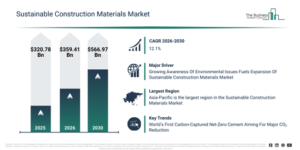
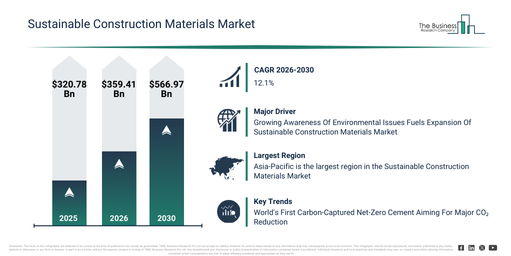
The sustainable construction materials market has experienced substantial growth in recent years. It is projected to expand from $320.78 billion in 2025 to $359.41 billion in 2026, exhibiting a compound annual growth rate (CAGR) of 12.0%. The historical expansion of this market can be attributed to factors such as increasing awareness of environmental impacts, the initial adoption of recycled building materials, a rise in green certification programs, the broadening of sustainable construction activities, and an escalating demand for low-carbon products.
The sustainable construction materials market size is poised for substantial expansion over the coming years. This market is projected to reach a valuation of $566.97 billion by 2030, exhibiting a compound annual growth rate (CAGR) of 12.1%. The anticipated growth during this period stems from various factors, including heightened investment in circular material technologies, the expansion of renewable material production, increased implementation of green building mandates, advancements in composite manufacturing, and the wider deployment of automated sustainable construction systems. Key developments expected throughout the forecast horizon involve the expanding application of low-carbon construction materials, an increase in automated material processing, greater integration of smart material tracking, progress in sustainable prefabrication, and the rising incorporation of recycled and renewable inputs.
Get A Free Sample Report With In-Depth Market Insights:
Sustainable Construction Materials Market Growth Backed By Core Demand Fundamentals
The increasing recognition of environmental concerns is anticipated to fuel the expansion of the sustainable construction materials market. This awareness signifies an understanding of human activities’ impact on the environment and the necessity of actions to address these problems. Such heightened awareness is driven by enhanced media coverage, educational efforts, and advocacy, leading to greater public concern and comprehension. Sustainable construction materials effectively tackle environmental issues by reducing the ecological footprint of building projects. This is achieved through the incorporation of eco-friendly materials that promote energy efficiency, minimize waste, and lower greenhouse gas emissions, thereby supporting the development of green buildings that contribute to long-term environmental conservation and sustainability. For instance, in July 2023, the Office for National Statistics, a UK-based government department, reported that in Great Britain, approximately 86.5% of adults had adopted lifestyle changes to address environmental issues, with 73.6% noting some changes and 12.8% having made significant adjustments. Consequently, the escalating awareness of environmental issues is a key driver for the growth of the sustainable construction materials market.
Sustainable Construction Materials Market Segment Landscape And Growth Outlook
The sustainable construction materials market covered in this report is segmented –
1) By Type: Bamboo, Reclaimed Wood, Green Insulation Materials, Structural Insulated Panels, Cross-Laminated Timber, Recycled Metal, Precast Concentrate, Recycled Plastic-Based Cement, Other Types
2) By Application: Exterior, Interior, Structural, Other Applications
3) By End-User: Residential, Commercial, Industrial
Subsegments:
1) By Bamboo: Solid Bamboo, Bamboo Laminates, Bamboo Composites
2) By Reclaimed Wood: Flooring, Beams And Timbers, Millwork And Paneling
3) By Green Insulation Materials: Cellulose Insulation, Wool Insulation, Cotton Insulation
4) By Structural Insulated Panels: SIPs With EPS, SIPs With XPS, SIPs With Polyurethane
5) By Cross-Laminated Timber: Standard CLT Panels, Prefabricated CLT Components
6) By Recycled Metal: Recycled Steel, Recycled Aluminum
7) By Precast Concentrate: Precast Wall Panels, Precast Flooring & Roofing Elements, Precast Structural Components
8) By Recycled Plastic-Based Cement: Plastic-Aggregate Concrete, Plastic-Modified Cement Composites, Polymer-Based Eco Concrete
9) By Other Types, Hempcrete, Ferrock, Mycelium-Based Materials, Fly Ash–Based Materials
Sustainable Construction Materials Market Growth Trends Reshaping The Competitive Landscape
Leading companies in the sustainable construction materials market are focusing on developing innovative solutions, such as carbon-captured net-zero cement, with the goal of substantially reducing carbon emissions and enhancing the environmental footprint of construction projects. Carbon-captured net-zero cement is a type of cement engineered to achieve a net-zero carbon footprint by capturing and either utilizing or storing carbon dioxide (CO₂) emissions generated during its manufacturing process. For instance, in November 2023, Heidelberg Materials, a Germany-based building material company, unveiled evoZero, the world’s first carbon-captured net-zero cement, addressing the urgent demand for sustainable construction materials and aiming to lead the decarbonization of the cement industry. This pioneering product incorporates advanced carbon capture and storage (CCS) technology at the company’s Brevik plant in Norway, successfully achieving net-zero carbon emissions without relying on external carbon offsets. It also features a transparent carbon accounting system verified through blockchain technology. This remarkable innovation signifies a major progression towards realizing carbon neutrality in the cement industry, promoting sustainable construction practices, and targeting a 10 million metric tons reduction of CO₂ by 2030.
Sustainable Construction Materials Market Competitive Landscape: Who Leads The Industry?
Major companies operating in the sustainable construction materials market are BASF SE, Compagnie de Saint-Gobain, Holcim Group Ltd., 3M Company, Novelis Inc., Knauf Gips KG, Skanska AB, CEMEX S.A.B. de C.V., DuPont de Nemours Inc., Sika AG, Owens Corning, Kingspan Group plc, Rockwool International A/S, Tarmac Ltd., Boral Limited, Forbo Holding AG, GAF Materials Corporation, Heidelberg Materials AG, The Alumasc Group plc, RedBuil LLC, Ecovative Design LLC
View The Full Sustainable Construction Materials Market Report:
Sustainable Construction Materials Market Regional Breakdown: Where Is Demand Concentrated?
Asia-Pacific was the largest region in the sustainable construction materials market in 2025. The regions covered in the sustainable construction materials market report are Asia-Pacific, South East Asia, Western Europe, Eastern Europe, North America, South America, Middle East, Africa.
Reach Out To Our Team:
The Business Research Company: https://www.thebusinessresearchcompany.com/
Americas: +1 310-496-7795
Asia: +44 7882 955267 & +91 8897263534
Europe: +44 7882 955267
Email us at: marketing@tbrc.info
Follow us on:
LinkedIn: https://in.linkedin.com/company/the-business-research-company
YouTube: https://www.youtube.com/channel/UC24_fI0rV8cR5DxlCpgmyFQ
Global Market Model: https://www.thebusinessresearchcompany.com/global-market-model

Wasay has over a decade of experience in market research, data modelling, and analytics, with prior experience at GlobalData and Decision Tree Consulting Services. At The Business Research Company , he leads research operations across syndicated studies, customized consulting engagements, and the Global Market Model platform. His professional experience includes supporting organizations such as Boston Consulting Group, KPMG, and Ernst & Young. Wasay holds a degree in Electronics and Communications Engineering, postgraduate management qualifications from International Management Institute Belgium and Indian School of Business and Entrepreneurship, and completed the Integrated Program in Business Analytics from Indian Institute of Management Indore.