
Built to provide research that’s more actionable and strategically valuable, The Business Research Company’s 2026 market reports include market attractiveness analysis, total addressable market sizing, company benchmarking matrices, interactive Excel dashboards, broader supply chain intelligence, emerging startup tracking, and in-depth product insights.
Advanced Heating, Ventilation And Air Conditioning (HVAC) Control Market Poised To Hit $9.81 Billion By 2030 With A 15.7% CAGR
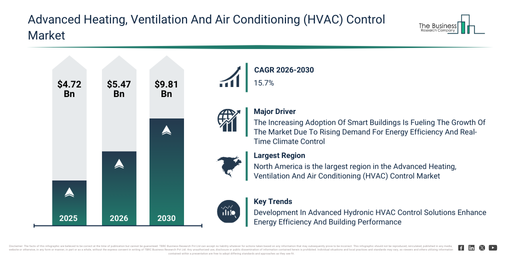
The advanced heating, ventilation and air conditioning (hvac) control market size has experienced rapid growth in recent years. It is projected to expand from $4.72 billion in 2025 to $5.47 billion in 2026, achieving a compound annual growth rate (CAGR) of 16.0%. The historical increase can be attributed to several factors, including a rise in urbanization and commercial infrastructure, increasing energy consumption in buildings, regulatory mandates on indoor air quality, advancements in sensor and automation technology, and the growth of smart building initiatives.
The advanced heating, ventilation and air conditioning (hvac) control market size is projected to experience substantial expansion over the upcoming years. This market is set to reach $9.81 billion by 2030, exhibiting a compound annual growth rate (CAGR) of 15.7%. The anticipated expansion during this period stems from factors such as the increasing demand for energy-efficient hvac solutions, the proliferation of green building certifications, the uptake of AI-powered building management systems, the seamless integration of hvac with IoT platforms, and heightened concern for occupant well-being and indoor air quality. Key developments expected within this forecast timeframe encompass predictive maintenance and energy optimization strategies, comfort management centered around occupants, responsive ventilation and air quality regulation, integration into broader smart building ecosystems, and cloud-based hvac analytics and reporting capabilities.
Get A Free Sample Report With In-Depth Market Insights:
Advanced Heating, Ventilation And Air Conditioning (HVAC) Control Market Opportunity Drivers: What’s Unlocking New Revenue Potential?
The expansion in the utilization of smart buildings is anticipated to drive the advancement of the advanced heating, ventilation, and air conditioning (HVAC) control market in the future. Smart buildings are defined as structures employing automated procedures to manage building functions, thereby improving occupant comfort and energy conservation. The development of smart buildings stems from the escalating requirement for energy-saving infrastructure. Advanced heating, ventilation, and air conditioning (HVAC) control systems facilitate smart buildings by allowing for instantaneous climate regulation, optimized energy use, and distant system oversight. For example, in March 2025, data from Netguru S.A., a Poland-based software development company, indicated that in 2023, U.S. households possessing smart home devices totaled 63.43 million, representing a 10.2% rise compared to 2022. Consequently, the growing integration of smart buildings is fueling the expansion of the advanced heating, ventilation, and air conditioning (HVAC) control market.
Advanced Heating, Ventilation And Air Conditioning (HVAC) Control Market Breakdown By Product Type And Application
The advanced heating, ventilation and air conditioning (hvac) control market covered in this report is segmented –
1) By Type: Centralized, Distributed
2) By Component: Controllers, Sensors, Actuators
3) By Technology Type: Smart Thermostats, Demand-Controlled Ventilation, Building Management Systems (BMS), Variable Refrigerant Flow (VRF) Systems
4) By Application: Commercial Buildings, Industrial Facilities, Residential Homes
5) By End-User: Building Owners, Facility Managers, Heating, Ventilation And Air Conditioning (HVAC) Contractors
Subsegments:
1) By Centralized: Supervisory Control Systems, Zonal Control Systems, Cloud-Based Control Platforms, Integrated Building Management System
2) By Distributed: Room-Level Control Units, Wireless Control Modules, Edge-Based Control Devices, Decentralized Control Algorithms
Advanced Heating, Ventilation And Air Conditioning (HVAC) Control Market Innovation Trends Shaping Future Development
Leading companies operating within the advanced heating, ventilation, and air conditioning (HVAC) control market are concentrating on developing sophisticated solutions, such as hydronic HVAC plant management, to boost overall system efficiency in large commercial and industrial buildings. Hydronic HVAC plant management involves optimizing heating and cooling systems that circulate water for thermal regulation. It effectively manages equipment to ensure consistent temperature, energy efficiency, and robust system performance in extensive facilities. For instance, in December 2024, Daikin Applied Europe, an Italy-based HVAC solutions company, launched its Smart Control System (SCS). This system is designed to oversee and optimize hydronic HVAC systems, including chillers, heat pumps, air handling units, and fan coils, through Modbus/RS485 communication. It incorporates scalable configurations (light, medium, full), advanced optimization algorithms, and plug-and-play installation for simplified setup and control. The product enhances energy efficiency, reduces operating costs, and ensures optimal comfort in light commercial buildings, offices, and small- to medium-sized hotels.
Advanced Heating, Ventilation And Air Conditioning (HVAC) Control Market Company Landscape And Competitive Strategy
Major companies operating in the advanced heating, ventilation and air conditioning (hvac) control market are Samsung Electronics Co. Ltd., Mitsubishi Electric Corporation, Siemens Aktiengesellschaft, LG Electronics Inc., Schneider Electric SE, Haier Smart Home Co. Ltd., Honeywell International Inc., AAB Ltd., Daikin Industries Ltd., Johnson Controls International plc, Carrier Global Corporation, Trane Technologies plc, Emerson Electric Co., Danfoss A/S, Lennox International Inc., Rheem Manufacturing Company, Fr. Sauter AG, Delta Controls Inc., Loytec electronics GmbH, KMC Controls Inc.
View The Full Advanced Heating, Ventilation And Air Conditioning (HVAC) Control Market Report:
Advanced Heating, Ventilation And Air Conditioning (HVAC) Control Market Regional Split: Which Areas Are Fueling Growth?
North America was the largest region in the advanced heating, ventilation, and air conditioning (HVAC) control market in 2025. Asia-Pacific is expected to be the fastest-growing region in the forecast period. The regions covered in the advanced heating, ventilation and air conditioning (hvac) control market report are Asia-Pacific, South East Asia, Western Europe, Eastern Europe, North America, South America, Middle East, Africa.
Reach Out To Our Team:
The Business Research Company: https://www.thebusinessresearchcompany.com/
Americas: +1 310-496-7795
Asia: +44 7882 955267 & +91 8897263534
Europe: +44 7882 955267
Email us at: marketing@tbrc.info
Follow us on:
LinkedIn: https://in.linkedin.com/company/the-business-research-company
YouTube: https://www.youtube.com/channel/UC24_fI0rV8cR5DxlCpgmyFQ
Global Market Model: https://www.thebusinessresearchcompany.com/global-market-model

Wasay has over a decade of experience in market research, data modelling, and analytics, with prior experience at GlobalData and Decision Tree Consulting Services. At The Business Research Company , he leads research operations across syndicated studies, customized consulting engagements, and the Global Market Model platform. His professional experience includes supporting organizations such as Boston Consulting Group, KPMG, and Ernst & Young. Wasay holds a degree in Electronics and Communications Engineering, postgraduate management qualifications from International Management Institute Belgium and Indian School of Business and Entrepreneurship, and completed the Integrated Program in Business Analytics from Indian Institute of Management Indore.