
Featuring market attractiveness scoring, total addressable market sizing, company benchmarking matrices, interactive Excel dashboards, deeper supply chain intelligence, emerging startup tracking, and granular product-level insights, The Business Research Company’s 2026 market reports are built to deliver research that is both more actionable and more strategically valuable.
Human Centric Lighting Market Size Forecast: How Big Could The Market Get By 2030?
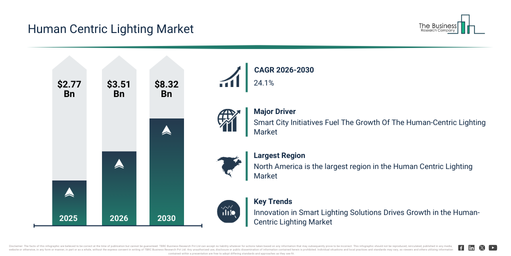
The human centric lighting market has experienced substantial growth in recent years. Its value is expected to rise from $2.77 billion in 2025 to $3.51 billion in 2026, reflecting a compound annual growth rate (CAGR) of 27.0%. This historical growth can be attributed to several factors, including heightened awareness regarding lighting’s influence on human health, the early adoption of LED lighting technologies, the demand for energy-efficient lighting solutions, an increased emphasis on workplace productivity, and the integration of smart building concepts.
The human centric lighting market size is anticipated to undergo substantial growth over the next few years. It is predicted to reach $8.32 billion by 2030, achieving a compound annual growth rate (CAGR) of 24.1%. This expansion during the forecast period can be attributed to a heightened focus on employee well-being, the increase in smart and connected buildings, ongoing healthcare infrastructure development, improvements in sensor and control technologies, and growing investments in sustainable lighting systems. Significant trends expected during this period include the rising adoption of circadian rhythm-based lighting systems, increasing integration of smart sensors in lighting controls, a growing demand for human-centric lighting in workspaces, the expansion of tunable white and color temperature lighting, and the increasing use of hcl in healthcare and educational facilities.
Get A Free Sample Report With In-Depth Market Insights:
Human Centric Lighting Market Growth Catalysts And Demand Drivers
The growing efforts to establish smart cities are anticipated to boost the expansion of the human-centric lighting market. A smart city, by definition, is an urban center leveraging advanced technology and data-informed strategies to elevate resident quality of life, streamline urban services, and foster sustainable progress. The development of smart cities stems from a combination of technological advancements, urban infrastructure requirements, supportive policies, private enterprise participation, and community involvement. Human-centric lighting serves as a vital element in smart city evolution, assisting in the creation of urban settings that enhance inhabitants’ health, productivity, and general welfare via adaptable, biologically optimized illumination systems. As an illustration, the Press Information Bureau, an Indian government entity, reported in June 2024 that the smart cities mission in India had made substantial progress across 100 cities. This included the approval of 8,013 projects, valued at ?1,64,158 crore ($19.66 billion), with 7,157 of these projects already finished, totaling ?1,43,958 crore ($12.24 billion). Consequently, the heightened focus on establishing smart cities is poised to propel the human-centric lighting market forward.
Human Centric Lighting Market Segment Analysis Spotlighting Growth Areas
The human centric lighting market covered in this report is segmented –
1) By Component: Sensors, Drivers, Microprocessors And Microcontrollers, Switches And Dimmers, Transmitters And Receivers
2) By Installation Type: New Installations, Retrofit Installations
3) By Application: Wholesale And Retail, Enterprises And Data Centers, Residential, Educational Institutions, Healthcare, Industrial, Hospitality
Subsegments:
1) By Sensors: Ambient Light Sensors, Motion Sensors, Presence Sensors, Color Temperature Sensors, Brightness Sensors
2) By Drivers: LED Drivers, AC-DC Drivers, Dimmable Drivers, Constant Current Drivers, Constant Voltage Drivers
3) By Microprocessors and Microcontrollers: Microcontrollers for Lighting Control, Microprocessors for Smart Lighting Systems, Integrated Circuits (ICs) for Lighting Systems, Wireless Communication Controllers
4) By Switches and Dimmers: Manual Switches, Smart Switches, Dimmer Switches, Touch-sensitive Switches, Wi-Fi/Bluetooth-enabled Dimmers
5) By Transmitters and Receivers: Wireless Transmitters, Wireless Receivers, Bluetooth Transmitters/Receivers, Zigbee-enabled Transmitters/Receivers, Infrared (IR) Transmitters/Receivers
Human Centric Lighting Market Trends Shaping Long-Term Demand
Leading firms in the human-centric lighting market are concentrating on launching cutting-edge offerings like smart lighting solutions to achieve a competitive advantage. These solutions represent sophisticated lighting systems that leverage internet connectivity, sensors, and automation to maximize energy efficiency, boost user convenience, and provide greater command over illuminated spaces. An example of this is the NatureConnect lighting system, introduced in May 2024 by Signify N.V., a lighting corporation headquartered in the Netherlands. The NatureConnect system simulates natural sunlight, contributing to enhanced well-being by improving sleep patterns, mood, and concentration. This system provides adaptable, energy-saving options tailored for professional settings, hospitality venues, and healthcare facilities.
Human Centric Lighting Market Leading Companies: Who Holds The Strongest Market Presence?
Major companies operating in the human centric lighting market are Eaton Corporation, Legrand, Signify, Hubbell Incorporated, Acuity Brands Inc., Osram GmbH, Zumtobel Group AG, LEDVANCE GmbH, Seoul Semiconductor Co. Ltd., Fagerhult Group, Trilux GmbH & Co. KG, Lutron Electronics Co. Inc., Cree Lighting, ERCO GmbH, Schréder Group, Beghelli S.p.A., Helvar Ltd., Delta Light NV, GE Lighting, Xicato Inc., OMS Lighting, Herbert Waldmann GmbH & Co. KG
View The Full Human Centric Lighting Market Report:
Human Centric Lighting Market Top Region: Where Does Most Revenue Come From?
North America was the largest region in the human centric lighting market in 2025. Asia-Pacific is expected to be the fastest-growing region in the forecast period. The regions covered in the human centric lighting market report are Asia-Pacific, South East Asia, Western Europe, Eastern Europe, North America, South America, Middle East, Africa.
Reach Out To Our Team:
The Business Research Company: https://www.thebusinessresearchcompany.com/
Americas: +1 310-496-7795
Asia: +44 7882 955267 & +91 8897263534
Europe: +44 7882 955267
Email us at: marketing@tbrc.info
Follow us on:
LinkedIn: https://in.linkedin.com/company/the-business-research-company
YouTube: https://www.youtube.com/channel/UC24_fI0rV8cR5DxlCpgmyFQ
Global Market Model: https://www.thebusinessresearchcompany.com/global-market-model

Wasay has over a decade of experience in market research, data modelling, and analytics, with prior experience at GlobalData and Decision Tree Consulting Services. At The Business Research Company , he leads research operations across syndicated studies, customized consulting engagements, and the Global Market Model platform. His professional experience includes supporting organizations such as Boston Consulting Group, KPMG, and Ernst & Young. Wasay holds a degree in Electronics and Communications Engineering, postgraduate management qualifications from International Management Institute Belgium and Indian School of Business and Entrepreneurship, and completed the Integrated Program in Business Analytics from Indian Institute of Management Indore.