Built to provide research that’s more actionable and strategically valuable, The Business Research Company’s 2026 market reports include market attractiveness analysis, total addressable market sizing, company benchmarking matrices, interactive Excel dashboards, broader supply chain intelligence, emerging startup tracking, and in-depth product insights.
Industrial Wireless Broken Signal Solutions Market Set To Climb From $4.83 Billion In 2026 To $6.36 Billion By 2030
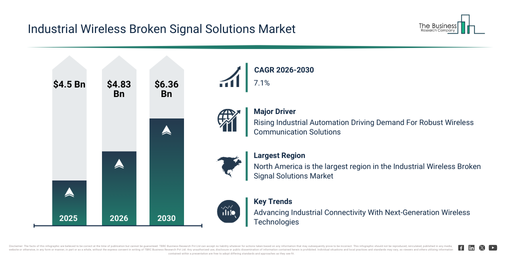
The industrial wireless broken signal solutions market size has experienced strong expansion in recent years. It is anticipated to increase from $4.5 billion in 2025 to $4.83 billion in 2026, exhibiting a compound annual growth rate (CAGR) of 7.4%. This historic growth can be attributed to the rising adoption of industrial automation, the increased use of wireless sensors, the expansion of smart factories, a growing need for remote monitoring, and the demand for low-latency communication.
The industrial wireless broken signal solutions market size is anticipated to undergo significant expansion in the coming years, reaching $6.36 billion by 2030, at a compound annual growth rate (CAGR) of 7.1%. This projected growth during the forecast period is attributable to the emergence of 5g networks in industrial settings, ai-based network optimization, the adoption of hybrid cloud industrial solutions, the deployment of industrial digital twins, and a heightened focus on cybersecurity for industrial networks. Noteworthy trends for the forecast period include industrial edge computing, predictive network maintenance, AI-driven wireless diagnostics, real-time industrial connectivity monitoring, and secure wireless protocol integration.
Get A Free Sample Report With In-Depth Market Insights:
Industrial Wireless Broken Signal Solutions Market Development Factors: What’s Supporting Demand?
The future expansion of the industrial wireless broken signal solutions market is anticipated to be driven by the growing adoption of automation within industries. Industrial automation involves incorporating sophisticated technologies like robotics, artificial intelligence (AI), and automated systems to optimize production, boost efficiency, and lessen the need for human involvement. The surge in automation across various sectors is due to companies’ efforts to enhance operational efficiency, minimize expenses, and improve the accuracy and uniformity of their processes. Industrial wireless broken signal solutions play a crucial role in supporting industrial automation by guaranteeing uninterrupted, dependable communication among machines, sensors, and control systems, particularly in settings susceptible to signal interruptions. For instance, in September 2024, according to the International Federation of Robotics (IFR), a German-based non-profit organization, industrial robot installations in the UK rose by 51%, reaching 3,830 units, while in the Americas, over 50,000 units were installed for the third consecutive year, totaling 55,389 units in 2023. Consequently, the rising industrial automation is a key factor propelling the expansion of the industrial wireless broken signal solutions market.
Industrial Wireless Broken Signal Solutions Market Segments: Where Is Growth Concentrated?
The industrial wireless broken signal solutions market covered in this report is segmented –
1) By Type: Industrial Wireless LAN, Industrial Cellular, Industrial Ethernet Switches, Industrial Secure Routers, Industrial Ethernet Gateways, Media Converters, Network Accessories
2) By Deployment Type: On-Premises Solutions, Cloud-Based Solutions, Hybrid Solutions
3) By Technology: Wi-Fi Solutions, Bluetooth Solutions, Zigbee Solutions, Cellular Solutions, Sigfox Solutions
4) By Application: Remote Monitoring, Asset Tracking, Real-Time Data Analysis, Industrial Automation, Predictive Maintenance
5) By End-User Industry: Utilities And Energy, Manufacturing, Oil And Gas, Transportation And Logistics, Healthcare
Subsegments:
1) By Industrial Wireless LAN: Access Points, Client Devices, Wireless Bridges, Repeaters
2) By Industrial Cellular: LTE Routers, 5G Routers, Cellular Modems, IoT Gateways
3) By Industrial Ethernet Switches: Managed Switches, Unmanaged Switches, PoE (Power over Ethernet) Switches, Industrial Core Switches
4) By Industrial Secure Routers: VPN Routers, Firewall Routers, Multi-WAN Routers, Edge Routers
5) By Industrial Ethernet Gateways: Protocol Gateways, Serial-to-Ethernet Gateways, Modbus Gateways, Cloud Connectivity Gateways
6) By Media Converters: Copper to Fiber Converters, Multi-mode to Single-mode Converters, PoE Media Converters, Industrial-Grade Media Converters
7) By Network Accessories: Antennas, Connectors, Network Cables, Surge Protectors
Industrial Wireless Broken Signal Solutions Market Transformation Trends: What Innovations Are Driving Change?
Leading companies within the industrial wireless broken signal solutions market are prioritizing the advancement of cutting-edge wireless communication technologies, including WiFi 7 adapters, aiming to boost wireless speed, decrease latency, and reinforce signal stability across industrial settings. This newest wireless standard, WiFi 7, provides exceptionally high data rates, minimal latency, and superior interference handling capabilities, essential for intensive industrial applications. An illustration of this is seen in February, 2024, when Linkreal Co., Ltd., an ethernet company based in China, introduced its LRIWF-BE200 industrial-grade WiFi 7 wireless adapter. The adapter facilitates quicker data transfer, boasts enhanced anti-interference prowess, and ensures dependable connectivity, all designed to curtail signal disruptions and perfect wireless communication in industrial environments. Capable of reaching wireless speeds of up to 8,774 Mbps, the adapter aligns with the bandwidth of 10G wired networks, a vital feature for industrial applications requiring high throughput.
Industrial Wireless Broken Signal Solutions Market Key Participants And Competitive Landscape
Major companies operating in the industrial wireless broken signal solutions market are Siemens AG, Panasonic Corporation, Cisco Systems Inc, Schneider Electric SE, Honeywell International Inc, ABB Ltd., Eaton Corporation PLC, Emerson Electric Co, NXP Semiconductors, Rockwell Automation Inc, Phoenix Contact, Arista Networks, Yokogawa Electric, Belden Inc., Advantech Co. Ltd, Moxa Inc., Huawei Technologies Limited, Telit Communications plc, Lekha Wireless Solutions, Resonous Tech Pvt Ltd., Aeologic Technologies, BigCat Wireless Pvt Ltd, Watsoo, Rejig Digital
View The Full Industrial Wireless Broken Signal Solutions Market Report:
Industrial Wireless Broken Signal Solutions Market Top Region: Where Does Most Revenue Come From?
North America was the largest region in the industrial wireless broken signal solutions market in 2025. Asia-Pacific is expected to be the fastest-growing region in the forecast period. The regions covered in the industrial wireless broken signal solutions market report are Asia-Pacific, South East Asia, Western Europe, Eastern Europe, North America, South America, Middle East, Africa.
Reach Out To Our Team:
The Business Research Company: https://www.thebusinessresearchcompany.com/
Americas: +1 310-496-7795
Asia: +44 7882 955267 & +91 8897263534
Europe: +44 7882 955267
Email us at: marketing@tbrc.info
Follow us on:
LinkedIn: https://in.linkedin.com/company/the-business-research-company
YouTube: https://www.youtube.com/channel/UC24_fI0rV8cR5DxlCpgmyFQ
Global Market Model: https://www.thebusinessresearchcompany.com/global-market-model

Wasay has over a decade of experience in market research, data modelling, and analytics, with prior experience at GlobalData and Decision Tree Consulting Services. At The Business Research Company , he leads research operations across syndicated studies, customized consulting engagements, and the Global Market Model platform. His professional experience includes supporting organizations such as Boston Consulting Group, KPMG, and Ernst & Young. Wasay holds a degree in Electronics and Communications Engineering, postgraduate management qualifications from International Management Institute Belgium and Indian School of Business and Entrepreneurship, and completed the Integrated Program in Business Analytics from Indian Institute of Management Indore.