Featuring market attractiveness scoring, total addressable market sizing, company benchmarking matrices, interactive Excel dashboards, deeper supply chain intelligence, emerging startup tracking, and granular product-level insights, The Business Research Company’s 2026 market reports are built to deliver research that is both more actionable and more strategically valuable.
Gas Sensors Market Size, Value And Growth Trajectory Through 2030
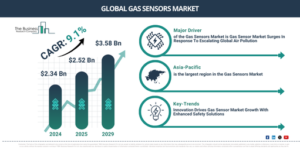
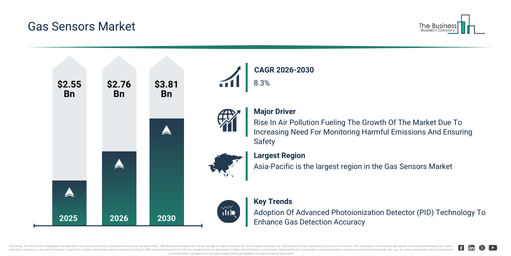
The gas sensors market has experienced significant expansion in recent years. Its valuation is projected to rise from $2.55 billion in 2025 to $2.76 billion in 2026, demonstrating a compound annual growth rate (CAGR) of 8.6%. This historical growth can be attributed to several factors including increased industrial safety monitoring, the initial integration into environmental detection systems, wider use in automotive emissions sensing, dependence on fundamental chemical sensors, and a rise in consumer electronics applications.
The gas sensors market is poised for robust expansion in the coming years, with its valuation projected to reach $3.81 billion by 2030, exhibiting a compound annual growth rate (CAGR) of 8.3%. This anticipated growth during the forecast period is fueled by several factors, including the escalating need for workplace safety adherence, increased deployment within smart home environments, the proliferation of connected automotive sensing applications, the broadening scope in healthcare diagnostics, and advancements in high-sensitivity multi-gas detection technologies. Key trends anticipated during this period encompass the widespread adoption of IoT-enabled real-time gas monitoring, the development of intelligent automated detection platforms, the emergence of AI-based hazard prediction systems, enhancements in robotics-assisted gas sensing, and the incorporation of energy-efficient, environmentally friendly sensor designs.
Get A Free Sample Report With In-Depth Market Insights:
Gas Sensors Market Growth Factors Behind Sustained Expansion
The expanding issue of air pollution is projected to boost the expansion of the gas sensor market in the future. Air pollution is defined as the existence of detrimental substances in the atmosphere, which can adversely affect human well-being and the natural surroundings. This pollution is escalating primarily because of swift industrial development and exhaust from vehicles. Gas sensors are instruments employed to identify the existence and density of particular gases present in the atmosphere. Furthermore, they serve to pinpoint gas leaks and aid in averting hazardous circumstances. An example highlighting this concern is a report from October 2025 by the World Meteorological Organization (WMO), a specialized agency based in Switzerland, which indicated that the worldwide average atmospheric CO₂ concentration reached 423.9 parts per million (ppm) in 2024. This represented an increase of 3.5 ppm from 2023, constituting the most significant annual rise ever documented. Consequently, the escalating problem of air pollution is stimulating the demand for and expansion of the gas sensor market.
Gas Sensors Market Segment Breakdown: Which Categories Lead On Revenue?
The gas sensors market covered in this report is segmented –
1) By Gas Type: Carbon Monoxide, Methane, Hydrogen, Ammonia, Oxygen, Other Gas Types
2) By Technology: Infrared Gas Sensor, Photo Ionization Sensors, Electrochemical Gas Sensors, Thermal Conductivity Gas Sensors, Metal Oxide-Based Gas Sensor, Catalytic Gas Sensor, Other Technologies
3) By End Use: Defense And Military, Healthcare, Consumer Electronics, Automotive And Transportation, Industrial, Other End Users
Subsegments:
1) By Carbon Monoxide: Electrochemical Sensors, Infrared Sensors
2) By Methane: Catalytic Sensors, Infrared Sensors
3) By Hydrogen: Metal Oxide Sensors, Electrochemical Sensors
4) By Ammonia: Solid-State Sensors, Electrochemical Sensors
5) By Oxygen: Electrochemical Sensors, Zirconia Sensors
6) By Other Gas Types: Nitrogen Dioxide (NO2), Sulfur Dioxide (SO2), Volatile Organic Compounds (VOCs)
Gas Sensors Market Industry Trends Fueling Future Revenue Growth
Major companies are actively involved in the gas sensors market, concentrating on developing innovative solutions such as photoionization detector (PID) sensors to achieve ultra-sensitive detection of volatile organic compounds (VOCs) and toxic gases, crucial for industrial safety and environmental monitoring applications. A PID sensor functions by utilizing ultraviolet (UV) light to ionize gas molecules, generating a current directly proportional to the gas concentration, which provides higher sensitivity, faster response, and a broader detection range compared to traditional electrochemical or metal-oxide sensors. For instance, in October 2024, Alphasense Ltd., a UK–based gas sensor manufacturer, introduced the PIDX series, an advanced line of PID sensors crafted for precise VOC measurement. This product features multiple detection ranges, from 0–4 ppm to 0–10,000 ppm, along with improved baseline stability across temperature and humidity variations, enhanced sensor repeatability, and integrated fault detection for maintenance alerts, making it ideal for portable and fixed gas detection systems.
Gas Sensors Market Leading Players And Competitive Positioning
Major companies operating in the gas sensors market are Honeywell International Inc, Amphenol Corporation, Figaro Engineering Inc, Dynament, Membrapor AG, Nemoto & Co. Ltd., Robert Bosch GmbH, Sensirion AG, Asea Brown Boveri Ltd, Teledyne FLIR LLC, Siemens AG, City Technology Ltd., GfG Gas Detection UK Ltd., Senseair, Gastec Corporation, austriamicrosystems AG, AlphaSense Inc., NevadaNano, MicroSensor Corporation, Dryad, Pendar Technologies, Alphasense Ltd., Aeroqual Ltd., Kapitalgesellschaft, Winsen Electronics Technology Co. Ltd., MSA Safety Incorporated, Cubic Sensor and Instrument Co. Ltd, Yokogawa Electric Corporation
View The Full Gas Sensors Market Report:
Gas Sensors Market Geographic Landscape: Which Region Leads Industry Growth?
Asia-Pacific was the largest region in the gas sensor market in 2025. The regions covered in the gas sensors market report are Asia-Pacific, South East Asia, Western Europe, Eastern Europe, North America, South America, Middle East, Africa.
Reach Out To Our Team:
The Business Research Company: https://www.thebusinessresearchcompany.com/
Americas: +1 310-496-7795
Asia: +44 7882 955267 & +91 8897263534
Europe: +44 7882 955267
Email us at: marketing@tbrc.info
Follow us on:
LinkedIn: https://in.linkedin.com/company/the-business-research-company
YouTube: https://www.youtube.com/channel/UC24_fI0rV8cR5DxlCpgmyFQ
Global Market Model: https://www.thebusinessresearchcompany.com/global-market-model

Wasay has over a decade of experience in market research, data modelling, and analytics, with prior experience at GlobalData and Decision Tree Consulting Services. At The Business Research Company , he leads research operations across syndicated studies, customized consulting engagements, and the Global Market Model platform. His professional experience includes supporting organizations such as Boston Consulting Group, KPMG, and Ernst & Young. Wasay holds a degree in Electronics and Communications Engineering, postgraduate management qualifications from International Management Institute Belgium and Indian School of Business and Entrepreneurship, and completed the Integrated Program in Business Analytics from Indian Institute of Management Indore.